

By Alex Ababio
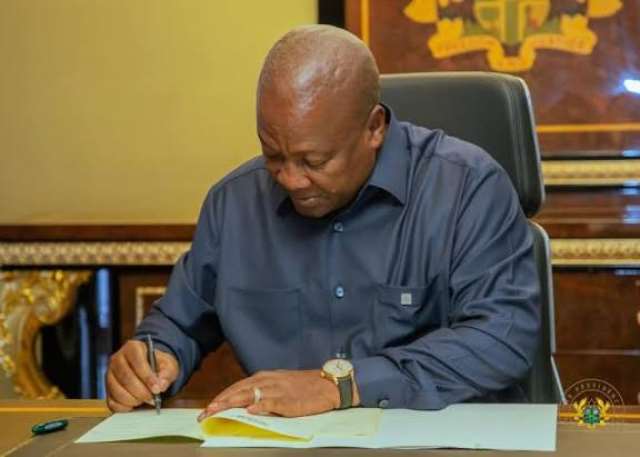
President John Dramani Mahama has assented to 10 major Bills passed by Parliament, formally completing a far-reaching legislative exercise that stretches across taxation, revenue mobilisation, justice administration, maritime security, national defence and Ghana’s strategically important cocoa industry.
The legislation was among a broader package of 12 Bills approved by Parliament during the Second Meeting of the Second Session of the Ninth Parliament, which ended on July 31, 2026. With presidential assent, the 10 Bills have crossed a critical constitutional threshold, although the practical impact of each reform will depend on the implementation arrangements, commencement provisions and enforcement mechanisms that follow.
The new laws are the Customs Act, 2026; Community Service Act, 2026; Tribunals Act, 2026; Maritime and Related Offences Act, 2026; National Defence University, Ghana Act, 2026; Income Tax (Amendment) Act, 2026; Energy Sector Levies (Amendment) Act, 2026; Ghana Cocoa Board Act, 2026; Value Added Tax (Amendment) Act, 2026; and Excise Act, 2026.
Together, they represent one of the most substantial clusters of legislation assented to at the same time by the Mahama administration, with implications for ordinary workers, businesses, cocoa farmers, mining companies, importers, prisoners, the judiciary and national security institutions.
The official parliamentary record confirms that several of the measures, including the Ghana Cocoa Board Bill and the Income Tax and Value Added Tax amendment Bills, were laid before Parliament on July 31, 2026, while the Tribunals Bill was laid by Attorney-General and Minister for Justice Dr Dominic Akuritinga Ayine on June 26.
A Tax Reform Package With Direct Consequences for Workers and Business
Among the most economically significant measures are the Income Tax (Amendment) Act, 2026, Value Added Tax (Amendment) Act, 2026, Excise Act, 2026 and Energy Sector Levies (Amendment) Act, 2026.
According to the Presidency, the new Income Tax legislation exempts people earning the national minimum wage or less from paying income tax.
“Anybody who is on the minimum wage or below the minimum wage is exempt,” President Mahama said after signing the legislation.
The measure places the new legislation within the wider debate over household incomes, taxation and the cost of living. For low-income workers, the effectiveness of the reform will depend not only on the legal exemption itself but also on accurate payroll administration and compliance by employers and tax authorities.
The VAT amendment also contains a major provision connected to Ghana’s gold and monetary policy. Under the reform announced by the Presidency, large-scale gold mining companies that surrender 30 per cent of their gold output to the Bank of Ghana will be exempt from paying VAT on those quantities.
The Excise Act, 2026, meanwhile, consolidates excise provisions affecting dutiable products and is intended to close loopholes associated with revenue leakages. The legislation also provides an incentive for domestic fruit processing.
“Importantly, it gives exemption from paying excise tax to local manufacturers of fruit juices,” President Mahama said. “It is supposed to give them an incentive in their production.”
The broader policy challenge, however, will be whether tax incentives and exemptions can stimulate domestic manufacturing without undermining revenue mobilisation.
Customs Reform and the Battle Against Revenue Leakages
For businesses involved in imports and international trade, the Customs Act, 2026 could become one of the most consequential reforms in the legislative package.
President Mahama said the new law brings scattered customs legislation and subsequent amendments together in a single statute.
“This voluminous document incorporates all the amendments that have been done over the years into one single document. It makes it simpler to administer and to make it more efficient,” he said.
He added that the reform would “seal the loopholes that have made the government lose a lot of revenue as a result of the scattered nature of the law.”
The law’s real test will therefore be operational. Consolidating legislation can make compliance easier and enforcement more coherent, but the fight against customs-related revenue losses also depends on effective border administration, technology, valuation systems and accountability.
The Energy Sector Levies (Amendment) Act, 2026 also targets what the Presidency described as the abuse of fuel oil exemptions previously available to factories and maritime vessel operators. Under the new arrangement described by the government, operators will pay the applicable taxes upfront and subsequently provide evidence to support reimbursement or reinvestment-related processes.
The Tribunals Act: Faster Justice or a Return to an Old Debate?
Perhaps no legislation in the package generated as much public controversy as the Tribunals Act, 2026.
The law gives effect to constitutional provisions under which Regional Tribunals may be established to handle designated categories of cases. Government officials argue that the new framework is designed to improve access to justice, reduce delays and strengthen specialised justice delivery.
Dr Dominic Ayine, the Attorney-General and Minister for Justice, previously said the legislation was intended to restore tribunals with “appropriate constitutional safeguards” while addressing delays in Ghana’s justice system.
Addressing concerns about the historical record of tribunals, Dr Ayine said the new system would not reproduce abuses associated with previous eras.
“Operationalising the Regional Tribunal does not intend to resurrect the ghost of the past abuses and excesses, and that will not exist in the new dispensation,” he said.
The government has pointed to safeguards including oversight arrangements and constitutional procedures. But critics remain unconvinced.
The parliamentary debate exposed deep political disagreement. The Minority Caucus opposed the Bill and raised concerns that it could create a parallel justice system. Samuel Abu Jinapor, the Member of Parliament for Damongo, questioned the rationale for bringing tribunals back, while Minority Leader Alexander Afenyo-Markin warned against what he described as a possible return to the shortcomings associated with the PNDC-era tribunal system.
Former Vice President and NPP flagbearer Dr Mahamudu Bawumia also called for wider national consultation before the Bill received presidential assent, arguing that changes to the justice architecture should command broad public confidence.
The investigative question now shifts from whether tribunals should exist to how they will operate: what categories of cases will they handle, how will tribunal members be selected, and will the promised safeguards be strong enough to maintain public confidence?
Community Service: A Major Shift in Ghana’s Criminal Justice Policy
The Community Service Act, 2026 introduces a non-custodial sentencing framework for certain offences, allowing courts to impose community service instead of imprisonment in appropriate cases.
President Mahama framed the reform partly as an economic and rehabilitation measure.
“Instead of putting people in jail and government going to have to pay for looking after prisoners for stealing goods or for committing some very minor offences, they can be sentenced to do community service,” he said.
The reform has received support from criminal justice advocates. Alhaji Ibrahim Oppong Kwarteng, Executive Director of the Crime Check Foundation, described the passage of the legislation as a landmark development and said the absence of a comprehensive non-custodial sentencing framework had contributed to congestion across Ghana’s prison facilities.
Legal practitioner Christian Malm Hesse also described the legislation as “a step in the right direction,” according to a report by Deutsche Welle, while stressing the importance of proper safeguards and implementation.
But the success of community sentencing will depend heavily on supervision, funding, public education and coordination among the Judiciary, correctional authorities, local governments and civil society.
Cocoa Reform: The 70 Per Cent Promise and the 50 Per Cent Processing Target
The Ghana Cocoa Board Act, 2026 carries some of the Mahama administration’s most politically significant economic commitments.
The law incorporates the government’s pledge to ensure that cocoa farmers receive at least 70 per cent of the world market price, while also pursuing a target of processing at least 50 per cent of Ghana’s cocoa beans locally.
“I’m sure our cocoa farmers will be happy,” President Mahama said.
“It incorporates the reform of the cocoa sector and includes our promise that we’re going to process at least 50% of our cocoa beans locally. Aside from that, the promise we made to farmers that they will earn 70% of the world market price of cocoa is also contained in this bill. So, promise made, promise fulfilled.”
The reforms had been outlined earlier by Finance Minister Dr Cassiel Ato Forson, who said the proposed legislation would establish a new pricing and financing framework for COCOBOD and seek to improve its financial sustainability and operational efficiency.
The major issue now is implementation. Turning a statutory promise into higher and more predictable farmer incomes will depend on international cocoa prices, exchange-rate movements, financing arrangements and the sustainability of COCOBOD itself.
Maritime Security and National Defence
The Maritime and Related Offences Act, 2026 gives domestic legal effect to Ghana’s obligations under the United Nations Convention on the Law of the Sea, known as UNCLOS.
According to the Presidency, the legislation is intended to give Ghanaian law-enforcement agencies stronger legal authority to prosecute offences committed within the country’s maritime space.
The National Defence University, Ghana Act, 2026 establishes the new military educational institution as a legal and statutory entity, providing the framework for accredited academic and strategic military programmes.
The Investigation Now Moves From Assent to Implementation
President Mahama’s signing of the 10 Bills marks the end of one legislative process, but it is only the beginning of another.
The true measure of these reforms will not be the signing ceremony alone. It will be found in implementation: whether customs leakages decline, whether low-income workers receive the promised tax relief, whether community service reduces pressure on prisons, whether the tribunals operate independently, and whether cocoa farmers genuinely receive the benefits promised under the new legal framework.
The Mahama administration has presented the legislation as part of a programme to modernise Ghana’s economy, justice system and state institutions. The Presidency said the package is intended to accelerate economic growth, plug revenue leakages, modernise justice delivery, strengthen national security and improve conditions for workers and farmers.
For Ghanaian citizens, businesses and investors, however, the most important chapter may still be unwritten.
The 10 laws are now on the statute book. The next question is whether the institutions responsible for enforcing them can translate ambitious legislation into measurable results.