

By Alex Ababio
Ghana is preparing to establish what could become one of the country’s most ambitious health-industrial projects: a 2,000-acre pharmaceutical industrial park in the Shai-Osudoku District, designed to bring drug manufacturing, medical-device production, herbal medicine, research and development and health technology under one integrated industrial ecosystem.
But behind the headline investment opportunity lies a harder question: can Ghana turn a pharmaceutical park from an infrastructure project into a globally competitive manufacturing and health-security industry?
The proposed development is being pursued under the Government’s 24-Hour Economy initiative, at a time when President John Dramani Mahama has separately announced a five-year strategy aimed at reversing Ghana’s dependence on imported medicines.
The project was disclosed by Kafui Linda Abbah-Foli, Head of Project Development at the 24-Hour Economy Secretariat, during the opening of the 2026 China-West Africa Medical and Health Industry Expo and AI Deployment and Project Cooperation Summit in Accra. The official 24-Hour Economy Secretariat identifies Abbah-Foli as Head of Project Development.
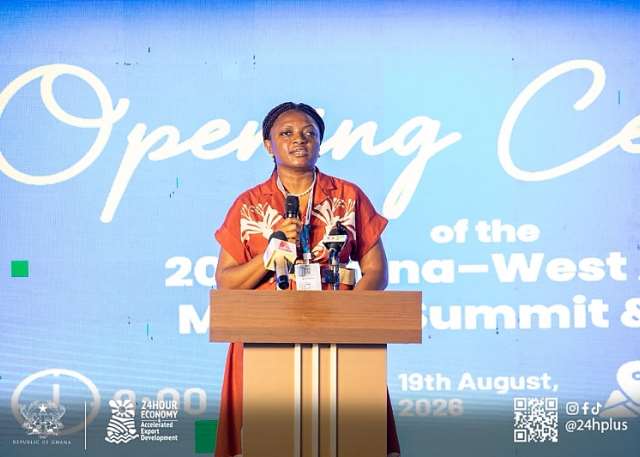
Abbah-Foli said approximately 2,000 acres of land had been identified in Shai-Osudoku, with pre-feasibility studies completed.
The proposed park is intended to tackle two longstanding barriers to Ghanaian pharmaceutical manufacturing: access to suitable industrial land and reliable bulk infrastructure.
“We are not just building a factory; we are building an ecosystem,” Abbah-Foli said.
That ecosystem, according to the project description, would provide roads, electricity, water, wastewater systems and specialised effluent-treatment infrastructure required for pharmaceutical manufacturing.
The 70% import dependency problem
The proposed industrial park comes as Ghana confronts a pharmaceutical import bill and supply-chain vulnerability that policymakers increasingly regard as a health-security issue.
Abbah-Foli said Ghana currently imports about 70 per cent of its pharmaceutical needs, including most of the active pharmaceutical ingredients (APIs) and excipients used by local manufacturers.
President Mahama has independently cited a similar figure.
At a Free Primary Healthcare event in Zuarungu in August, he said: “We import 70 per cent of the drugs that we use. But we have the capacity to produce those drugs here ourselves.”
On August 24, the President went further, announcing a five-year strategy under which the Government wants at least 70 per cent of medicines consumed in Ghana to be produced locally. He described pharmaceutical production as a pillar of Ghana’s broader health-sovereignty agenda.
The policy ambition therefore represents a dramatic reversal: Ghana wants to move from importing roughly seven out of every ten medicines to producing roughly seven out of every ten domestically.
The industrial park could provide the physical platform for that transformation. But infrastructure alone will not solve the problem.
What the park is supposed to manufacture
The Government’s proposal goes beyond conventional drug factories.
The intended value chain includes pharmaceutical products, medical devices, herbal medicines, research and development, technology transfer and related health industries.
Abbah-Foli said the project already had an anchor investor and a pipeline of prospective tenants, including existing Ghanaian pharmaceutical manufacturers and companies from India, China and the United States. Ghanaian health professionals in the diaspora have also reportedly expressed interest.
The development is expected to include worker housing and a township, with an ambition of supporting up to 20,000 people within the first five years of operation.
Project-development activities are expected to be completed by the end of 2026, after which the Government intends to proceed to a full feasibility study, detailed design and master planning.
That timeline is significant because it means the announcement is not yet equivalent to a completed industrial park. The project still has to pass through feasibility, financing, design, land and infrastructure-development stages.
That distinction will be important for investors, taxpayers and communities.
The missing middle: APIs and pharmaceutical inputs
One of the biggest weaknesses in Ghana’s pharmaceutical value chain is precisely the area the proposed park says it wants to address: upstream manufacturing.
Local drug manufacturers can assemble or formulate medicines in Ghana while still depending heavily on imported APIs, excipients, packaging materials and specialised equipment.
Ghana’s 2026–2029 Health Sector Medium-Term Development Plan explicitly identifies over-reliance on imported medical products as a vulnerability, citing exposure to international supply disruptions and exchange-rate fluctuations. The document says more than 70 per cent of medicines and nearly all vaccines are imported and calls for local pharmaceutical and medical-device production supported by finance, tax incentives, Good Manufacturing Practice and research partnerships.
The same policy document emphasises that resilient supply chains require better forecasting, procurement, warehousing, cold-chain infrastructure, digital logistics systems and stronger regulation.
That means Ghana’s pharmaceutical challenge is not simply “build factories.”
It is a supply-chain problem.
It encompasses raw materials, financing, technology, electricity, water, laboratory capacity, skilled scientists, clinical trials, regulatory approval, procurement, distribution and access to export markets.
Ghana already has a regulatory advantage
There is, however, an important foundation on which the park can build.
Ghana’s Food and Drugs Authority (FDA) has maintained WHO Maturity Level 3, a designation reflecting a stable, well-functioning and integrated medicines regulatory system. WHO’s 2025 Ghana Annual Report says the FDA sustained ML3 following re-benchmarking.
WHO originally confirmed Ghana’s ML3 status in 2020 after assessment using its Global Benchmarking Tool. WHO described ML3 as a functional regulatory system capable of providing effective oversight of medical products.
The FDA has also achieved an additional milestone: its clinical-trials regulatory function reached WHO Maturity Level 4 in July 2024, making Ghana the first regulatory authority in Africa to achieve that level for clinical-trial oversight.
For pharmaceutical investors, these capabilities matter because manufacturing at scale requires credible regulatory systems, quality assurance, pharmacovigilance, clinical-trial oversight and internationally recognised standards.
The FDA’s own published records also demonstrate that Ghana already has a base of licensed local pharmaceutical manufacturing facilities.
The proposed park therefore should not be treated as the beginning of Ghanaian pharmaceutical manufacturing, but as an attempt to industrialise and scale an existing ecosystem.
Experts warn that import dependence is a national-security issue
The Pharmaceutical Society of Ghana has made the health-security argument even more forcefully.
Dr (Pharm.) Paul Owusu Donkor, President of the Pharmaceutical Society of Ghana, warned in June 2026 that approximately 70 per cent of medicines used in Ghana were imported and argued that dependence on global supply chains creates a national-security vulnerability.
“If we continue to rely on global supply chain systems for our medicines, then we are compromising our national security,” he cautioned.
His warning is consistent with the lessons of COVID-19, when countries around the world competed for medicines, vaccines, medical equipment and raw materials.
WHO has repeatedly argued that local production can strengthen health security, improve access and create industrial capacity when it is supported by appropriate technology transfer, regulation, financing and market mechanisms.
At the 2025 World Local Production Forum, WHO highlighted ecosystem strengthening, technology transfer, regulatory harmonisation, digital transformation and green production as key components of sustainable local manufacturing.
That warning is particularly relevant to Ghana: a pharmaceutical industrial park filled with factories that still import nearly all their critical raw materials would reduce some vulnerabilities but would not deliver genuine pharmaceutical self-sufficiency.
COVID-19 exposed the strategic weakness
Ghana’s current push is also connected to the country’s inability to manufacture human vaccines domestically.
When Ghana launched the Vax & Pharm-Ghana Project in 2025, government officials acknowledged that approximately 70 per cent of medicines were sourced externally and that Ghana did not manufacture human vaccines.
Then-Health Minister Kwabena Mintah Akandoh said COVID-19 demonstrated that “health security could not be outsourced and access to life-saving medicines cannot be left to chance or charity.”
WHO Country Representative Dr Fiona Braka said the Vax & Pharm project was supporting Ghana’s 10-year National Vaccine Manufacturing Roadmap and strengthening the systems required for local production. She also pointed to Ghana FDA’s WHO Maturity Level 3 status as an important foundation for production to international standards.
The pharmaceutical park could therefore become a physical complement to the vaccine-manufacturing roadmap.
The land question could become the first major test
The Government itself acknowledges one of the project’s biggest risks: land acquisition.
Abbah-Foli said the 24-Hour Economy programme had introduced a participatory land-acquisition model under which traditional authorities and land-owning communities could become shareholders and receive dividends and rental income.
The concept is potentially significant because large-scale industrial projects can trigger disputes if communities believe they are being dispossessed without fair compensation or long-term economic participation.
For the Shai-Osudoku project, community participation will therefore need to move beyond consultation into transparent agreements covering land valuation, ownership, compensation, environmental safeguards, employment, revenue-sharing and dispute resolution.
This is particularly important because pharmaceutical manufacturing also generates industrial wastewater and hazardous materials. The proposed provision of wastewater and effluent-treatment facilities is therefore not merely an investor convenience; it is an environmental and public-health requirement.
The bigger economic opportunity
If successfully executed, the park could create a new Ghanaian industrial niche linking pharmaceutical manufacturing, medical devices, biotechnology, clinical research, artificial intelligence, diagnostics, universities and export finance.
Africa’s wider pharmaceutical market provides the commercial argument.
At the 2026 West Africa Pharma and Healthcare Expo, Anthony Ameka, Chief Executive Officer of the Federation of Africa Medical Equipment, Disposables and Devices Manufacturers and Suppliers (FOAMEDDMS), said Africa produced only about three per cent of global pharmaceutical output while importing between 70 and 80 per cent of medicines consumed on the continent.
He also said Africa depended on imports for more than 95 per cent of APIs and over 90 per cent of advanced medical devices and healthcare technologies.
That dependency represents a vulnerability—but also a market opportunity.
Ghana could potentially use the African Continental Free Trade Area to build manufacturing capacity aimed not only at Ghana’s 34-million-plus population but at regional markets.
But to become an export hub, Ghanaian factories will need competitive prices, reliable power, high-quality production, internationally accepted regulatory certification, efficient ports and logistics, skilled labour and predictable government procurement.
The investigation that now matters
The Government has presented the pharmaceutical park as an ecosystem. The real test will be whether the ecosystem actually works.
The crucial questions now include: Who is the anchor investor? What is the estimated capital cost? How will the 2,000 acres be financed and acquired? What incentives will tenants receive? What proportion of production will be APIs rather than finished formulations? What companies have signed commitments? What is the projected cost of infrastructure? How much public money will be exposed? And what measurable conditions will investors have to meet to receive state incentives?
These questions matter because Ghana has previously announced industrial ambitions that struggled to translate into sustainable production.
The proposed park also needs a credible strategy for financing pharmaceutical companies. Commercial banks may consider pharmaceutical manufacturing capital-intensive and risky, while manufacturers need long-term financing for equipment, validation, research and regulatory compliance.
The Government’s own health-sector plan recognises the need for tax incentives, finance, GMP support, R&D and technology-transfer partnerships.
That is the difference between an industrial estate and a pharmaceutical industry.
A potential turning point—but not yet a victory
Ghana now has an unusual convergence of policy momentum: a five-year pharmaceutical self-sufficiency target from the Presidency, a 24-Hour Economy industrial-park proposal, a national vaccine-manufacturing roadmap, an established regulatory system recognised by WHO, and growing international interest in African health manufacturing.
But the 2,000-acre proposal remains at the project-development stage.
The Government’s most important task now is to convert the announcement into bankable investment, transparent land arrangements, functioning infrastructure, technology transfer, local research, competitive manufacturing and measurable production targets.
If it succeeds, Shai-Osudoku could become more than another industrial enclave. It could become a strategic platform for Ghanaian pharmaceutical manufacturing, medical technology, high-skilled employment and regional exports.
If it fails, Ghana could simply end up with another large tract of land attached to an ambitious policy promise.
The distinction will be determined not by the size of the land—or the number of factories announced—but by how much of the pharmaceutical value chain Ghana actually captures.
And that is where the real investigation begins.