

By Alex Ababio
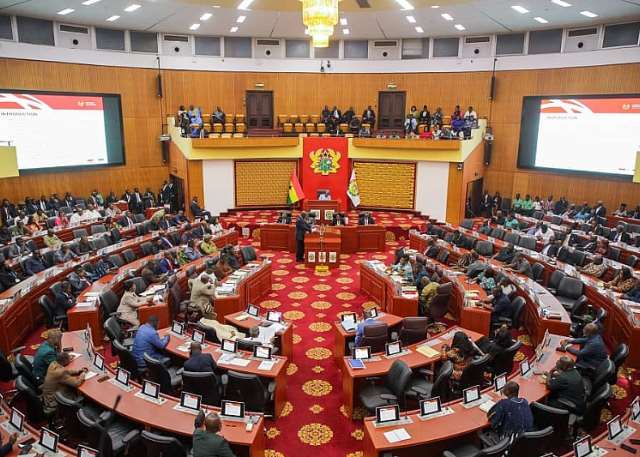
Speaker of Parliament Alban Sumana Kingsford Bagbin has announced that the House will scrutinise the reported US$1.7 billion, roughly GH¢22 billion, loss associated with the Domestic Gold Purchase Programme (DGPP).
The move follows a motion filed by the New Patriotic Party (NPP) Minority Caucus seeking a parliamentary inquiry and the appearance of Ghana Gold Board (GoldBod) Chief Executive Officer Sammy Gyamfi.
The motion was received by Bagbin’s office on Friday, August 21, 2026. The Speaker said he had reviewed it and intended to admit it for consideration.
“With the motion they have filed, which was received in my office on the 21st of August, 2026, just three days ago, I have gone through the motion myself, and I intend to admit the motion because we have to at least have an end to litigation as to whether it’s a loss or it’s a cost,” he said.
He added: “This House will have the opportunity to go through it. And please, Ghanaians are very intelligent people. They will listen, they will read between the lines, and they will make their decisions.”
But the parliamentary investigation faces a more complicated question than the political headlines suggest: who actually incurred the US$1.7 billion cost?
The IMF figure is real — but its attribution matters
The International Monetary Fund’s 2026 Article IV consultation and accompanying Selected Issues paper say the rapid scaling-up of the Bank of Ghana’s DGPP in 2025 resulted in losses exceeding US$1.7 billion, about 1.5% of GDP. The IMF also says the programme facilitated US$10.9 billion of artisanal gold exports in 2025 and was largely phased out by end-June 2026, with GoldBod taking over its operations and costs from July.
That distinction is central. The IMF describes the loss in connection with the Bank of Ghana’s programme, rather than simply as a US$1.7 billion corporate loss on GoldBod’s accounts.
Prof Ebo Turkson, Associate Professor of Development Economics at the University of Ghana, made the same distinction on JoyNews’ Newsfile on August 15.
«“No, GoldBod has not made 1.7 billion losses. It is a cost that has come to the central bank through the gold purchase programme.”»
The Bank of Ghana’s own 2025 financial statements add another layer. The central bank reported an operating loss of GH¢15.63 billion and an other comprehensive income loss of GH¢19.32 billion. It said the operating loss was primarily driven by open-market operations and the cost of the DGPP, with the gold programme cost arising mainly from the exchange-rate differential between the gold-market rate used to purchase artisanal and small-scale gold and the interbank rate used for accounting.
The same year produced macroeconomic gains. Gross international reserves rose from US$9.11 billion at end-2024 to US$13.83 billion at end-2025; the cedi appreciated 40.7%; and inflation fell from 23.8% to 5.4%.
GoldBod’s defence
GoldBod CEO Sammy Gyamfi has rejected the suggestion that GoldBod itself made a US$1.7 billion loss. He has said GoldBod acted as a purchasing and aggregation agent for the Bank of Ghana and did not control the subsequent sale of the gold, selling prices or off-take agreements.
GoldBod’s public response says the US$1.7 billion represents policy costs associated with the central bank’s reserve-building intervention rather than an operational deficit on GoldBod’s corporate books. Its audited 2025 accounts show an operational surplus of about GH¢909.7 million, alongside an unutilised government subvention of roughly GH¢4.55 billion.
Gyamfi has also argued that the wider economic returns must be considered. He said GoldBod and the Bank of Ghana generated more than US$10.8 billion in foreign-exchange earnings from the purchase and export of artisanal and small-scale gold, while the Bank intermediated about US$10.6 billion for the market. He has cited stronger reserves and cedi appreciation as evidence of macroeconomic stabilisation.
The Minority’s counterargument
The NPP Minority Caucus disputes that interpretation. In a statement signed by Minority Leader Alexander Kwamena Afenyo-Markin, the caucus said:
«“GoldBod’s response to an IMF finding confirms that public funds were lost under the program in 2025.”»
The Minority added:
«“That is public money, whichever state balance sheet it sits on. This is the point he did not address, and it is the point he must now address.”»
The missing calculation: what did Ghana actually buy?
Professor Godfred Alufar Bokpin, Professor of Finance at the University of Ghana Business School, has pushed the debate further. Speaking on Joy FM on August 24, he said moving gold-purchase financing away from the Bank of Ghana’s balance sheet was a step in the right direction, but warned that the reported financial loss could still understate the programme’s full economic cost.
«“The losses actually exceed the $1.7 billion,” Bokpin said, arguing that the assessment should include environmental damage and the wider value chain.»
He has also argued that the programme’s pricing structure, including discounts and incentives, did not adequately capture their cost, describing some losses as “design defects.”
This raises a crucial question for Parliament: if Ghana buys more gold through formal channels but that gold is produced through environmentally destructive mining, can the programme be declared economically successful without accounting for damage to forests, rivers and agricultural land?
A programme in transition
The DGPP began in 2021, before GoldBod existed. GoldBod was established under the Ghana Gold Board Act, 2025 (Act 1140), which made it the statutory sole buyer of domestic artisanal and small-scale gold. The Bank of Ghana says the programme’s basic structure remained in place even after GoldBod became the operational channel.
In April 2026, the Ghana Accelerated National Reserve Accumulation Policy (GANRAP) became operational, with the Bank responsible for reserve management and GoldBod handling acquisition, supported by the Ministry of Finance and other public-sector partners.
The transition is facing financing pressure. Reuters reported on August 24 that some GoldBod buyers had gone weeks without expected advance funding, forcing some traders to rely on loans. GoldBod denied a general funding shortfall, saying financing decisions were based on creditworthiness and risk assessments. Reuters also reported that GoldBod raised US$839 million in purchase advances in 2026 and US$75 million through a forex auction that was later paused after concerns from the Bank of Ghana.
Those developments make the inquiry important for whether the redesigned system can avoid repeating the costs.
What Parliament should demand
A serious inquiry should reconcile three sets of numbers: the IMF’s more than US$1.7 billion programme loss; the Bank of Ghana’s audited financial results; and GoldBod’s audited corporate accounts.
Lawmakers should demand the transaction-level reconciliation showing purchase prices, assay and service fees, discounts, off-taker margins, exchange-rate effects, financing costs and realised gains or losses. They should examine the agency agreements between GoldBod and the Bank of Ghana, the treatment of advances, and the allocation of risks under GANRAP.
Parliament should also establish whether the policy produced a positive net economic return after considering financial costs, environmental damage, fiscal incentives and the value of foreign-exchange reserves accumulated.
The evidence supports a more nuanced conclusion than either political camp suggests. The US$1.7 billion figure is real and comes from IMF analysis. But available evidence does not support simply describing it as a US$1.7 billion corporate loss by GoldBod. It is a substantial cost associated with the Bank of Ghana’s DGPP, while GoldBod’s own audited accounts present a different financial picture.
That is precisely why Bagbin’s parliamentary inquiry matters.
The question before Parliament should not be whether GoldBod “lost” US$1.7 billion in isolation. It should be whether Ghana’s gold-reserve strategy was designed, priced, governed and accounted for in a way that delivered value commensurate with the enormous public resources and economic risks involved.
As Bagbin put it, Ghanaians will “listen,” “read between the lines” and make their decisions. Parliament must now ensure that the figures, contracts, transactions and policy assumptions are placed fully on the public record.