

By Alex Ababio | Investigative Special Report
For more than six decades, Ghana and Gabon have enjoyed cordial diplomatic relations. Yet, despite years of political goodwill, trade and investment between the two West and Central African nations have remained far below their potential.
That may now be changing.
The official three-day state visit by Gabonese President Brice Clotaire Oligui Nguema to Ghana marks what both governments describe as the beginning of a new phase—one focused not merely on diplomatic exchanges but on measurable economic cooperation, industrial development and regional integration under the African Continental Free Trade Area (AfCFTA).
The visit, hosted by President John Dramani Mahama, produced two signed Memoranda of Understanding (MoUs), identified twelve strategic sectors for collaboration and signaled a broader ambition to strengthen African economic partnerships at a time when many countries on the continent are seeking to diversify their economies away from dependence on raw commodity exports.
A Ceremonial Welcome with Strategic Significance
President Nguema was received at the Accra International Airport with full military honours and a guard of honour mounted by the Ghana Armed Forces before beginning an itinerary that reflected both history and diplomacy.
His first official stop was the Kwame Nkrumah Memorial Park, where he laid a wreath in honour of Ghana’s founding President, Dr. Kwame Nkrumah, whose vision of African unity continues to influence continental integration efforts.
From there, the Gabonese leader proceeded to the Jubilee House for bilateral discussions with President Mahama.
Before the presidential talks commenced, Ghana’s Minister for Foreign Affairs, Samuel Okudzeto Ablakwa, and Gabon’s Minister of Foreign Affairs, Marie-Edith Tassyla-Ye-Doumbeneny, signed two important agreements.
The first establishes a structured framework for regular political consultations between both foreign ministries.
The second creates formal cooperation in diplomatic training between Ghana’s Foreign Service Institute and Gabon’s Institute of Diplomatic Studies, aiming to strengthen institutional capacity and diplomatic professionalism in both countries.
From Political Friendship to Economic Results
Perhaps the most significant outcome of the bilateral talks was the shared recognition that historical friendship alone is no longer enough.
According to the joint communiqué released after the meeting, Presidents Mahama and Nguema agreed that the next phase of Ghana-Gabon relations must translate political goodwill into concrete economic opportunities capable of creating jobs, attracting investment and improving livelihoods.
Rather than limiting cooperation to diplomatic exchanges, the two leaders instructed their respective ministries to develop implementation frameworks covering 12 priority sectors:
– Trade and investment
– Mining and mineral value addition
– Oil, gas and energy
– Agriculture and agribusiness
– Fisheries and aquaculture
– Forestry and climate change
– Maritime affairs and the blue economy
– Education
– Digital transformation
– Health
– Tourism
– Defence and security
The breadth of these sectors demonstrates that both governments envision a comprehensive partnership extending beyond traditional diplomacy.
Why Mining Cooperation Could Become a Game Changer
Mining emerged as one of the most strategically important areas discussed.
Ghana remains Africa’s leading gold producer, while Gabon possesses some of the world’s highest-grade manganese reserves and has increasingly pursued policies aimed at processing minerals locally instead of exporting raw materials.
During the talks, the two governments agreed to exchange expertise on responsible mining practices, mineral governance and value addition.
This is significant because both countries face similar policy questions: how to maximize economic returns from natural resources while improving environmental protection and community benefits.
Across Africa, institutions including the African Development Bank have consistently argued that mineral beneficiation and local processing are essential if resource-rich countries are to generate sustainable industrial growth instead of remaining exporters of raw materials.
The Ghana-Gabon discussions therefore align with a broader continental shift toward industrialization and value addition rather than commodity dependence.
Climate Cooperation Extends Beyond Forest Protection
Another notable pillar of the partnership involves climate policy.
Gabon has earned international recognition for protecting large areas of the Congo Basin rainforest, one of the world’s most important carbon sinks.
Ghana, meanwhile, has expanded climate resilience initiatives while pursuing restoration of degraded forests and promoting sustainable land management.
Recognizing these complementary strengths, Presidents Mahama and Nguema agreed to strengthen collaboration on climate action, carbon markets and nature-based solutions.
Environmental economists have increasingly identified carbon finance as a potential revenue source for African countries that successfully conserve forests while reducing emissions.
For both Ghana and Gabon, cooperation in this area could extend beyond environmental policy into sustainable investment and climate financing opportunities.
AfCFTA Takes Centre Stage
One of the strongest messages emerging from the bilateral talks was support for African economic integration.
The two Presidents reaffirmed their commitment to the African Continental Free Trade Area (AfCFTA), whose Secretariat is headquartered in Accra.
AfCFTA seeks to create the world’s largest free trade area by connecting 54 African countries into a single market for goods and services.
If fully implemented, economists say the agreement has the potential to significantly increase intra-African trade by reducing tariffs, simplifying customs procedures and encouraging industrial value chains across borders.
For Ghana and Gabon, stronger bilateral cooperation could become a practical example of how African countries can use AfCFTA to move beyond political declarations toward real commercial partnerships.
Beyond Economics: A Common African Voice
The discussions were not limited to commerce.
President Mahama commended Gabon’s consistent support for Ghana at the United Nations General Assembly and proposed deeper collaboration in agribusiness, fisheries, mining and climate finance.
President Nguema, accompanied by a high-level delegation of ministers and senior government officials, praised Ghana’s mining reforms and cocoa-processing initiatives while thanking Ghana for its solidarity during Gabon’s political transition.
He also formally requested Ghana’s support for Gabon’s bid to host a future African Union Summit.
The two leaders jointly condemned xenophobia and discrimination against African citizens across the continent, calling for stronger solidarity in pursuit of the African Union’s Agenda 2063 and the United Nations Sustainable Development Goals.
Here’s Part 2 of your investigative special report.
Strategic Partnership or Diplomatic Symbolism? The Real Test Begins
While the signing of two Memoranda of Understanding (MoUs) represents a significant diplomatic milestone, policy analysts note that their success will ultimately depend on implementation rather than ceremony.
The joint communiqué issued after the bilateral talks makes this clear. Both Presidents directed their respective ministries and state institutions to develop concrete cooperation frameworks, signalling an intention to move beyond declarations toward measurable outcomes in trade, investment, industrialisation and people-to-people exchanges.
For Ghana, the timing is particularly important. The country continues to pursue economic reforms while positioning itself as a regional investment hub. The International Monetary Fund (IMF), following its 2026 Article IV consultation and sixth review of Ghana’s Extended Credit Facility programme, said Ghana had made “substantial stabilization gains” through reforms that reduced inflation, strengthened external reserves and improved investor confidence.
Analysts believe stronger economic fundamentals could make Ghana a more attractive destination for partnerships with fellow African economies such as Gabon.
AfCFTA: Turning Continental Vision into Commercial Reality
One of the strongest messages from the visit was the renewed commitment to the African Continental Free Trade Area (AfCFTA), whose Secretariat is headquartered in Accra.
AfCFTA Secretary-General Wamkele Mene has repeatedly argued that Africa’s priority is no longer negotiating trade rules but implementing them effectively. Speaking on Ghana Television’s Breakfast programme earlier this month, Mene said:
«”Ensuring the effective implementation of the agreed free trade rules remains our highest priority.”»
He added that intra-African trade continues to expand and that implementation must now deliver measurable benefits for businesses and citizens across the continent.
Against that backdrop, closer cooperation between Ghana and Gabon could become a practical example of how AfCFTA can facilitate investment, industrial partnerships and regional value chains between West and Central Africa.
Mining and Value Addition
Mining featured prominently during President Nguema’s discussions with President Mahama.
Ghana is Africa’s largest gold producer, while Gabon ranks among the world’s leading producers of manganese—a critical mineral used in steel manufacturing and increasingly important for battery technologies.
Rather than focusing solely on extraction, both governments agreed to cooperate on responsible mining, mineral governance and value addition.
This aligns with a growing continental policy shift encouraging African countries to process more of their natural resources domestically instead of exporting raw materials with limited economic returns. Expanding mineral processing industries could create higher-skilled jobs, increase export earnings and strengthen industrial development across both economies.
Climate, Forests and Carbon Finance
Environmental cooperation is another area with considerable strategic potential.
Gabon is internationally recognised for protecting much of its rainforest, a key component of the Congo Basin ecosystem and one of the world’s largest natural carbon sinks.
Ghana, meanwhile, has expanded programmes focused on forest restoration, climate resilience and sustainable land management.
During their talks, the two Presidents agreed to cooperate on forestry, climate action, carbon markets and nature-based solutions.
Environmental economists increasingly view properly regulated carbon markets as an opportunity for African countries to attract climate finance while protecting biodiversity.
If translated into concrete projects, collaboration between Ghana and Gabon could strengthen both countries’ access to international climate financing while supporting conservation and sustainable development objectives.
Agriculture, Fisheries and Food Security
Agriculture also featured prominently in the discussions.
President Mahama proposed stronger collaboration in agribusiness and fisheries, recognising that both countries are seeking to improve food security, modernise agricultural production and create more value from local resources.
The cooperation agenda extends beyond farming to include fisheries, aquaculture and the blue economy—areas that could generate employment while supporting sustainable management of marine resources.
With climate change placing increasing pressure on food production across Africa, collaboration in research, technology transfer and agribusiness investment may become one of the partnership’s most practical outcomes.
Symbolism Meets Sustainability
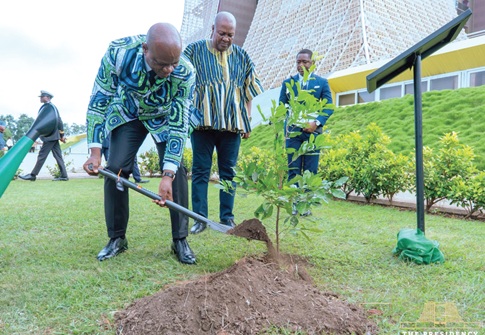
Beyond the policy discussions, President Nguema participated in a tree-planting ceremony at Jubilee House.
While symbolic, the event reflected the environmental priorities that both governments highlighted during the bilateral talks.
The Gabonese leader also paid tribute to Ghana’s founding President, Dr. Kwame Nkrumah, at the Kwame Nkrumah Memorial Park, reinforcing the Pan-African ideals that continue to shape relations between the two countries.
A United African Voice
The two Presidents also discussed wider continental issues.
They reaffirmed their commitment to the African Union’s Agenda 2063 and the United Nations Sustainable Development Goals while jointly condemning xenophobia and discrimination against Africans on the continent.
President Mahama commended Gabon’s support for Ghana at the United Nations General Assembly, while President Nguema thanked Ghana for its solidarity during Gabon’s political transition and sought Ghana’s support for Gabon’s bid to host a future African Union Summit.
Looking Ahead
President Nguema’s invitation for President Mahama to undertake a reciprocal official visit to Libreville—accepted by the Ghanaian leader—signals that both governments intend to maintain high-level political engagement.
However, experienced observers of African diplomacy caution that bilateral agreements should ultimately be judged by implementation rather than announcements.
The creation of joint investment projects, expanded trade volumes, technology transfer, educational exchanges and measurable industrial cooperation will determine whether this visit becomes a historic turning point or simply another diplomatic milestone.
For businesses, investors and policymakers, the next few months will be critical. Ministries, regulators and private-sector institutions in both countries are expected to begin translating the twelve priority sectors into actionable programmes.
If successfully implemented, the Ghana-Gabon partnership could emerge as one of Africa’s most promising examples of South-South cooperation under the AfCFTA framework—linking two resource-rich economies with complementary strengths in mining, energy, agriculture, forestry, digital transformation and regional trade.
More than sixty years after establishing diplomatic relations, Ghana and Gabon now appear determined to write a new chapter—one measured not by diplomatic protocol alone, but by investment, industrial growth, job creation and shared prosperity for their citizens.