

By Alex Ababio
Ghanaian Watch Investigative Special Report | Cybersecurity, Financial Crime and International Cooperation
Ghana’s latest crackdown on suspected international fraud networks has triggered a diplomatic disagreement over who led the operation, raising questions about law enforcement accountability, international cooperation and the country’s capacity to investigate sophisticated cybercrime.
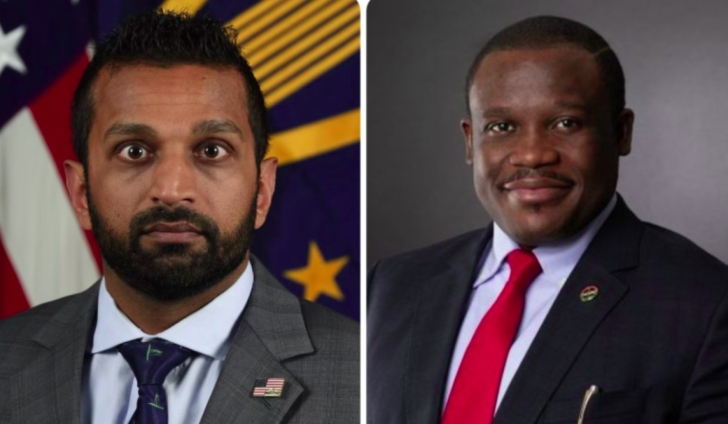
The dispute followed an announcement by Federal Bureau of Investigation (FBI) Director Kash Patel that an operation in Ghana had resulted in more than 130 people being arrested or detained, 89 victims being identified, more than 300 electronic devices being seized and nearly US$10 million in suspected fraud-related losses being identified.
However, Ghana’s Minister for Communication, Digital Technology and Innovations, Samuel Nartey George, has challenged the presentation of the operation, insisting that Ghanaian law enforcement and intelligence agencies led the exercise with support from the United Kingdom’s National Crime Agency (NCA) and the FBI.
The disagreement goes beyond public recognition. It raises questions about how international cybercrime investigations are coordinated, how victims of trafficking are identified and protected, and what happens to suspects and digital evidence after a multinational operation.
Sam George challenges FBI’s account of Ghana operation
In a post on X on Thursday, October 8, 2026, Mr George responded directly to Mr Patel, arguing that fighting cybercrime requires cooperation between countries rather than presenting the activities of international partners as independent achievements.
“@FBIDirectorKash, as Ghana’s Minister responsible for Cybersecurity, I believe the fight against cybercrime is transnational and requires collaboration. Ghanaian law enforcement and intelligence led the Cyberhunt operations, with primary support from the UK @NCA_UK and the @FBI you lead,” he wrote.
He continued:
“To suggest the @FBI acted solely to execute this operation in your tweet undermines the potential for future collaboration. I expect that you will reflect on the benefits of our continued cooperation and act accordingly. For God and Country.”
The minister’s objection concerned how the operation was presented publicly.
Mr Patel’s announcement described the crackdown as part of the FBI’s global Operation Blackout campaign. However, the announcement, as reported in the available coverage, did not provide a detailed account of the respective responsibilities of Ghanaian authorities, the British NCA and the FBI.
It is therefore important to distinguish between the FBI emphasising its contribution and an independently established finding that it conducted the operation without Ghanaian participation.
Mr George has asserted that Ghanaian agencies led the exercise. A detailed operational account from the participating institutions would help establish which agencies planned the raids, executed arrests, identified victims and handled the evidence.
The disagreement also highlights the importance of recognising the legal authority of the country in which an operation takes place.
Sources: Graphic Online, October 8, 2026; MyJoyOnline, October 8, 2026.
More than 130 people arrested or detained as FBI reports nearly $10 million in losses
Mr Patel announced the results of the Ghana operation under Operation Blackout, describing it as another crackdown on international scam centres.
The figures he released were significant: nearly US$10 million in identified losses, 89 identified victims, more than 130 individuals arrested or detained and over 300 electronic devices seized.
“These scam compounds target American citizens and destroy lives – and this FBI is crushing them in every corner of the world. More to come,” Mr Patel said.
The announcement also stated that some of those arrested or detained were victims who would be repatriated to their home countries.
That detail is particularly important because it suggests that investigators may be dealing with more than one category of person at the suspected facilities.
Some individuals may be suspected of organising or participating in fraud, while others may have been coerced into carrying out fraudulent activities. Their circumstances must be established through proper investigations rather than assumed from their presence at a location.
The FBI has not publicly identified all those arrested or detained in the announcement described by the news reports. Nor has the announcement provided a complete list of the Ghanaian institutions involved, the precise locations of the operations or the charges, if any, brought against individual suspects.
The reported US$10 million figure also requires careful interpretation.
It represents losses identified by investigators at the time of the announcement. It should not automatically be interpreted as money recovered, assets frozen or funds available for compensation to victims.
Similarly, the seizure of more than 300 electronic devices does not, by itself, establish how many contain evidence of criminal activity.
Investigators would need to examine the devices, establish ownership, identify relevant communications and financial transactions, and connect any evidence to particular suspects.
The FBI said the investigation was continuing. Consequently, the figures represent preliminary operational results rather than a final judicial determination of guilt.
Source: Graphic Online, October 8, 2026, reporting the FBI director’s announcement.
Operation Blackout and the international scam-centre problem
The Ghana operation forms part of Operation Blackout, which Mr Patel describes as a global effort to dismantle scam centres targeting Americans.
According to the figures in his October 8 announcement, the wider initiative had recorded roughly US$17 billion in seized assets, hundreds of arrests of alleged scammers, the freeing of thousands of trafficked workers and efforts to warn more than 10,000 Americans before they lost money.
He also reported an estimated US$670 million in losses prevented.
These are figures attributed to the FBI director’s public announcement. They should not be confused with independently audited totals, and the precise relationship between the reported seizures, fraud losses and other outcomes requires further documentation.
Nevertheless, the scale of the figures illustrates the financial and human costs associated with transnational fraud.
Scam operations can involve networks of people who identify potential victims, impersonate romantic partners or business contacts, manipulate victims into transferring money, and move proceeds through accounts controlled by other participants.
Digital communications, online payment services, social media platforms and international financial transactions can allow the people coordinating a scheme to operate across several jurisdictions.
This creates a practical challenge for law enforcement: evidence may be held in one country, victims may live in another, and suspects or financial assets may be located elsewhere.
An investigation can therefore require cooperation between police, intelligence services, financial investigators, prosecutors and international partners.
In Ghana’s case, the central question is how the participating agencies divided these responsibilities and what further action will follow the arrests.
Human trafficking adds another dimension to cybercrime investigations
The reported inclusion of trafficking victims among those arrested or detained raises a separate accountability issue.
Authorities must distinguish between people suspected of committing offences and people who may have been forced or deceived into participating in them.
The United Nations Office on Drugs and Crime (UNODC) has documented the use of trafficked people in organised cyber-enabled fraud operations, including scam compounds in parts of Southeast Asia.
Its report, Casinos, Cyber Fraud, and Trafficking in Persons for Forced Criminality in Southeast Asia, published in 2023, examines how organised criminal groups exploit vulnerable people and compel some trafficking victims to participate in online fraud.
The report provides an important international context for understanding why a crackdown on a suspected scam centre cannot be assessed solely by counting arrests.
A credible investigation must establish who controlled the operation, who benefited financially, whether individuals were recruited under false pretences, and whether anyone was threatened, confined or forced to commit offences.
The report concerns Southeast Asia; it does not establish that the people involved in Ghana’s operation experienced the same conditions.
That distinction matters. Investigators must establish the circumstances of the individuals identified in Ghana rather than assume that every person at a suspected compound was either a willing offender or a trafficking victim.
The FBI’s statement that some people would be repatriated suggests that authorities recognise different categories of individuals may be involved. However, public details about the identification, screening and protection of potential trafficking victims remain limited.
Ghanaian authorities should clarify what procedures are being used to identify possible victims, arrange appropriate protection and determine whether repatriation is safe and voluntary where required by law.
Abu Trica extradition shows the importance of Ghana-US cooperation
The latest operation comes amid continuing cooperation between Ghanaian and United States authorities in investigations into alleged international fraud.
A significant example is the case involving Frederick Kumi, popularly known as Abu Trica, who was extradited to the United States on July 9, 2026.
According to a July 14, 2026, statement from the US Department of Justice, Kumi, 31, was accused of participating in a romance-fraud network that allegedly targeted more than 80 elderly victims in the United States and caused losses exceeding US$8 million.
The department said the alleged scheme operated from approximately April 2023 to November 2025.
According to the indictment described by US prosecutors, members of the network used online dating sites and social media to identify victims and establish relationships under fictitious identities.
The allegations included the use of artificial-intelligence-driven video platforms to communicate with victims while impersonating women.
Prosecutors also alleged that some victims were persuaded to transfer money after being told stories involving inheritances of gold or diamonds.
The department said Kumi and co-defendant Daniel Yussif, also known as Denteni or Slab, allegedly acted as leaders of a group involved in the scheme.
Kumi was arrested in Ghana on December 11, 2025, and extradited to the United States on July 9, 2026.
He faces charges of conspiracy to commit wire fraud and conspiracy to commit money laundering.
The allegations remain subject to the judicial process. An indictment is not proof of guilt, and the accused is entitled to a fair trial.
The US Department of Justice specifically acknowledged Ghanaian institutions for their cooperation in securing Kumi’s arrest and extradition.
They included the Attorney-General’s Office, the Economic and Organised Crime Office (EOCO), the Ghana Police Service, the Cyber Security Authority, the Ghana National Intelligence Bureau and the FBI Legal Attaché Office in Accra.
The acknowledgement also named US agencies, including the Drug Enforcement Administration and Homeland Security Investigations.
This documented cooperation is relevant to the present dispute because it demonstrates that major international fraud investigations can depend on contributions from several national institutions.
The Abu Trica case is separate from the October 2026 operation. There is no basis in the available announcements to conclude that the two investigations involve the same suspects or criminal network.
Source: US Department of Justice, Northern District of Ohio, July 14, 2026.
What happens to the suspects, victims and seized devices?
Beyond the disagreement over leadership, the next stage of the Ghana investigation will determine whether the reported arrests lead to successful prosecutions and meaningful protection for victims.
One immediate question is whether Ghanaian authorities intend to prosecute any suspects in Ghana or whether some individuals may face extradition proceedings.
The answer will depend on the evidence, the applicable laws, the alleged offences and the jurisdiction in which charges are pursued.
Extradition is not automatic following an international arrest. It involves legal procedures and consideration of the applicable requirements.
The more than 300 seized devices also present a significant investigative task.
Electronic devices can contain communications, financial records, account credentials and other information relevant to an investigation. However, investigators must establish the authenticity, relevance and evidential value of material recovered from them.
A transparent account of the investigation should explain whether forensic examinations are under way, whether investigators have identified additional victims and whether any assets have been frozen or recovered.
Authorities should also clarify whether the reported US$10 million represents suspected losses linked to the Ghana operation alone and how that figure was calculated.
Such information would help the public distinguish between money allegedly lost by victims, proceeds allegedly obtained by suspects and funds actually recovered by investigators.
The identities of suspects should be disclosed in accordance with applicable law and legitimate investigative considerations, while the privacy and safety of trafficking victims must be protected.
Cybersecurity accountability: Questions Ghanaian authorities must answer
The operation offers Ghana an opportunity to demonstrate that international cooperation can produce measurable results while preserving national accountability.
However, the public cannot fully assess its effectiveness using arrest figures alone.
Ghana’s Ministry of Communication, Digital Technology and Innovations, the Ghana Police Service, EOCO and the Cyber Security Authority should provide further information, where legally permissible, on the following issues:
– Operational leadership: Which Ghanaian agencies planned and led the operation, and what specific roles did the British NCA and FBI perform?
– Arrests and detention: How many people remain in custody, how many have been released, and what legal grounds apply to their detention?
– Potential trafficking victims: How many individuals have been identified as possible victims, and what screening, protection and repatriation arrangements are in place?
– Financial losses: How was the nearly US$10 million estimate calculated, and how much money, if any, has been recovered or frozen?
– Digital evidence: What forensic examinations are being conducted on the more than 300 seized devices, and how will investigators ensure that the evidence can be used in court?
– Prosecution: Which cases are being investigated for prosecution in Ghana, and are any extradition requests being considered?
These questions do not diminish the value of international cooperation. They establish the information needed to evaluate the operation’s legal, financial and public-safety outcomes.
Conclusion: Recognition must be matched by evidence and results
The disagreement between Sam George and Kash Patel has placed Ghana’s role in a major cybercrime operation at the centre of public debate.
The FBI has announced substantial results under Operation Blackout, including more than 130 arrests or detentions, 89 identified victims and nearly US$10 million in identified losses.
Mr George, however, insists that Ghanaian law enforcement and intelligence agencies led the operation with support from the UK National Crime Agency and the FBI.
A detailed account from the participating institutions is needed to establish the precise division of responsibilities and resolve the outstanding questions.
The broader stakes are considerable. International fraud networks can exploit digital technology, vulnerable people and gaps between national jurisdictions. Countering them requires effective investigations, reliable evidence, lawful prosecutions and cooperation that extends beyond public announcements.
For Ghana, success should ultimately be measured not simply by how many people were arrested, but by whether criminal networks were dismantled, trafficking victims were protected, victims received meaningful support, financial proceeds were traced and the evidence resulted in lawful accountability.
Recognising the contributions of Ghanaian and international agencies is part of that process. So is ensuring that the public receives accurate information about what the operation achieved and what remains to be done.