

By Alex Ababio
Ghana’s renewed call for stronger action against malnutrition comes at a critical moment: the country has made significant progress in reducing childhood stunting, but anaemia, diet affordability, food insecurity and climate-related shocks continue to expose millions of people to nutritional risks.
Vice-President Professor Naana Jane Opoku-Agyemang has therefore called for stronger multi-sectoral action and sustained investment to tackle malnutrition, arguing that the problem can no longer be treated solely as a health-sector issue.
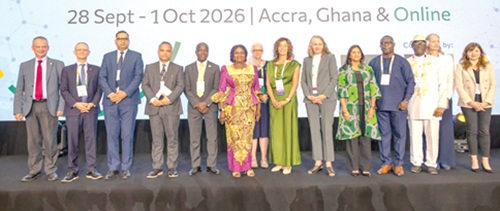
She made the call on September 29, 2026, when she opened the seventh Global Conference of the Micronutrient Forum (MNF) in Accra under the theme, “Nutrition at the Frontiers of a Changing Environment.” The four-day conference runs from September 28 to October 1 and brings together policymakers, scientists, researchers, development partners, civil society and private-sector actors.
The Vice-President said malnutrition affects people across the life cycle, with consequences beginning in childhood and potentially extending into adulthood, pregnancy and subsequent generations.
“More than individual interventions, solutions require science, sustained investment, strong public institutions, and resilient health systems across countries and sectors,” she said.
Her warning exposes the central challenge confronting Ghana: improving nutrition requires more than distributing supplements or treating severely malnourished children. It requires policies that influence household incomes, food prices, agricultural production, school meals, maternal healthcare, sanitation, social protection and climate resilience.
The hidden nutrition crisis
The latest available national evidence shows that Ghana has made progress, but the problem remains substantial.
The 2022 Ghana Demographic and Health Survey found that 17 per cent of children under five were stunted, a major improvement from 33 per cent in 1993. However, the burden was considerably higher in rural communities, at 20 per cent, and reached 30 per cent in the then Northern Region and 29 per cent in North East Region. Six per cent of children under five were wasted, while 12 per cent were underweight.
UNICEF’s 2025 Child Nutrition Report similarly estimated Ghana’s latest modelled stunting prevalence at about 16 per cent, with wasting at 6 per cent and overweight at 2 per cent. UNICEF classified Ghana as making some progress on stunting but no progress towards the 2030 wasting target.
The figures demonstrate why a single national average can conceal serious regional and household-level inequalities.
Anaemia presents another major challenge.
A 2025 peer-reviewed analysis of the 2022 Ghana Demographic and Health Survey, involving more than 7,500 women screened for anaemia, found prevalence of 40.4 per cent among non-pregnant women and 51.4 per cent among pregnant women. The study also found that women in the poorest wealth quintile had significantly higher risks of anaemia.
The findings reinforce the Vice-President’s argument that nutrition is closely linked to poverty and access to services.
The study’s authors included researchers from Nagasaki University, the University of the Ryukyus and Ghana’s University of Health and Allied Sciences, including public-health expert Professor Frank Baiden. Their conclusion was that reducing anaemia requires integrated approaches involving healthcare, nutrition, sanitation and economic equity.
From hospital treatment to prevention
Professor Opoku-Agyemang said Ghana must move nutrition further into routine healthcare.
“There is therefore an opportunity for us to embed nutrition care into prevention, maternal care, child care, immunisation and community-level care,” she said.
This is significant because nutrition problems frequently interact with other health risks.
A mother affected by anaemia, for example, may face greater pregnancy-related risks, while poor maternal nutrition can affect birth outcomes and infant development. Children who experience chronic undernutrition may also suffer consequences that extend beyond childhood.
The World Health Organization’s latest global anaemia estimates describe anaemia as a major public-health concern and warn of consequences including adverse pregnancy and birth outcomes, increased morbidity and mortality risks and impaired cognitive and motor development in children.
The policy implication is straightforward: nutrition screening and counselling cannot remain isolated programmes. They need to become part of the everyday operation of primary healthcare, antenatal services, child welfare clinics and community health programmes.
The affordability problem
But health services alone cannot solve a problem partly determined by what families can afford to eat.
Ghana has developed Food-Based Dietary Guidelines designed to promote diverse diets containing fruits, vegetables, legumes, nuts and animal-source foods. The guidelines also explicitly recognise affordability and environmental sustainability as important components of a healthy food system.
The difficulty is translating those recommendations into everyday diets for households facing economic pressure.
The Food and Agriculture Organization has developed the Cost and Affordability of a Healthy Diet indicator precisely because physical availability of food does not necessarily mean households can afford a nutritionally adequate diet. The measure combines local food prices and income distributions to assess economic access to foods required for a healthy diet.
Ghana is among the countries involved in work to build national systems for monitoring the cost and affordability of healthy diets. In 2025, FAO, the NDPC and the University of Health and Allied Sciences began work examining how Ghana’s agricultural and food expenditure could become more nutrition-sensitive.
That work gives practical meaning to the Vice-President’s call for stronger expenditure tracking.
The issue is no longer simply how much government spends, but whether public spending across agriculture, health and social protection is producing better nutrition outcomes.
School feeding: a major investment with a bigger question
The Ghana School Feeding Programme illustrates both the scale of the government’s nutrition-related intervention and the importance of monitoring what happens after money is allocated.
Professor Opoku-Agyemang cited the programme as reaching more than 4.5 million children. Current government figures are even more specific.
Gender, Children and Social Protection Minister Dr Agnes Naa Momo Lartey said in September 2026 that 4,527,636 children were benefiting daily. The programme’s allocation increased from GH¢1.393 billion in 2024 to GH¢1.788 billion in 2025 and GH¢1.982 billion in 2026. The per-child grant rose from GH¢1.50 to GH¢2.00.
The government has also introduced reforms aimed at improving nutritional quality and accountability.
The Ministry reviewed 16 regional ecological menus, introduced soybean powder into meals such as kenkey, waakye, jollof rice and soups, and began piloting a digital monitoring system known as School Connect. The World Bank has supported menu cards covering food preparation, portion control and nutritional standards.
These measures matter because feeding millions of children is not automatically equivalent to improving nutrition.
The nutritional value of meals, portion sizes, protein content, food safety, menu compliance and regularity of feeding all determine the programme’s impact.
The government’s own decision to strengthen monitoring reflects this reality.
Climate change is now a nutrition issue
The other major pressure identified at the Accra conference is climate change.
Sunil Dahiya, Acting Regional Director of the Alliance for a Green Revolution in Africa, linked climate shocks to food production and nutrition. He called for greater investment in climate-resilient and nutritious seeds, improved storage and processing, efficient regional trade and innovative financing.
Recent Ghana-focused research strengthens that argument.
A 2026 study published in Sustainable Futures examined climate change, food consumption and food security in Ghana and found that higher temperatures pushed households away from diversified diets. It also identified household and agricultural income as important mechanisms affecting food consumption.
This creates a potentially damaging chain: climate shocks can affect agricultural production; production shocks can affect food prices and household incomes; higher prices can reduce dietary diversity; and reduced dietary diversity can increase nutritional vulnerability.
For Ghana, therefore, climate adaptation is increasingly a food and nutrition policy issue, not merely an environmental policy issue
The financing question
Professor Opoku-Agyemang said Ghana is committed to increasing financing for essential nutrition services and improving the tracking of nutrition-related expenditure across government.
She stressed that domestic financing and international cooperation should complement one another, arguing that progress would require “national intervention, international cooperation, science and innovation, and many more financial resources made available now to support long-term systems rather than short-term interventions.”
That distinction may prove crucial.
Nutrition programmes can generate strong results when interventions are maintained, but fragmented projects can struggle when external funding ends or institutional responsibility becomes unclear.
The Micronutrient Forum says micronutrient deficiencies affect one in two children and two in three women globally, illustrating why the issue has implications beyond individual healthcare and into human capital and economic development.
Executive Director of the Micronutrient Forum, Dr Saskia Osendarp, said the Accra conference provides an opportunity to examine evidence on integrating nutrition with other sectors, scaling cost-effective interventions, using data to inform policy and programmes, and developing new financing approaches.
The conference’s programme reflects that broad agenda, covering biology and intervention efficacy, programme implementation, financing, food systems, climate, health and social protection.
From conference promises to measurable outcomes
The Accra meeting comes with a substantial international platform.
The official conference organisers currently expect about 1,500 participants, with more than half coming from Africa and other low- and middle-income countries. The event is being held at the invitation of the Government of Ghana, with support from the NDPC, African Union and African Development Bank.
Earlier planning material cited higher participation figures, including estimates of up to 2,500 participants through in-person and online participation. The latest official conference information, however, lists approximately 1,500 participants, making that the more current figure.
For Ghana, the real test will come after the conference closes.
The Vice-President’s message places nutrition at the intersection of public health, agriculture, education, social protection, climate policy and public finance. Ghana already has important building blocks: a national food-based dietary guideline, a large school-feeding programme, primary healthcare structures, nutrition programmes and systems for monitoring public expenditure.
The unresolved question is whether these systems can operate as one coordinated national nutrition strategy.
The evidence suggests that Ghana has achieved important gains, particularly in reducing childhood stunting. But the persistence of anaemia, wasting, dietary affordability problems and climate-related food risks means the country cannot treat those gains as permanent.
The warning from Accra is therefore less about creating another nutrition programme than about connecting the programmes Ghana already has.
As Professor Opoku-Agyemang put it, “More than individual interventions,” the solution requires science, sustained investment, strong public institutions and resilient health systems.
The next measure of success will be whether that principle translates from conference halls into household diets, healthier mothers, better-nourished children and measurable improvements in Ghana’s nutrition indicators.c