

By Alex Ababio
President John Dramani Mahama has announced that Ghana’s Parliament will this year ratify the African Union Convention on Ending Violence Against Women and Girls (AUCEVAWG), describing it as a decisive step to protect the Ghanaian girl child and guarantee equal opportunity for young girls and women.
The AUCEVAWG, a comprehensive legal instrument for the prevention and elimination of all forms of violence against women and girls on the continent, was adopted in February 2025 at the 38th Ordinary Session of the Assembly of Heads of State and Government of the African Union.
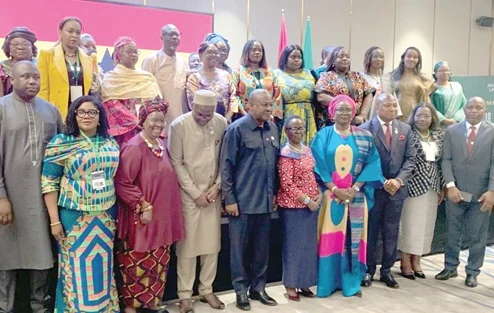
Speaking at a High-Level Breakfast Meeting on Financing and Reaffirming Africa’s Gender Commitments — a side event at the 39th AU Summit on Friday, February 13, 2026 — President Mahama lamented the slow pace of ratifications across the continent.
“In February 2025, this Assembly adopted the African Union Convention on Ending Violence Against Women and Girls, a historic step, and yet progress has been slow.
This session of our Parliament is going to ratify the convention. I urge all member states to sign and ratify this convention before the end of 2026,” he said.
But beyond the applause and diplomatic calls for urgency lies a deeper question: will ratification translate into measurable change for women and girls across Ghana and Africa?
A Convention Born Out of Crisis
Across Africa, violence against women and girls remains pervasive despite decades of advocacy and legislative reforms. According to continental gender assessments and data compiled by UN agencies and African development institutions, nearly one in three women on the continent has experienced physical or sexual violence in her lifetime. Child marriage, harmful traditional practices, trafficking, online abuse, and domestic violence continue to affect millions.
President Mahama did not mince words about the economic cost.
“Violence against women and girls is not only a moral outrage. It is an economic catastrophe costing Africa billions annually in health care, lost productivity and justice expenditures, while devastating families and communities,” he said.
Public finance experts estimate that gender-based violence (GBV) drains African economies through lost labor participation, increased health expenditure, policing and judicial costs, and intergenerational poverty. In Ghana alone, civil society organizations have repeatedly warned that underreporting masks the true scale of the crisis, particularly in rural communities.
The AUCEVAWG seeks to address these systemic failures by creating legally binding obligations for member states, including criminalization of various forms of violence, survivor-centered justice mechanisms, protection services, data systems, and financing commitments.
However, analysts caution that Africa is not short of frameworks. Implementation has historically been the stumbling block.
The Maputo Precedent
President Mahama, who currently serves as the AU Champion on Gender and Development Issues, emphasized that AU gender instruments were not merely symbolic documents.
“They are not merely gender frameworks, but cornerstones of Africa’s human rights and development architecture,” he said, adding pointedly that, “frameworks matter, but political will matters more.”
His remarks echo the experience of the Protocol to the African Charter on Human and Peoples’ Rights on the Rights of Women in Africa, commonly known as the Maputo Protocol, adopted in 2003. The instrument legally guarantees wide-ranging rights for women, including reproductive rights, protection from harmful practices, and equality before the law.
President Mahama urged the nine member states yet to ratify the Maputo Protocol to do so without delay, noting that 46 member states have already adopted it.
Yet, more than two decades after its adoption, enforcement gaps remain across many ratifying states. Experts argue that ratification without domestic legal harmonization, adequate budget allocations, and monitoring frameworks often results in limited impact.
Ghana ratified the Maputo Protocol in 2007, but civil society organizations continue to advocate for stronger enforcement mechanisms, especially in relation to domestic violence prosecutions, sexual assault case management, and survivor support services.
Ghana’s Domestic Commitments
President Mahama outlined several domestic initiatives that he said demonstrate Ghana’s commitment to gender equality.
“We’ve achieved gender parity in school enrolment and improved completion rates for girls,” he stated.
Education data from Ghana’s Ministry of Education and global education monitoring reports confirm that Ghana has made significant strides in narrowing gender gaps at the basic education level. However, disparities persist in STEM participation, rural school completion rates, and tertiary-level enrollment in certain disciplines.
The President further disclosed that in the 2026 budget, government allocated GH₵401 million — nearly equivalent to over $40 million — to capitalise the Women’s Development Bank.
“The largest such allocation targeted at expanding affordable credit, financial literacy, and enterprise support for women, particularly those in the informal and vulnerable employment,” he said.
Ghana’s informal sector accounts for more than 70 percent of total employment, with women disproportionately represented in low-income, vulnerable occupations. Access to affordable credit remains a major barrier to scaling women-led enterprises. Economists say if effectively managed, the Women’s Development Bank could significantly boost women’s economic participation — a key determinant in reducing vulnerability to abuse.
President Mahama also cited social protection interventions:
“We instituted the Livelihood Empowerment Against Poverty League, the school feeding programme, free sanitary pads for school girls and free tertiary education for persons with disabilities.”
Social policy analysts note that such interventions, if properly funded and monitored, can reduce economic dependence — a major factor that traps many women in abusive relationships.
Affirmative Action: Ambition Meets Reality
In a landmark move, Ghana’s Parliament enacted the Affirmative Action Gender Equity Act in 2024. The Act sets binding targets for women’s representation: 30 percent by 2026, 35 percent by 2028, and 50 percent by 2030.
“Parliament has also enacted the Affirmative Action Gender Equity Act of 2024, setting binding targets for women’s representation at 30 per cent by 2026, 35 per cent by 2028, and 50 per cent by 2030. This requires dedicated budgetary allocations for gender programmes,” President Mahama said.
Political scientists argue that representation matters not only symbolically but substantively. Studies across democracies show that increased female representation in parliament correlates with stronger social policy frameworks, child protection laws, and gender-sensitive budgeting.
Yet, achieving 30 percent representation by 2026 will require significant shifts in party nomination processes, campaign financing structures, and internal political culture.
The Gender Index Warning
The President referenced Africa’s broader performance metrics.
“The African Gender Index score of 0.505 reminds us of the long way ahead,” he said.
The African Gender Index, jointly developed by the African Development Bank and the UN Economic Commission for Africa, measures gender equality across economic, social, and political dimensions. A score of 0.505 suggests moderate but uneven progress.
“At a time of global uncertainty, economic shocks, climate crisis, conflict and growing resistance to gender equality, Africa must stand firm. Gender equality is non-negotiable,” President Mahama declared.
Experts warn that climate shocks, displacement, and economic crises often exacerbate gender-based violence, particularly in fragile communities.
Financing the Fight Against Violence
Beyond ratification, the real test will be financing.
President Mahama called on all African Heads of State and Government to adopt gender-responsive budgeting by 2028 with a defined minimum allocation for gender equality.
Gender-responsive budgeting integrates gender analysis into fiscal policy, ensuring that budget allocations address specific disparities. While several African countries have introduced elements of this approach, implementation remains inconsistent.
“Let us commit to urgent certification and implementation of the AU Convention on Ending Violence Against Women and Girls, supported by costed national action plans,” he urged.
Policy researchers emphasize that costed national action plans are critical. Without defined budgets, timelines, and measurable indicators, conventions risk becoming aspirational statements rather than operational tools.
Accountability and the Road Ahead
President Mahama also called for stronger monitoring mechanisms.
“Let us convene a high-level stock-taking summit to publicly report on our progress, reinforce accountability and celebrate our success stories,” he said.
Civil society leaders argue that transparency and data systems will be central to success. Many African countries lack reliable national databases on gender-based violence cases, prosecution rates, and survivor services coverage.
For Ghana, ratification of the AUCEVAWG would require alignment with existing laws such as the Domestic Violence Act and the Human Trafficking Act, as well as strengthened coordination among the Ministry of Gender, law enforcement, judiciary, and social services.
A Defining Moment
President Mahama’s declaration positions Ghana as a potential leader in continental gender reform. As AU Champion on Gender and Development Issues, his government’s ability to move swiftly from ratification to implementation could influence other states.
But history suggests that conventions alone do not end violence. Political will, sustained financing, institutional reform, and cultural change must converge.
“Let us raise financial and economic inclusion to ensure women and our youth enjoy equal access to finance, assets, markets, decent work and economic decision-making,” the President said.
The coming months will test whether Ghana’s Parliament transforms that pledge into binding law — and whether that law transforms lives.
For millions of women and girls across Africa, the urgency is not diplomatic. It is deeply personal.