

By Alex Ababio
A Traditional Authority Takes the Lead in the fight against Galamsey
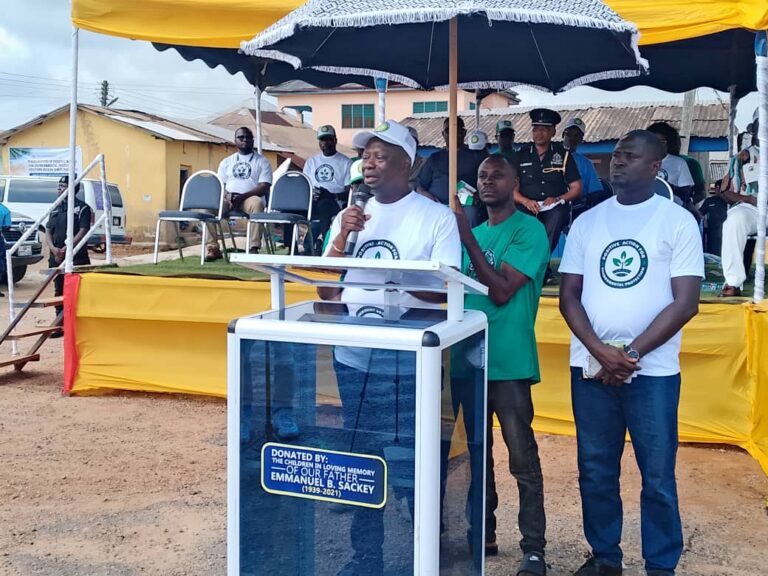
In a decisive move that underscores the growing role of traditional institutions in environmental governance, the Western Regional House of Chiefs has formally inaugurated a new non-governmental organisation (NGO) aimed at supporting national efforts to combat illegal mining, popularly known as galamsey, in Ghana’s Western Region.
The NGO, christened Positive Action for Environmental Protection Ghana (PAFEP-WRC-GH), has been established to design and implement practical strategies to help curb galamsey activities, restore degraded lands, and protect rivers and water bodies that have suffered extensive pollution due to illegal mining.
The inauguration ceremony brought together traditional rulers, government officials, environmental experts, local government authorities, and civil society actors, reflecting the multi-stakeholder nature of the galamsey problem and the urgent need for shared responsibility.
“Positive Action Now”: A Call for Collective Responsibility
Delivering the keynote address on the theme “Positive Action For Environmental Protection: Shared Responsibility”, the President of the Western Regional House of Chiefs, Nana Kobina Nketsia V, stressed that the fight against galamsey cannot be left to government alone.
According to Nana Kobina Nketsia V, the slogan “Positive Action Now” must become a national rallying cry that inspires citizens, chiefs, local authorities, and private actors to take ownership of environmental protection.
“If we continue to talk without acting, our rivers will not wait for us,” Nana Kobina Nketsia V said in a direct appeal. “Positive Action Now must resonate with all Ghanaians. The environment is our shared inheritance, and safeguarding it is a collective duty.”
He noted that traditional leaders, as custodians of the land, have a moral and cultural obligation to ensure that natural resources are used responsibly for the benefit of present and future generations.
Aligning Traditional Leadership with State Policy
The Minister of Lands and Natural Resources, Mr Emmanuel Armah-Kofi Buah, commended the Western Regional House of Chiefs for taking proactive steps to complement government interventions against galamsey.
Addressing the gathering, Mr Buah described the inauguration of PAFEP-WRC-GH as “a timely and strategic partnership” that aligns with the government’s broader environmental restoration agenda.
“When chiefs take the lead, enforcement becomes easier and community compliance improves,” Mr Buah stated. “This initiative strengthens our resolve to restore degraded lands and reclaim polluted water bodies.”
New Licensing Regime and Regulatory Reforms
Mr Emmanuel Armah-Kofi Buah outlined several policy measures introduced by the government to address illegal mining, beginning with a restructured licensing regime for small-scale mining.
Under the new system, the issuance of mining permits starts at the community level, involving chiefs, district assemblies, and community leaders before approvals are finalized by state institutions.
“We have decentralised the process deliberately,” the minister explained. “Local leaders understand their terrain better and can help prevent abuse.”
Another significant reform highlighted by Mr Buah is the regulation of excavator importation. He explained that individuals seeking to import excavators into Ghana must now provide proof of valid mining documentation.
As a result of this policy, approximately 1,300 excavators without proper documentation have been locked up in Accra, following the implementation of the government’s geo-fencing and tracking policy.
“This is not rhetoric; it is enforcement backed by technology,” Mr Buah said. “Illegal miners are finding it increasingly difficult to operate under the radar.”
Complementary National Initiatives
Beyond licensing and equipment regulation, the minister cited other interventions currently being rolled out nationwide. These include:
The Tree for Life Initiative, which focuses on reforestation and land reclamation
Responsible Cooperative Mining and Skills Development Programme (rCOMDESP), aimed at formalising small-scale mining
The establishment of the National Illegal Mining Operations Secretariat (NAIMOS)
Deployment of the Blue Water Guards to protect rivers and other water bodies
According to the Ministry of Lands and Natural Resources, these programmes are designed to balance environmental protection with livelihoods, recognising that sustainable mining must coexist with economic realities.
Infrastructure at Risk: Chiefs Sound the Alarm
Adding a regional perspective, Awulae Agyevi Kwame, Paramount Chief of the Nsein Traditional Area, painted a grim picture of the infrastructural damage caused by galamsey activities.
He revealed that illegal mining has severely affected railway tracks and Ghana Gas pipelines, posing significant safety and economic risks.
“This is no longer just an environmental issue,” Awulae Agyevi Kwame warned. “Galamsey is threatening national infrastructure and public safety.”
He urged fellow traditional rulers to rise above partisan considerations and work together to stem the tide.
The Role of Local Governance and Families
The Municipal Chief Executive (MCE) for Nzema-East, Mr Herbert Kuah-Dickson, emphasised that the fight against galamsey must penetrate the household level.
According to him, family heads and farmers are critical stakeholders who must be actively engaged in environmental protection efforts.
“If landowners and families refuse access, illegal mining collapses,” Mr Kuah-Dickson stated. “This is why community education is essential.”
He also called on the media to exercise responsibility in reporting on mining-related issues.
“It is inaccurate to say that everyone in small-scale mining is doing illegal mining,” he said. “We must distinguish between legal operators and criminals.”
Academic and Expert Perspectives
Environmental governance scholars have welcomed the initiative by the Western Regional House of Chiefs as a model worth replicating nationwide.
Dr. Josephine Asare, a Senior Lecturer in Environmental Policy and a PhD holder in Natural Resources Governance, described the NGO’s formation as “a convergence of customary authority and modern environmental management.”
“Research consistently shows that community-led enforcement yields better compliance,” Dr Asare noted in an interview. “Traditional institutions can bridge the trust gap between the state and local populations.”
Similarly, Prof. Kwame Mensah, a mining policy expert with over 20 years of research experience, referenced recent academic findings indicating that regions with active chief-led oversight record lower incidents of illegal mining.
“The evidence is clear,” Prof. Mensah said. “Where chiefs are empowered and accountable, galamsey declines.”
Lessons from Research and Global Practice
Recent PhD studies on artisanal and small-scale mining in West Africa highlight that criminalisation alone does not solve illegal mining. Instead, integrated approaches—combining regulation, livelihood support, and local leadership—produce sustainable outcomes.
A 2023 doctoral thesis from the University of Ghana concluded that inclusive governance frameworks significantly reduce environmental degradation in mining communities. These findings align closely with the objectives of PAFEP-WRC-GH.
Internationally, Ghana’s approach has drawn attention from environmental governance bodies, particularly for its use of technology-based tracking systems and community engagement.
Looking Ahead: From Symbolism to Impact
As PAFEP-WRC-GH begins operations, expectations are high that the NGO will move beyond symbolism to deliver measurable results in land restoration, water protection, and community education.
Nana Kobina Nketsia V reiterated that the NGO would collaborate with academic institutions, government agencies, and international partners to ensure evidence-based interventions.
“This is a long journey,” he said. “But with commitment, honesty, and positive action now, we can restore the dignity of our environment.”
Conclusion: A Shared Responsibility
The inauguration of Positive Action for Environmental Protection Ghana (PAFEP-WRC-GH) marks a significant milestone in Ghana’s ongoing battle against galamsey. By placing traditional leadership at the heart of environmental action, the Western Regional House of Chiefs has sent a clear message: protecting the environment is a shared responsibility that demands urgent, coordinated, and sustained action.
As government policies tighten, experts weigh in, and communities become more engaged, the success of this initiative may well define the future of environmental governance in Ghana’s mining regions.