

By Alex Ababio
At Cape Coast Castle, where thousands of enslaved Africans were imprisoned before being shipped across the Atlantic, the walls still carry the painful memories of one of history’s darkest chapters.
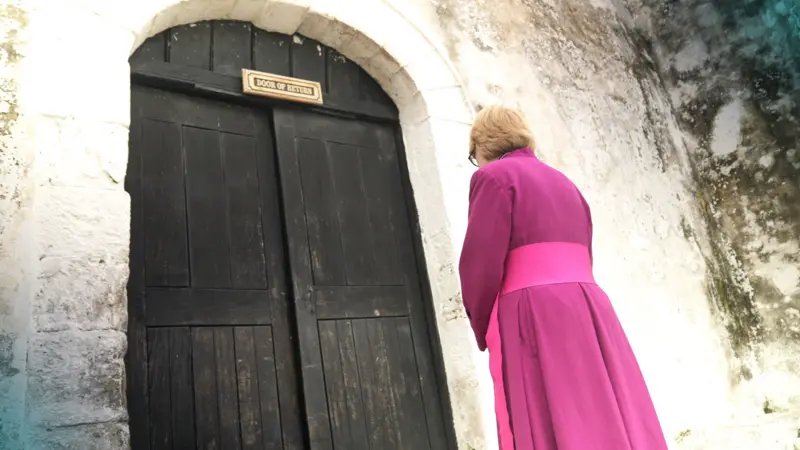
For centuries, the underground dungeons, narrow corridors and the infamous “Door of No Return” have stood as evidence of the human suffering created by the transatlantic slave trade.
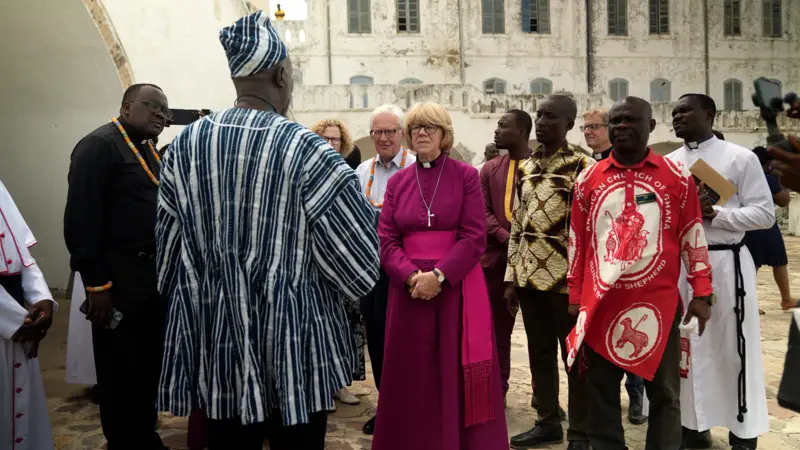
It was at this historic site in Ghana that the Archbishop of Canterbury, Dame Sarah Mullally, confronted Britain’s religious links to slavery and renewed the Church of England’s commitment to a controversial £100 million reparative justice fund.
Standing inside the castle, the spiritual leader of the worldwide Anglican Communion acknowledged the painful role played by the institution she leads.
“We played a part in the transatlantic slave trade. That is clear. Part of the Christian belief in repentance is about action, so we are putting in place action to support those communities that feel the legacy of the slave trade.”
Her admission has reignited a global debate: Can financial investment repair centuries of exploitation, and who should benefit from reparative justice?
A Church confronting its historical links to slavery
The Church of England’s decision to establish a reparative justice programme followed a detailed historical investigation into the links between its financial institutions and slavery.
In 2023, research commissioned by the Church Commissioners — the body managing the Church of England’s investment portfolio — revealed that the Church had historic connections to transatlantic slavery through investments and financial relationships.
The investigation found that a predecessor fund had invested in the South Sea Company, a company involved in Britain’s slave trading activities during the 18th century.
The Church Commissioners acknowledged that the institution benefited from wealth connected to slavery and accepted responsibility for addressing those historical links.
The Church later announced a £100 million commitment to support communities affected by the legacy of enslavement through research, investment and engagement programmes.
According to the Church of England, the initiative is intended to create long-term social and economic impact rather than operate as direct individual compensation.
The institution said the programme would focus on areas including education, economic empowerment, health, heritage preservation and community development.
Why Cape Coast Castle remains central to the debate
Cape Coast Castle is one of Ghana’s most significant historical sites connected to the transatlantic slave trade.
Built by European powers from the 17th century, the castle became a major trading centre where enslaved Africans were held before being transported mainly to the Americas.
Historians estimate that millions of Africans were forcibly transported across the Atlantic between the 16th and 19th centuries under a brutal system that destroyed communities and caused generations of economic and social consequences.
During her visit, Archbishop Mullally described the experience inside the castle as deeply disturbing.
“You can’t help but be deeply moved by the horrific conditions that people were kept in and the way that they were treated.”
She also pointed to the symbolism of the chapel located above the slave dungeons.
The contrast between Christian worship above and human suffering below, she said, demonstrated the complicated history of Christianity’s relationship with slavery.
Ghana’s growing demand for global reparations
The Archbishop’s visit comes at a time when Ghana has intensified calls for reparative justice from countries and institutions that benefited from the transatlantic slave trade.
Ghana has positioned itself as a leading voice in Africa’s global reparations campaign.

In 2023, Ghana hosted the first African Union-backed conference on reparations, bringing together African leaders, historians and advocates to discuss compensation and justice for historical exploitation.
Ghana’s Minister for Foreign Affairs, Samuel Okudzeto Ablakwa, welcomed Archbishop Mullally’s approach and argued that acknowledging historical wrongdoing was an important step.
He said:
“What the Archbishop of Canterbury is doing in Ghana on her current visit will begin to send the right signals.”
Mr Ablakwa also linked the conversation to Christian teachings about accountability and repentance.
“The Christian religion which they brought to Ghana and Africa teaches us that without admission of sins, there can be no salvation.”
The difficult question: Is £100 million enough?
While supporters have praised the Church’s decision, critics argue that the amount does not reflect the scale of historical damage caused by slavery.
The Church’s own oversight group later recommended a much larger ambition, suggesting that the reparative justice programme should eventually expand beyond the initial £100 million commitment.
The debate has also exposed disagreements over what reparations should actually mean.
Supporters argue that reparations are not simply about writing cheques but addressing continuing inequalities linked to colonial exploitation.
Professor Sir Hilary Beckles, a leading Caribbean historian and Vice-Chancellor of the University of the West Indies, has been one of the strongest global voices advocating reparatory justice.
Professor Beckles has argued that slavery created economic advantages for European societies while causing long-term damage to African and Caribbean communities.
He has repeatedly called for a structured reparatory justice framework involving investment, development support and institutional accountability.
The Caribbean Community (CARICOM) Reparatory Justice Commission, which Professor Beckles chairs, has also developed a 10-point reparatory justice plan calling for areas such as debt cancellation, technology transfer, public health support and education investment.
Critics challenge the reparations approach
The Church’s slavery fund has faced opposition from some members of the Anglican community and commentators who question whether modern institutions should financially address actions committed centuries ago.
Critics have raised concerns about historical responsibility, legal liability and whether current generations should pay for decisions made by previous generations.
Some argue that funds should focus on present-day poverty reduction rather than historical reparations.
However, supporters counter that many modern institutions continue to benefit from wealth accumulated during colonial and slavery periods.
They argue that reparative justice is not about individual guilt but institutional responsibility.
Experts: The debate is about history, economics and justice
Economic historians have noted that the financial impact of slavery cannot be separated from the development of modern global economies.
Professor Joseph E. Inikori, a respected historian of Africa’s economic history, has documented how Atlantic slavery affected African societies and contributed to European economic growth.
His research highlights how forced labour systems extracted human and economic resources from Africa while disrupting local development.
Similarly, historian Professor David Olusoga, author of Black and British: A Forgotten History, has argued that Britain’s history of slavery and empire has shaped modern institutions and social structures.
Experts involved in the reparations debate generally agree on one point: the legacy of slavery remains a historical issue with modern consequences.
The disagreement is over the appropriate response.
Beyond apologies: What does meaningful accountability look like?
For Ghana and many African countries, the conversation is not only about financial compensation.
It is also about historical recognition, preservation of cultural heritage, economic partnerships and correcting narratives about Africa’s role in world history.
The descendants of enslaved Africans in the Caribbean, Africa and elsewhere continue to debate what justice should look like.
Some advocate direct payments, while others support investment programmes targeting education, healthcare, entrepreneurship and community development.
The Church of England’s £100 million commitment therefore represents both an opportunity and a test.
The question is whether the programme will create lasting change or become another symbolic gesture without measurable impact.
A historic moment, but the debate continues
As Archbishop Sarah Mullally walked through Cape Coast Castle, she confronted a painful chapter connecting religion, wealth and slavery.
Her words marked a significant acknowledgement from one of Britain’s oldest institutions.
But acknowledgement is only the beginning.
The deeper question now facing governments, churches and corporations connected to slavery’s history is whether recognition will be followed by meaningful action.
For Ghana, the descendants of enslaved Africans and advocates of reparative justice worldwide, the struggle is not only about remembering the past.
It is about deciding what responsibility looks like in the present.
At Cape Coast Castle, the “Door of No Return” has become a symbol of suffering. The challenge for today’s leaders is whether they can help transform that symbol into a doorway towards justice, dignity and reconciliation.