

By Alex Ababio | Ghanaian Watch
KUMASI, Ghana — The Ghana Grid Company Limited (GRIDCo) has set December 2026 as the deadline for completing a fifth electricity feeder in Kumasi, promising additional capacity for households, businesses and industries struggling with intermittent power interruptions.
The project is expected to add about 80 megawatts (MW) to the Kumasi electricity supply network through a new feeder connected to a 145-megavolt-ampere (MVA) transformer at the Ridge Substation.
However, the intervention raises a bigger question for electricity consumers: will additional transmission capacity translate into a more reliable power supply, or will faults within the distribution network continue to leave businesses and households in darkness?
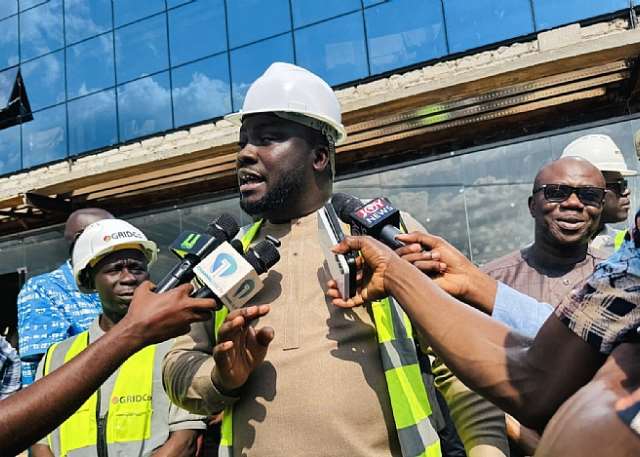
The Chief Executive Officer of GRIDCo, Ing. Frank Asirifi Otchere, announced the December deadline during an inspection of ongoing electricity infrastructure projects involving GRIDCo, the Electricity Company of Ghana (ECG) and Ashanti Regional Minister Dr Frank Amoakohene.
“We are working to add a fifth feeder. This would add to the transformer and increase the capacity to serve demand. And we anticipate that the work would be done by December,” Mr Otchere said.
The announcement comes amid persistent complaints about intermittent power interruptions in Kumasi and other parts of the Ashanti Region, with consumers calling for more dependable electricity and better communication about planned outages.
The Ridge Substation expansion: What the 80MW promise means
At the Ridge Substation, the delegation inspected the installation of a new 145MVA transformer intended to strengthen electricity supply in the metropolis.
The transformer installation has necessitated the construction of a fifth feeder to supplement the four existing feeders supplying ECG.
According to GRIDCo, the additional feeder is expected to contribute approximately 80MW to the Kumasi supply network.
The investment is significant because electricity demand continues to increase as residential communities expand and commercial and industrial activities grow.
For businesses operating refrigeration equipment, manufacturing machinery, cold-storage facilities and other electricity-dependent services, interruptions can mean lost production, damaged goods and additional operating expenses.
However, the promised 80MW should not be confused with a guarantee that every consumer will receive uninterrupted electricity.
A feeder is part of the electricity network that distributes power from a substation towards consumers. Its effectiveness depends on the capacity of the upstream transmission infrastructure, the condition of distribution equipment and the ability of the local network to handle demand.
Consequently, the completion of the fifth feeder must be followed by effective network management and improvements to ECG’s distribution infrastructure.
The €8.7 million transmission project behind Kumasi’s power expansion
The Ridge intervention forms part of wider efforts to strengthen electricity transmission infrastructure in the Ashanti Region.
One major project is the reconstruction of the 161-kilovolt (kV) transmission line connecting the Ahodwo and Anwomaso substations.
In a July 8, 2025 joint press statement, GRIDCo, the European Union (EU) and the French Development Agency (AFD) announced the €8.7 million reconstruction project.
The project involves upgrading an existing 18-kilometre, single-circuit transmission line, with a rated capacity of 364MVA, into a double-circuit 161kV line with an estimated capacity of approximately 1,000MVA.
The investment also includes associated substation expansion and improvements to GRIDCo’s Supervisory Control and Data Acquisition (SCADA) and telecommunications systems.
SCADA technology allows electricity system operators to monitor and control transmission infrastructure remotely. It also helps engineers identify faults and respond more quickly to disruptions.
The official project statement explained that the improvements would strengthen real-time monitoring, improve grid operations and support the integration of additional generation capacity.
The project is also expected to improve operating voltages for more than 400,000 consumers.
At the July 2025 launch, the then Chief Executive of GRIDCo, Ing. Mark Baah, said: “This project has been in GRIDCo’s expansion plans for a long time.”
He added that the investment was part of a wider project supported by AFD to facilitate the evacuation of electricity from the Anwomaso generation hub and support electricity exports to Burkina Faso.
Energy Minister Dr John Abdulai Jinapor also highlighted the importance of the investment.
“The Ashanti Region is a fast-growing hub for generation capacity in Ghana. I am optimistic that once this project completes, power supply reliability for Kumasi will further improve to match demand which has been growing exponentially,” he said.
The EU Ambassador to Ghana, Irchad Razaaly, said the partnership was intended to deliver more reliable and efficient electricity while supporting Ghana’s energy infrastructure and cross-border electricity trade.
These commitments demonstrate that the transmission upgrade is not simply a local maintenance exercise. It is part of a wider investment in Ghana’s electricity transmission network.
Construction progress and the December deadline
During the November 2026 inspection, GRIDCo officials reported that engineers were stringing conductors across 60 transmission towers along the Anwomaso-to-Ahodwo corridor.
Mr Otchere explained that the old towers and conductors had been decommissioned and replaced, leaving conductor stringing as the final phase of the project.
The upgrade is intended to increase the amount of electricity that can be transferred between the substations.
There is, however, an important technical distinction in the figures being discussed.
GRIDCo’s July 2025 project document gives the existing and proposed transmission capacities as 364MVA and approximately 1,000MVA respectively. These are apparent-power ratings, not megawatt measurements.
The distinction matters because MVA and MW measure different electrical quantities. The actual active power delivered in MW depends partly on the system’s power factor and operating conditions.
Therefore, the 1,000MVA transmission rating should not automatically be interpreted as 1,000MW of usable electricity.
Consumers also need clarity on the separate completion schedules for the transmission line and the fifth feeder. GRIDCo’s latest assurance places the feeder’s completion at the end of December, while the transmission upgrade is also being prioritised for completion within the same period.
Ghana’s rising electricity demand puts pressure on infrastructure
The expansion in Kumasi comes as national electricity demand continues to increase.
The Energy Commission’s 2026 Energy Outlook for Ghana, published in February 2026, provides important evidence of the growing pressure on the country’s electricity system.
According to the report, Ghana’s peak electricity demand reached 4,283MW in 2025, representing an 8.4 per cent increase over the 2024 figure.
Total electricity consumption, including losses, reached 27,015 gigawatt-hours (GWh), approximately 9.3 per cent higher than in 2024.
The Commission projects that national peak demand could reach 4,581MW in December 2026 under its base-case scenario.
This represents a further 7 per cent increase over the 2025 peak.
The report also identifies challenges beyond the physical capacity of transmission lines.
It says the dependable generation capacity available to meet peak demand in 2026 is estimated at 5,455MW. However, planned and unplanned power plant outages could reduce the available reserve margin below the recommended 18 per cent planning target during several months.
The Commission projects that the reserve margin will reach only 12 per cent in December under its base-case assessment.
These findings are important because electricity reliability depends on more than the installation of transformers, conductors and transmission towers.
The country must also maintain sufficient generation capacity, secure fuel supplies and coordinate maintenance across the electricity system.
The Energy Commission further reports that Ghana’s electricity generation in 2025 depended heavily on thermal power, which accounted for 66.8 per cent of generation. Hydropower contributed 32.4 per cent, while other renewables accounted for approximately 0.8 per cent.
The figures underline the wider operational and financial pressures facing the electricity sector.
The distribution problem GRIDCo cannot solve alone
Although GRIDCo is responsible for electricity transmission, ECG operates the distribution network that delivers electricity to homes and businesses.
This distinction is central to understanding why additional transmission capacity may not immediately end power interruptions.
ECG’s own 2024 Energy Accounting System Report provides evidence of continuing weaknesses in the distribution system.
The report recorded cumulative system losses of 27.05 per cent across ECG’s national operational areas.
These losses include technical and non-technical losses associated with distribution infrastructure, electricity theft, metering errors and billing errors.
The report also disclosed that ECG had not completed the separation of its Ashanti East, Ashanti West and Ashanti South operational regions for the energy accounting exercise.
Consequently, the report presented Ashanti as one combined operational area rather than providing separate figures for the three regions.
It further identified faulty or offline boundary meters, inconsistent data and delays in automating the energy accounting system as operational challenges.
These disclosures are important because they show that improving electricity reliability requires more than increasing the amount of power transmitted into Kumasi.
The distribution network must also be strengthened, monitored and maintained.
The 27.05 per cent figure must not, however, be interpreted as the percentage of electricity lost specifically in Kumasi. It is ECG’s national cumulative figure for 2024.
ECG warns that outages will not disappear immediately
ECG’s Director of Operations, Ebenezer Ghunney, has cautioned consumers against expecting the new transformer to eliminate all power interruptions.
He explained that although the installation would significantly improve electricity supply, faults could still occur elsewhere within the distribution network.
This warning highlights the need for coordinated investment by both electricity companies.
A stronger transmission system may improve the availability of electricity at substations, but damaged distribution transformers, faulty cables, overloaded local networks and other technical problems can still interrupt supply.
Officials have also indicated that ongoing infrastructure works could cause intermittent and localised power interruptions over approximately one month.
The temporary disruptions are being presented as necessary to complete the improvements.
Public communication and accountability
Ashanti Regional Minister Dr Frank Amoakohene has promised better communication to help consumers prepare for planned electricity interruptions.
He said a joint team involving GRIDCo, ECG, the Ashanti Regional Coordinating Council and the Information Services Department was being established to provide real-time updates.
The proposed arrangement could help households, businesses and public institutions plan around scheduled interruptions.
However, its effectiveness will depend on whether information reaches affected communities before outages occur.
Consumers need clear information about affected locations, dates, expected restoration times and changes to announced schedules.
GRIDCo and ECG must also provide regular progress updates on the projects and explain any delays.
The real test begins after completion
Kumasi’s electricity infrastructure expansion represents an important investment in the region’s economic future.
The fifth feeder, the new Ridge transformer and the Anwomaso-Ahodwo transmission upgrade could improve the capacity and reliability of electricity supply.
But the December deadline must be measured against actual results.
GRIDCo needs to demonstrate that the projects have been completed and commissioned, while ECG must show that improvements at the transmission level are translating into better distribution services.
The key indicators should include fewer unplanned outages, improved voltage stability, shorter restoration times and reliable electricity for businesses and households.
The Energy Commission’s demand projections suggest that pressure on the national electricity system will continue to increase.
For Kumasi, therefore, the challenge is not simply to add another feeder. It is to build an electricity network capable of supporting a growing commercial and industrial city without leaving consumers uncertain about when their next power interruption will occur.
December 2026 will provide the first major test of whether the promises made by GRIDCo can translate into a measurable improvement in electricity reliability across Kumasi and the wider Ashanti Region.