

By Alex Ababio
President John Dramani Mahama has renewed assurances that Ghana’s stalled $150 million West Africa Coastal Areas Management Programme (WACA) will resume, promising relief to thousands of residents facing relentless tidal waves along the Volta Region’s fragile coastline. But beneath the pledge lies a deeper story—one of funding bottlenecks, climate vulnerability, and mounting pressure on government to deliver long-delayed protection.
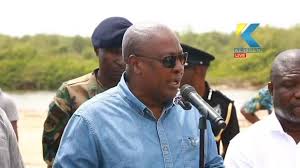
During a visit on April 29, 2026, to hard-hit coastal communities including Fuveme in the Ketu South Municipality, Mahama responded to growing public frustration over delays in the implementation of the West Africa Coastal Areas Management Programme, a flagship intervention backed by the World Bank.
“We protected the $150 million that is meant for the West Africa Coastal Areas Management Programme (WACA) project. So your money is safe and the project is going to go on,” Mahama told residents.
“Some of the other World Bank projects stalled and the money is being repurposed for other important priorities and so I just want to ask for your cooperation as we continue the processes to do the work.”
A Coastline Under Siege
For over a decade, communities stretching from Keta to Aflao have endured worsening coastal erosion and tidal flooding. Entire settlements have been partially submerged, with homes, schools, and fishing infrastructure washed away.
According to Ghana’s Ministry of Works and Housing, parts of the eastern coastline lose several meters of land annually. This aligns with broader findings from the World Bank and the United Nations Environment Programme, which warn that West Africa’s coastline is among the most rapidly eroding in the world, with economic losses estimated at billions of dollars each year.
In Ketu South alone, local authorities have repeatedly declared humanitarian concerns as tidal waves displace families, forcing emergency relocations.
Residents in Fuveme and neighboring communities say the situation has worsened in recent years, driven by rising sea levels linked to climate change.
The WACA Promise—and Delays
The WACA programme, launched with support from the World Bank, is designed to help West African countries—including Ghana, Togo, Benin, and Côte d’Ivoire—strengthen coastal resilience through infrastructure, ecosystem restoration, and policy reforms.
Ghana’s $150 million allocation was expected to fund:
Coastal defense structures (revetments, sea walls)
Mangrove restoration
Community resettlement and livelihood support
Early warning systems
However, implementation has been slow and uneven.
Public documents from the World Bank indicate that while Ghana has made progress in project preparation and environmental assessments, execution delays have been linked to procurement processes, land acquisition challenges, and administrative transitions.
Mahama’s latest statement confirms what insiders have long suggested: some World Bank-funded projects in Ghana have faced restructuring, raising concerns among coastal residents that WACA funds could be diverted.
His reassurance that the $150 million remains intact appears aimed at calming fears of reallocation.
Climate Pressure Meets Governance Gaps
Experts say the urgency of the WACA project cannot be overstated.
The Intergovernmental Panel on Climate Change has consistently warned that low-lying coastal zones in Africa are at high risk of sea-level rise, storm surges, and saltwater intrusion, with vulnerable populations bearing the brunt.
In Ghana, coastal zones contribute significantly to:
Fisheries and food security
Tourism revenue
Cross-border trade
Yet, coastal protection infrastructure has lagged behind the pace of environmental change.
A 2023 World Bank report on coastal resilience in West Africa notes that without urgent intervention, erosion could cost Ghana up to 5% of GDP in affected regions by 2050 due to property loss, infrastructure damage, and displacement.
Human Impact: “We Are Losing Everything”
Beyond statistics, the crisis is deeply personal.
Residents in affected communities describe a cycle of rebuilding and destruction.
Fishing families—who depend on proximity to the sea—are particularly vulnerable. Each tidal surge not only damages homes but also destroys nets, boats, and storage facilities.
Local leaders have repeatedly appealed for government action, warning that delays in projects like WACA are exacerbating poverty and forcing migration.
In some areas, informal relocation efforts have begun, but without structured support, these moves often lack access to basic services.
Government Balancing Act
Mahama’s comments also hint at broader fiscal pressures.
Ghana has in recent years undergone economic restructuring, including engagement with international financial institutions to stabilize public finances. This has affected the rollout of several infrastructure projects.
His acknowledgment that “other World Bank projects stalled” reflects a wider challenge: balancing limited resources across competing national priorities such as:
Debt restructuring
Energy sector financing
Social protection programs
Still, the president’s commitment to resume WACA suggests the project remains politically and economically significant.
Regional Implications
The stakes extend beyond Ghana.
The WACA programme is a regional initiative, and delays in one country can affect cross-border coastal management strategies.
West Africa’s coastline is interconnected—erosion patterns in Ghana can influence neighboring Togo and Benin due to sediment flow disruptions.
This makes coordinated implementation critical.
The World Bank has emphasized that integrated coastal zone management is essential to prevent “downstream” environmental consequences, where protective measures in one country inadvertently worsen erosion elsewhere.
What Happens Next?
Mahama’s pledge signals a potential restart—but key questions remain:
When will construction resume?
Which communities will be prioritized?
How will transparency and accountability be ensured?
Procurement timelines, contractor selection, and environmental compliance processes will determine how quickly the project moves from promise to reality.
Civil society groups in Ghana have increasingly called for greater transparency in large-scale infrastructure projects, particularly those funded by international partners.
Accountability and Oversight
For journalists and watchdog organizations, WACA represents a critical test case for accountability journalism in climate adaptation projects.
Tracking:
Fund disbursement
Contract awards
Project milestones
Community engagement
will be essential to ensure the $150 million delivers tangible impact.
Given the scale of investment, even minor inefficiencies could translate into significant losses.
A Defining Moment for Coastal Protection
Mahama’s assurance has provided temporary relief to anxious communities, but expectations are high.
The continuation of the WACA project is not just about infrastructure—it is about:
Protecting livelihoods
Preventing displacement
Safeguarding economic stability
As climate threats intensify, the cost of inaction continues to rise.
For residents of Fuveme, Keta, and surrounding coastal towns, the message is clear: the sea is advancing, and time is running out.
Whether the promised $150 million translates into durable protection—or becomes another delayed intervention—will define Ghana’s response to one of its most pressing environmental challenges.