

By Alex Ababio — Investigative Special Report
When videos began circulating across social media platforms suggesting that newly deployed tricycles under Ghana’s Free Primary Healthcare (FPHC) initiative were being used as ambulances, the backlash was swift—and politically charged.
Within hours, both the Ghana Health Service and President John Dramani Mahama were compelled to issue clarifications.
But beyond the viral misinformation lies a deeper, more consequential story: how Ghana is attempting to fix one of its most persistent public health challenges—reaching millions in underserved communities—and whether the current approach is enough.
The Viral Claim vs. Official Reality
In a press release dated April 18, 2026, the Ghana Health Service (GHS) firmly rejected claims that the tricycles were intended as emergency ambulances.
“These FPHC tricycles are not ambulances and have not been procured to be used as such. It needs to be emphasised that for some years now, the Service has a record of successfully deploying such tricycles for outreach services,” the statement, signed by Director-General Dr. Samuel Kaba Akoriyea, read.
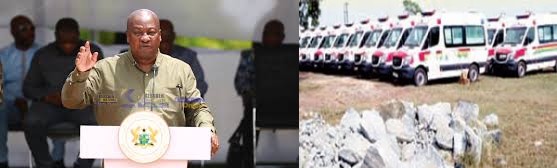
At a sod-cutting ceremony the same day, President Mahama reinforced the message:
“There are more than 6,000 CHPS compounds in Ghana. Among the equipment we presented were motorcycles and tricycles. Let me be clear, those tricycles are not ambulances.”
Instead, the vehicles are designed to support preventive healthcare delivery, enabling health workers to move between communities for immunisation, screening, and education.
The Bigger Context: Ghana’s CHPS System Under Pressure
Ghana’s Community-based Health Planning and Services (CHPS) programme—widely recognised by institutions such as the World Health Organization as a model for community health delivery—has long struggled with logistics and mobility constraints.
With over 6,000 CHPS compounds nationwide, many located in remote or hard-to-reach areas, health workers often travel long distances on foot or rely on unreliable transport.
According to WHO reports on primary healthcare systems in sub-Saharan Africa, transport limitations remain one of the leading barriers to effective last-mile service delivery, particularly for vaccination campaigns and maternal health services.
That is the gap the FPHC tricycles are meant to fill.
What the Tricycles Are Actually Designed to Do
President Mahama explained that the tricycles are not emergency vehicles but mobile service units:
“They are vehicles for the health workers… to go to the village, deliver vaccinations and also do health screening.”
Each tricycle is equipped with compartments designed to carry:
Vaccines (with cold-chain support)
Diagnostic tools
Health education materials
“And so at the back of the tricycle they have a compartment where they can keep vaccines… to keep the vaccines cool,” the President added.
The Ghana Health Service further clarified that these vehicles are part of a “strategic intervention designed to enhance last-mile service delivery”, particularly in rural and peri-urban areas.
Why the Confusion Matters
At first glance, the misunderstanding may seem trivial. But public health experts say it reflects a deeper communication gap—and rising public expectations.
Dr. Anthony Nsiah-Asare has previously emphasised in public discussions reported by Ghanaian media that emergency response infrastructure remains a critical gap in Ghana’s healthcare system, despite improvements in primary care access.
Similarly, data from the Ghana National Ambulance Service has consistently shown that ambulance coverage remains limited relative to population needs, especially in rural districts.
This explains why many Ghanaians, upon seeing the tricycles, assumed they were being introduced as a low-cost substitute for ambulances.
Expert Insight: Preventive Care vs Emergency Response
Global health policy experts have long drawn a clear distinction between preventive primary care systems and emergency medical services.
According to the World Bank, investments in primary healthcare—such as outreach services, immunisation, and early disease detection—are among the most cost-effective interventions for improving population health outcomes.
However, the same reports caution that primary healthcare cannot replace emergency response systems, which require specialised infrastructure, trained personnel, and advanced equipment.
In Ghana’s case, the FPHC tricycles fall squarely within the preventive care category.
Regional Adaptation: One Size Does Not Fit All
President Mahama highlighted that the rollout strategy is tailored to regional realities:
“So in the southern parts, where the health workers cannot ride motorcycles, they’ll be given tricycles to go from village to village to do their work.”
Motorcycles are being deployed in northern Ghana, where terrain and user familiarity make them more practical.
The Ghana Health Service also noted that tricycles offer:
Greater stability on rough roads
Safer operation in adverse weather
Increased accessibility for female health workers
This aligns with broader global health recommendations on gender-sensitive healthcare delivery systems, particularly in rural settings.
The Economic Logic Behind the Initiative
From a cost perspective, the decision to deploy tricycles instead of expanding ambulance fleets is significant.
Health financing experts often point out that ambulances are capital-intensive, requiring:
High procurement costs
Maintenance infrastructure
Skilled paramedics
By contrast, tricycles represent a lower-cost, scalable solution for preventive outreach.
According to development financing frameworks promoted by institutions like the World Bank, such investments are crucial for countries aiming to achieve universal health coverage (UHC) without overburdening public budgets.
Programme Rollout: What We Know So Far
The Free Primary Healthcare initiative, launched in April 2026, is expected to begin in 150 districts in its first phase.
The Ghana Health Service says the programme is designed to:
Expand access to preventive care
Improve vaccination coverage
Strengthen early detection of diseases such as hypertension and diabetes
This aligns with Ghana’s broader commitments under global health frameworks, including UHC targets.
The Unanswered Questions
Despite the clarifications, several critical questions remain:
1. Where is the Emergency System Upgrade?
While tricycles improve outreach, they do not address emergency response gaps.
2. Sustainability and Maintenance
How will the government ensure:
Regular maintenance
Fuel supply
Replacement cycles
3. Data and Impact Measurement
Will the Ghana Health Service publish:
Coverage improvements
Health outcome data
Cost-effectiveness analysis
Public Trust and the Cost of Misinformation
The Ghana Health Service has urged the public to disregard misleading claims.
But the incident highlights a broader issue: the speed at which misinformation can shape public perception of national programmes.
In an era where social media often outpaces official communication, even well-intentioned initiatives can face backlash if messaging is not clear and proactive.
A Strategic Shift—But Not a Complete Solution
There is little doubt that the FPHC tricycles represent a strategic intervention in Ghana’s healthcare system.
They directly address:
Mobility challenges
Last-mile service delivery
Preventive healthcare access
However, they also expose the limits of current reforms.
As Ghana continues to balance cost, access, and quality, the success of the initiative will depend not just on deployment—but on integration with broader health system investments, particularly in emergency care.
Final Word
President Mahama’s statement may have settled the immediate controversy:
“Let me be clear, those tricycles are not ambulances.”
But the larger conversation is far from over.
Because for many Ghanaians—especially those in remote communities—the real question is not what the tricycles are.
It is whether they are enough.