

By Alex Ababio
Environment Editor, Ghanaian Watch
April 27, 2026
For three generations, Kofi Annan, a 54-year-old fisherman from Princess Town in Ghana’s Western Region, has watched the Atlantic Ocean from his canoe. He has seen the water change. He has seen the catch shrink. And he has seen the lights.
“At night, we see them far out,” Annan told Ghanaian Watch in February 2025 during an investigation into illegal fishing along the Western Region coastline. “The oil boats come, and then the trawlers come after them. No one stops anyone. They use lights to attract the small fish. They take everything.”
Annan’s testimony reflects a crisis that has been quietly unfolding in Ghana’s waters for years. Chinese-owned industrial trawlers, operating with impunity, are systematically depleting Ghana’s fish stocks through illegal fishing practices including light fishing and the use of undersized nets. The result has been devastating for the 100,000-plus artisanal fishermen who depend on the ocean for their survival.
The scale of the problem is staggering. The Environmental Justice Foundation estimates that as much as 60 percent of fish caught by trawlers in Ghanaian waters are undersized pelagic fish, which are easier to catch than deep-water species. These juvenile fish, known locally as “logo,” are either discarded at sea or frozen into blocks and sold back to coastal communities.
The practice targets small pelagic species including sardinella and chub mackerel. According to the Food and Agriculture Organization, these key stocks have declined by 73 percent over the past two decades.
Environmental Justice Foundation chief executive officer and founder Steve Trent described the practice as “systematic extraction” that is “accelerating the collapse of Ghana’s small pelagic fishery.” Writing in Oceanographic Magazine on February 9, 2026, Trent added that this crisis is “undermining artisanal livelihoods, raising local fish prices and deepening inequality across coastal communities.”
The Economics of Extinction
The financial impact on Ghana’s coastal communities has been catastrophic. The Environmental Justice Foundation reports that the average annual income of Ghana’s artisanal fishermen has dropped by as much as 40 percent per canoe over the past 15 years. The country loses more than $50 million annually to illegal, unreported, and unregulated fishing, according to the foundation’s estimates.
A new study published in the journal Nature has cast even sharper light on the problem. Researchers from the University of Wisconsin-Madison and Duke University, working with the nongovernmental organization Global Fishing Watch, used machine learning and satellite imagery to track industrial fishing vessels worldwide. Their findings are alarming: more than 75 percent of the world’s industrial fishing vessels are not publicly tracked, operating as so-called “dark fleets” that turn off their Automatic Identification System transmitters.
Dr. David Kroodsma, director of research and innovation at Global Fishing Watch and co-lead author of the study, said these dark vessels present significant obstacles to marine conservation efforts. “Although not all boats are obligated by law to transmit their position, the presence of vessels not participating in public monitoring systems, commonly referred to as ‘dark fleets,’ presents obstacles to the conservation and management of natural resources,” he said.
For African countries, the cost of this illegal activity is immense. The study estimated that IUU fishing costs African nations up to $11.49 billion annually, with dark vessel activity concentrated primarily in African and South Asian waters.
The Chinese Connection
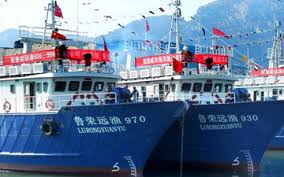
According to the Environmental Justice Foundation, approximately 90 percent of Ghana’s industrial trawling fleet is owned by Chinese corporations using local “front” companies to register as Ghanaian and circumvent the law. The foundation interviewed 58 trawler crew members and 87 fishers, processors, and sellers for its investigation. It found that 70 percent of interviewed crew members admitted to fishing with modified nets intended to prevent the escape of small pelagic fish and maximize bycatch.
China operates the world’s largest distant-water fishing fleet and ranks as the worst illegal fishing offender globally, according to the IUU Fishing Risk Index. Eight of the world’s top 10 companies engaged in illegal fishing are Chinese-owned.
Chinese fishing ships notoriously engage in bottom trawling, dragging huge nets along the ocean floor and indiscriminately scooping up all manner of marine life. The practice kills juvenile fish, leading to declining fish stocks, and destroys ecosystems critical to the survival of marine species.
Ghana’s fisheries regulations authorize a bycatch allowance of only 15 percent. However, the Environmental Justice Foundation estimates that between 53 percent and 60.5 percent of all fish landed by trawlers in Ghanaian waters are bycatch.
Government Response: Promises and Gaps
In response to mounting pressure, Ghanaian President John Mahama signed the Fisheries and Aquaculture Act on November 21, 2025. The law expanded the Inshore Exclusive Zone, the waters reserved for artisanal fishers, from 6 nautical miles to 12 nautical miles.
“This area will serve as a sanctuary for rebuilding fish stocks, protecting biodiversity and ensuring a long-term ecological balance of our ocean,” President Mahama said in a speech in Accra. He added that the country’s National Blue Economy Strategy would be “built on six key pillars: Blue wealth, blue health, blue knowledge, blue finance, blue equity and blue safety and security.”
Speaking at the launch of the “Save Our Sea” campaign in Kumasi on March 4, 2026, the Acting Executive Director of the Fisheries Commission, Professor Kwadwo Berchie Asiedu, underscored the urgency of Ghana’s marine protection agenda.
“We are starting this one by implementing the first Marine Protected Area. The declaration is going to happen this year, maybe this month. The MPA has so many benefits. It’s for the fish to lay their eggs and also for the fish to rest. In that sense it would increase our catch per unit effort,” he explained.
Professor Asiedu, who also serves on the National Blue Economy Strategy Technical Committee, revealed that the Ministry of Fisheries and Aquaculture was drafting legislative instruments under the Fisheries and Aquaculture Act 2025, Act 1146. “These will introduce stiffer penalties for marine habitat destruction and grant the Commission greater autonomy in enforcing conservation mandates,” he said.
On April 14, 2026, Vice President Prof. Naana Jane Opoku-Agyemang officially declared Ghana’s first Marine Protected Area at Greater Cape Three Points, covering 703 square kilometers and 21 coastal communities from Ampatano to Domunli.
However, enforcement remains a significant concern. On April 24, 2026, Minister for Fisheries and Aquaculture Emelia Arthur launched a new multi-stakeholder initiative called the IEZ Enforcement and Transparency Policies Implementation Project. The three-year project, implemented by the Ghana Fisheries Alliance in partnership with Hen Mpoano and the Environmental Justice Foundation, aims to strengthen enforcement of the Inshore Exclusive Zone and improve monitoring systems.
Speaking at the stakeholder engagement in Accra, Minister Arthur described the initiative as a significant milestone in Ghana’s reform agenda. “Sustainable resource governance requires implementation, not just policy direction,” she said. “Effective enforcement outcomes require sustained collaboration.”
Community Voices: The Human Cost
For the fishers of Ghana’s Western Region, these policy announcements come too late.
Emmanuel Arthur, secretary to the chief fisherman in the coastal town of Apam, told the Environmental Justice Foundation that if the new law is implemented effectively, it will give marine ecosystems and communities like his a chance to rebuild.
“Everyone remain calm and go back to the olden ways of fishing practices our forefathers used … what they used to feed their kids, so that we can all support the ban on saiko,” he said. “The community can lead normal lives without saiko. They can go about their normal fishing practices without any issues or problems.”
But trust is fragile. Many fishers have heard promises before.
In Dixcove, a 47-year-old canoe owner who asked not to be named for fear of retaliation from fisheries enforcement officers, described watching industrial trawlers operate inside the 12-nautical-mile exclusion zone. “We call the Fisheries Commission. Sometimes they answer. Sometimes they do nothing. The trawlers come back the next night.”
Professor Asiedu acknowledged the enforcement gaps. “Beyond enforcement, the Ministry of Fisheries and Aquaculture is spearheading mangrove restoration projects across lagoons, recognising them as vital carbon sinks and nurseries for fish,” he told the Ghanaian Times. Innovative financing mechanisms such as blue bonds and debt-for-nature swaps are also being explored.
The Role of Media
The Save Our Sea campaign, organized by the Ghana Agricultural and Rural Development Journalists Association in partnership with the Earth Journalism Network, has trained journalists on effective coverage of marine issues.
Charles Smith, Ghana Country Coordinator for the Earth Journalism Network, emphasized the media’s role. “This project is to support journalists through training and grants so they can report on efforts being undertaken across Ghana, Mexico, and the Philippines,” he said.
Richmond Frimpong, President of GARDJA, noted that over three million Ghanaians depend on fisheries for their livelihoods. “Informed journalism will be instrumental in shaping public understanding and mobilizing community support as Ghana works toward conserving 30 percent of its marine resources by 2030,” he said.
Conclusion: A Choice Between Abundance and Empty Nets
Ghana stands at a crossroads. The declaration of the Cape Three Points Marine Protected Area represents a historic commitment. But without aggressive enforcement against Chinese-owned trawlers operating illegally, without investment in satellite monitoring to track dark vessels, and without genuine consultation with coastal communities, the MPA risks becoming what fishers fear most: a paper ocean.
As the Vice President said at the Busua declaration ceremony, “Protecting our marine environment is not a choice between fish or no fish; it is a choice between a legacy of abundance or a legacy of empty nets.”
For Kofi Annan of Princess Town, who still rises before dawn each day to push his canoe into the Atlantic, that choice has already been made by forces beyond his control. “I have three children,” he said. “They will not fish. There will be nothing left for them.”