

By Alex Ababio
Kumasi is at a critical point in its urban development. The city remains one of Ghana’s most important commercial, educational and cultural centres, but its growth is increasingly exposing weaknesses in transportation, sanitation, public infrastructure, urban planning and technology.
Against this backdrop, Kumasi Metropolitan Assembly (KMA) Mayor Richard Kwasi Ofori Boadi Agyemang is calling for a stronger institutional partnership with the Kwame Nkrumah University of Science and Technology (KNUST)—an alliance that could determine whether research generated in Kumasi’s premier university is translated into practical solutions for the city.
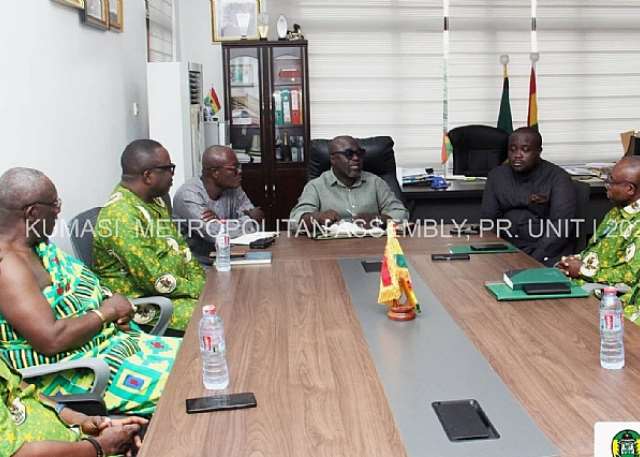
The Mayor made the call when he received a KNUST delegation led by Vice-Chancellor Professor Christian Agyare at the Assembly.
He identified waste management, traffic congestion, street lighting, landscaping and technological gaps as areas where closer cooperation between academia and local government could produce practical and lasting interventions.
The proposal comes at a particularly significant moment for KNUST. Professor Agyare formally began his four-year tenure as the university’s 13th Vice-Chancellor on August 1, 2026, succeeding Professor Rita Akosua Dickson. KNUST’s Governing Council appointed him in May after a formal search process.
That timing gives the proposed KMA-KNUST relationship a potentially broader significance: it is not simply a courtesy partnership between two institutions located in the same city, but an opportunity to connect scientific research, urban governance, infrastructure investment and economic development.
The problem Kumasi cannot research away
The Mayor’s priorities reflect problems that residents encounter every day.
Kumasi’s 2021 population was 443,981, according to research drawing on Ghana’s 2021 Population and Housing Census. The wider urban area, however, extends beyond KMA’s administrative boundaries, meaning transportation, waste, land-use and infrastructure problems increasingly cross municipal boundaries.
This is one reason why an institutional partnership must go beyond occasional meetings.
Kumasi already has a substantial research base capable of informing urban policy. KNUST’s Regional Transport Research and Education Centre Kumasi (TRECK), for example, has an explicit research programme on intelligent traffic management systems in smart cities, sustainable transport technologies and improved accessibility.
The centre’s research agenda includes intelligent traffic management, sustainable transport infrastructure, public transport, logistics and urban governance.
Professor Charles Anum Adams, an Associate Professor of Transportation Engineering at KNUST and Director of TRECK, specialises in traffic planning and management, road safety, traffic modelling and simulation.
His area of expertise illustrates what KMA could gain from a deeper relationship with the university: rather than relying exclusively on conventional traffic interventions, the Assembly can potentially use traffic modelling, data and intelligent transport systems to identify where congestion originates and which interventions offer the greatest economic return.
KNUST research has already examined intelligent traffic management specifically for Kumasi. A 2018 KNUST thesis argued that increasing urban traffic congestion requires innovative control strategies to improve vehicle movement.
The university’s Department of Planning also has a research cluster dedicated to Sustainable Transport and Future Urban Spaces, covering urban mobility, land-use planning, transport infrastructure, road safety, intelligent transport systems and public transport.
The expertise therefore exists. The unresolved question is whether KMA and KNUST can create the institutional machinery to deploy it.
Waste: an old Kumasi problem requiring new economics
Waste management is another area where research and municipal action could be brought together.
A KNUST study of urban waste management in Kumasi found that inadequate refuse collection facilities affected middle- and low-income communities and that the distance residents had to travel to disposal points influenced disposal behaviour.
Although the study dates back to 2001, its underlying lesson remains relevant: waste management is not simply about collecting rubbish after it has accumulated. It involves infrastructure, household behaviour, logistics, land-use planning, financing and enforcement.
That means a modern KMA-KNUST partnership could potentially examine the economics of waste collection routes, transfer stations, recycling, organic-waste processing, private-sector participation and data-driven monitoring.
The commercial implications are considerable.
A cleaner city can reduce environmental and public-health risks while improving the attractiveness of commercial districts, residential neighbourhoods and investment locations. For businesses, inefficient waste systems create additional operating costs; for property owners, poor sanitation can undermine neighbourhood value; and for local government, weak collection systems can increase pressure on already limited public resources.
KMA’s recent enforcement actions show the scale of the urban-management challenge. In July 2026, the Assembly cleared approximately 500 unauthorised wooden structures at the Bayakasua settlement behind the COCOBOD building, working with security agencies and utility companies. Modern Ghana reported that ECG retrieved about 100 illegally connected meters during the operation.
Such interventions demonstrate that sanitation, planning, public safety, utilities and land management are interconnected—not separate policy problems.
Streetlights and the economics of urban safety
Street lighting, another issue raised by the Mayor, is similarly more than an aesthetic concern.
A February 2025 analysis by journalist Kofi Adu Domfeh documented serious street-lighting deficiencies along sections of central Kumasi, describing stretches around the KMA, Rain Tree Street, the Ashanti Regional Coordinating Council and parts of Adum, Danyame and Ahodwo as poorly lit at night.
For an expanding commercial city, inadequate lighting can affect pedestrian safety, nighttime commerce, public transport and perceptions of security.
A KMA-KNUST research programme could therefore assess lighting through a broader smart-city infrastructure framework—mapping dark spots, evaluating energy-efficient lighting options, assessing maintenance costs and identifying locations where improved lighting could produce the greatest public-safety and economic benefits.
Roads alone will not solve congestion
The Mayor’s emphasis on traffic is equally significant.
In June 2026, KMA began clearing unauthorised structures along the Santasi Roundabout–Asokwa Interchange corridor ahead of a planned road expansion intended to improve traffic flow and reduce travel times.
But KNUST’s research agenda suggests that Kumasi’s congestion problem requires more than widening roads.
The university’s transport researchers focus on the interaction between transport systems, land use, public transport and urban development.
That distinction matters. If new road capacity encourages further development without complementary public transport and land-use planning, congestion can eventually return.
The proposed partnership could therefore develop a Kumasi Urban Mobility Observatory using traffic counts, GPS data, accident records, public transport information and land-use data to guide investment decisions.
From partnership to measurable performance
Professor Christian Agyare welcomed the Mayor’s proposal and reaffirmed KNUST’s readiness to collaborate with KMA. But he also called for the partnership to be formally structured, with clear responsibilities and sustained impact.
That may be the most important part of the proposal.
Ghana has no shortage of committees, memoranda and stakeholder meetings. The real test is whether an institutional arrangement produces measurable results.
KNUST’s new Vice-Chancellor has publicly outlined a leadership vision centred on science, technology, research, innovation, sustainability, entrepreneurship and strategic partnerships. The university says his leadership philosophy includes adaptive governance and technology-driven transformation.
That vision aligns closely with the Mayor’s call to channel research toward Kumasi’s practical problems.
The two institutions could begin with a small number of measurable projects: a citywide traffic-data platform; a waste-management optimisation pilot; a smart street-lighting audit; urban landscaping standards; and digital mapping of infrastructure and development risks.
Each project could have a defined budget, responsible institution, implementation timetable and public performance indicators.
The investor question
The Mayor also urged KMA and KNUST to leverage the global standing of Otumfuo Osei Tutu II, the Asantehene, to attract investors and explore new opportunities for the Garden City.
This is potentially important because investment follows more than political announcements. Investors need reliable infrastructure, predictable planning systems, access to information, efficient transport, security and a credible pipeline of projects.
Kumasi has already seen attempts to connect research with infrastructure policy. In March 2026, the Asenso-Boakye Infrastructure Research Hub was commissioned at KNUST’s Department of Planning. The hub is designed to focus on transport, housing, water and sanitation, energy infrastructure, digital connectivity and climate-resilient development planning.
Mayor Agyemang Boadi himself attended that event and argued for stronger links between research and national development.
The emerging question, therefore, is whether the KMA-KNUST proposal can move from speeches to an investment-grade urban development model.
The real test begins now
The meeting signals a renewed commitment by KMA and KNUST to align research, innovation and local governance with Kumasi’s development needs.
But the success of the initiative should ultimately be judged by outcomes residents can see.
Can traffic delays be reduced? Can waste collection become more reliable? Can dark streets be identified and fixed systematically? Can urban landscaping survive beyond ceremonial planting? Can digital technologies improve municipal services? Can research reduce infrastructure costs and attract responsible private investment?
These are the questions that will determine whether the partnership becomes another institutional agreement or a genuine transformation programme.
Kumasi does not lack expertise. It has KNUST, a major research university; an expanding private sector; a powerful traditional institution; a metropolitan government; and a large population driving one of Ghana’s most important regional economies.
What has often been missing is the mechanism for bringing those assets together.
The Mayor’s proposal therefore presents an opportunity—but also a test.
As Professor Agyare takes charge of KNUST, the university and KMA have a chance to build something more ambitious than a conventional memorandum of understanding: a research-to-policy-to-investment pipeline capable of turning Kumasi’s urban problems into measurable development projects.
For the Garden City, that could be the difference between managing congestion, waste and infrastructure problems year after year—and actually redesigning the systems that produce them.