By Alex Ababio
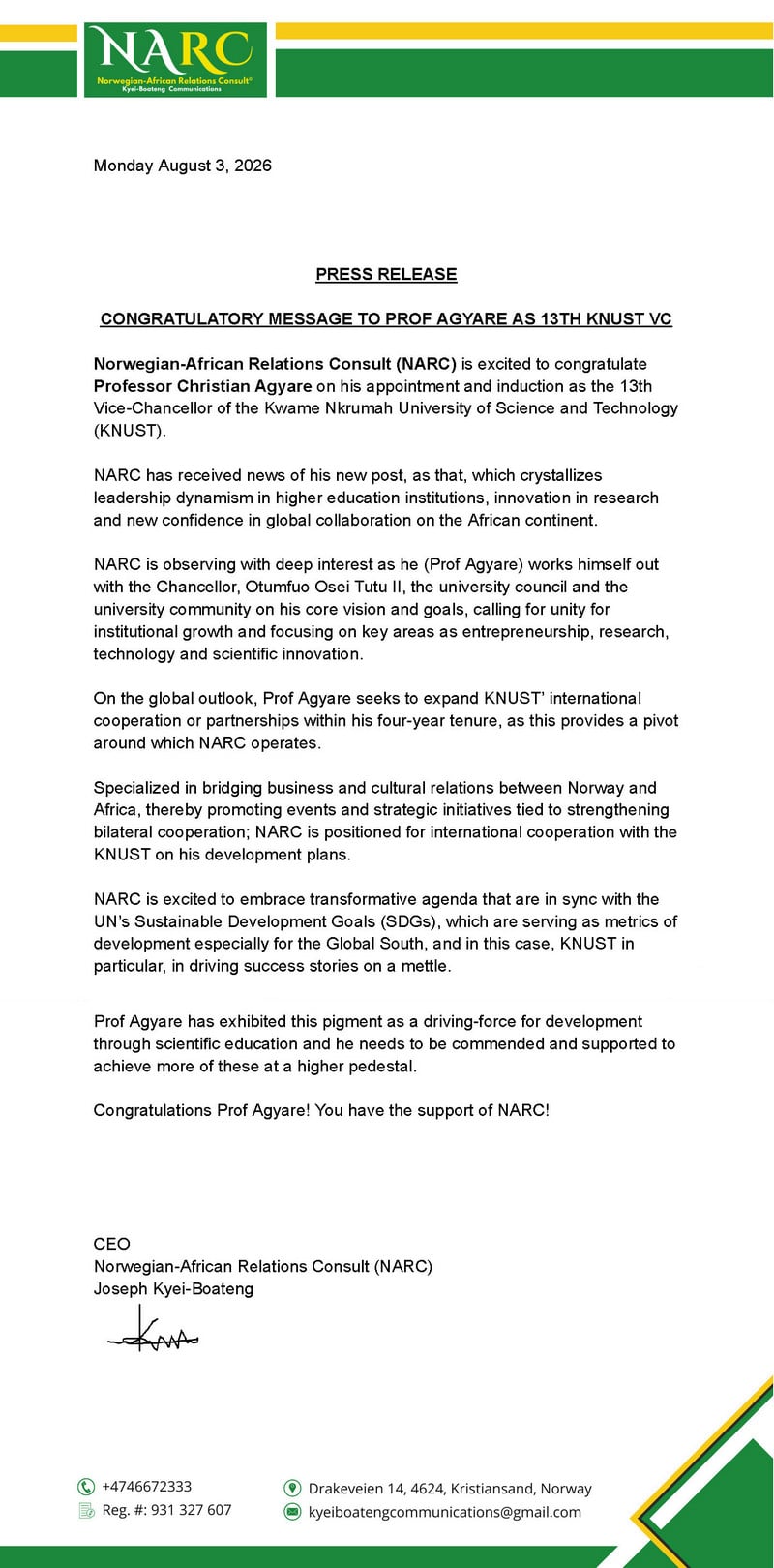
The appointment of Professor Christian Agyare as the 13th Vice-Chancellor of the Kwame Nkrumah University of Science and Technology (KNUST) has attracted congratulations from academic institutions, professional bodies and development partners, with the latest endorsement coming from the Norwegian-African Relations Consult (NARC), which says it is ready to deepen international cooperation with the university.
The endorsement comes at a time when African universities are under increasing pressure to strengthen research excellence, commercialise innovation, attract international funding and produce graduates capable of competing in a rapidly evolving global economy.
Professor Agyare officially succeeds Professor Rita Akosua Dickson, whose four-year tenure ends on July 31, 2026. His appointment was approved by the KNUST Governing Council for a four-year term beginning August 1, 2026, making him the University’s 13th Vice-Chancellor since its establishment in 1951.
NARC Sees Opportunity for Stronger Norway-Africa Academic Partnerships
In a statement, the Norwegian-African Relations Consult (NARC) extended warm congratulations to Professor Agyare, describing his appointment as a significant milestone that reflects “leadership dynamism in higher education institutions, innovation in research, and renewed confidence in global collaboration on the African continent.”
The organisation noted that it is closely observing Professor Agyare’s early engagements with the Chancellor, Otumfuo Osei Tutu II, the University Council and the wider university community as he outlines his strategic vision for the institution.
According to NARC, the Vice-Chancellor’s emphasis on unity, entrepreneurship, research, technology and scientific innovation aligns closely with KNUST’s long-term aspirations as one of Africa’s leading science and technology universities.
The organisation further highlighted Professor Agyare’s ambition to strengthen international partnerships throughout his tenure, describing the vision as consistent with NARC’s own objective of promoting stronger cooperation between Norway and African countries in education, research, culture and business.
NARC expressed its readiness to collaborate with KNUST on strategic initiatives that support the University’s development agenda.
The organisation also commended Professor Agyare for championing scientific education and aligning his vision with the United Nations Sustainable Development Goals (SDGs).
«”Prof. Agyare has exhibited this drive as a force for development through scientific education, and he needs to be commended and supported to achieve more at a higher pedestal,” the statement said.»
NARC concluded by reaffirming its support for the new Vice-Chancellor.
Why Professor Agyare’s Appointment Matters
Beyond the congratulatory messages lies a much bigger story about the future direction of higher education in Ghana.
Professor Christian Agyare is not only an experienced university administrator but also one of Ghana’s internationally recognised pharmaceutical scientists.
According to KNUST, he has served the university for more than 25 years, rising through academic and administrative leadership before becoming Provost of the College of Health Sciences. He previously headed KNUST’s Quality Assurance and Planning Unit, where he led major governance reforms, introduced digital performance management systems and coordinated the University’s first five-year cyclical accreditation review.
His academic credentials are equally significant.
He earned his Bachelor of Pharmacy and Master of Pharmacy degrees from KNUST before obtaining a Doctor rerum naturalium (Dr. rer. nat.) from the University of Münster in Germany. He later undertook postdoctoral and research appointments at Novartis/Seeding Labs in Boston and the University of California, San Francisco, where he worked on pharmaceutical and parasitic disease research.
Research Excellence Behind the Appointment
One of Professor Agyare’s strongest credentials is his research portfolio.
Official university records show he has authored more than 200 peer-reviewed scientific publications, accumulated over 5,000 citations, achieved an H-index of 36, and secured more than US$11 million in competitive international research funding.
Those grants have come from respected organisations including the German Research Foundation (DFG), German Academic Exchange Service (DAAD), Biotechnology and Biological Sciences Research Council (BBSRC), Mastercard Foundation and the World Bank.
His research focuses on areas of growing global importance, including antimicrobial resistance, ethnopharmacology, wound healing, natural product pharmacology, parasitology and anticancer drug discovery.
These are fields increasingly recognised by global health institutions as critical to improving healthcare outcomes and pharmaceutical innovation across Africa.
Building on KNUST’s Growing International Reputation
Professor Agyare assumes office at a time when KNUST continues to strengthen its position among Africa’s leading universities in science, engineering, technology and innovation.
The University says his vision is centred on advancing:
– Science and technology
– Research excellence
– Innovation
– Entrepreneurship
– Sustainability
– Student-centred education
– Strategic international partnerships
These priorities mirror broader international discussions on the future of higher education.
Studies on African universities have consistently argued that universities must become engines of innovation, research commercialisation and digital transformation if they are to meet the demands of rapidly growing economies and expanding student populations.
Transition Already Underway
KNUST has already begun a structured transition process ahead of Professor Agyare’s assumption of office.
According to the University, management has initiated a comprehensive orientation programme covering governance, administration and institutional strategy.
The incoming Vice-Chancellor has pledged to pursue a leadership style based on collaboration, inclusiveness and stakeholder engagement, stressing that institutional unity would remain central to his administration.
“I am committed to carrying everyone along,” Professor Agyare said during the transition process, emphasising that KNUST’s future depends on harnessing the collective expertise of staff, students and stakeholders.
Global Partnerships Becoming Increasingly Important
NARC’s interest in collaborating with KNUST reflects a wider trend in global higher education.
Universities increasingly depend on international partnerships to secure research funding, facilitate staff and student exchanges, establish joint laboratories and commercialise innovation.
For Ghanaian universities, such collaborations also provide opportunities to strengthen technology transfer, entrepreneurship and industry partnerships while improving international visibility.
Professor Agyare’s previous international research appointments and collaborations position him well to expand these networks.
His election as the first African member of the Board of Directors of the Society of Medicinal Plant and Natural Product Research (GA) further demonstrates the global recognition he enjoys within the scientific community.
Expectations from the Academic Community
With his appointment now confirmed, expectations are high.
Many observers believe his administration will be judged not only by academic rankings but also by its ability to increase research funding, strengthen graduate education, improve innovation ecosystems and deepen partnerships with government, industry and international institutions.
For organisations such as NARC, the appointment also presents opportunities to expand educational and research cooperation between Africa and Europe.
Whether these ambitions translate into measurable outcomes will become clearer over the next four years.
For now, however, Professor Christian Agyare begins his tenure with strong academic credentials, extensive administrative experience, global scientific recognition and the confidence of organisations that believe KNUST is well positioned to become an even more influential centre for research, innovation and sustainable development on the African continent.