

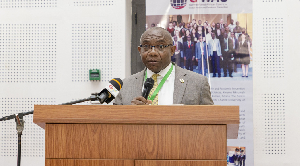
By Alex Ababio
The appointment of Professor Christian Agyare as the next Vice-Chancellor of the Kwame Nkrumah University of Science and Technology (KNUST) marks a defining moment for Ghana’s premier science and technology university, coming at a time when public universities are under growing pressure to expand research output, strengthen digital transformation, improve global rankings and manage rising financial constraints.
In a decision confirmed at the university’s 292nd Special Governing Council meeting on May 13, 2026, KNUST officially named Professor Agyare as its 13th Vice-Chancellor for a four-year term beginning August 1, 2026.
The appointment ends months of intense speculation surrounding the university’s succession process and ushers in a new leadership era following the historic tenure of Professor Rita Akosua Dickson, KNUST’s first female Vice-Chancellor.
According to an official statement published by KNUST, Professor Agyare succeeds Professor Dickson whose tenure ends on July 31, 2026.
A Strategic Choice for a Research-Driven University
Professor Christian Agyare is not an outsider to the KNUST system.
The renowned Professor of Pharmaceutical Microbiology has spent more than 25 years within the university’s academic and administrative structure, rising through several strategic leadership positions before becoming Provost of the College of Health Sciences.
KNUST described him as “a distinguished academic, globally recognised researcher and accomplished institutional leader.”
His academic credentials reflect the increasingly globalised nature of African higher education leadership.
According to the university, Professor Agyare obtained his Bachelor of Pharmacy and Master of Pharmacy degrees from KNUST before earning a Doctor rerum naturalium (Dr. rer. nat.) degree from the University of Münster in Germany. He also undertook postdoctoral and research work at Novartis/Seeding Labs in Boston and the University of California, San Francisco.
These international affiliations are significant because Ghanaian universities are increasingly competing for global research partnerships, international grants and academic visibility.
KNUST disclosed that Professor Agyare has authored more than 200 peer-reviewed publications, earned over 5,000 citations and secured more than US$11 million in competitive research grants from institutions including the German Research Foundation (DFG), DAAD, the World Bank and the Mastercard Foundation.
Education policy analysts say these achievements likely strengthened his candidacy at a time when universities worldwide are prioritising research commercialisation, innovation and international funding partnerships.
The Search Process and Governance Questions
KNUST officials insist the Vice-Chancellor selection process followed established university statutes and governance procedures.
According to GBC Ghana Online, the Search Committee responsible for vetting applicants was chaired by Supreme Court Justice Sir Denis Agyei.
The Governing Council subsequently accepted the committee’s report recommending Professor Agyare as the most suitable candidate.
However, the transition process has not been entirely free from controversy.
Recent reports indicated that allegations of political interference emerged during the selection process.
KNUST publicly rejected those claims, insisting the process was transparent, professional and conducted according to institutional regulations.
The issue reflects broader governance debates within Ghana’s public universities where leadership appointments often attract intense lobbying, alumni pressure and political scrutiny.
Higher education governance experts have repeatedly warned that perceptions of political influence can undermine institutional autonomy and public confidence in university administration.
The End of the Rita Dickson Era
Professor Rita Akosua Dickson’s exit represents more than a routine leadership transition.
Her appointment in 2020 made history as she became the first woman to serve as Vice-Chancellor of KNUST, one of Africa’s leading science and technology institutions.
During her tenure, KNUST expanded infrastructure projects, increased international partnerships and accelerated digital transformation initiatives.
Media reports and university publications credited her administration with improving KNUST’s international academic visibility and strengthening research systems.
Yet her administration also faced difficult moments.
The transition follows months of debate over reports of a possible extension of her tenure beyond retirement age protocols.
Sections of university stakeholders, including some union members and alumni groups, reportedly questioned whether an extension aligned with university statutes and public sector retirement rules.
Though the university eventually moved forward with the succession process, the discussions exposed deeper tensions within Ghana’s tertiary education governance structure over leadership continuity, succession planning and institutional autonomy.
Why Health Sciences Leadership Matters
Professor Agyare’s emergence from the College of Health Sciences is itself strategically important.
Across Africa, universities are increasingly investing in health sciences, biotechnology, pharmaceutical research and medical innovation following lessons from the COVID-19 pandemic and growing public health pressures.
KNUST itself has expanded aggressively in medical education and biomedical research.
The university recently intensified efforts to position Kumasi as a major centre for health research and specialist medical training, particularly with the ongoing development of the KNUST Teaching Hospital project supported by GETFund.
Analysts believe Professor Agyare’s pharmaceutical sciences background could further strengthen the university’s health research agenda.
According to KNUST, his research spans antimicrobial resistance, ethnopharmacology, parasitology, wound healing and anticancer drug discovery.
These fields have growing global relevance as Africa battles infectious diseases, rising antimicrobial resistance and increasing demand for locally driven pharmaceutical innovation.
Digital Transformation and Global Rankings
One of the biggest challenges confronting Professor Agyare will be sustaining KNUST’s digital transformation agenda while improving the university’s international competitiveness.
University rankings increasingly depend on research output, digital infrastructure, global collaborations, postgraduate enrolment and citation impact.
KNUST noted that while serving as Head of the Quality Assurance and Planning Unit between 2016 and 2020, Professor Agyare led reforms including online staff appraisal systems, research supervision assessment systems and the introduction of biometric smart identification systems for staff and students.
Such reforms are becoming essential as universities worldwide adopt technology-driven governance systems.
Education experts say African universities that fail to modernise digital infrastructure risk falling behind in international academic competitiveness.
Student expectations are also evolving rapidly, with increasing demand for online learning systems, digital academic services and innovation-driven entrepreneurship programmes.
The Funding Crisis Facing Ghana’s Universities
Despite KNUST’s achievements, the incoming administration faces significant economic pressures.
Public universities across Ghana continue to struggle with funding deficits, infrastructure expansion costs and rising operational expenses.
The challenge is compounded by increasing student enrolment.
KNUST, like many African universities, is under pressure to expand access while maintaining academic quality and research standards.
The issue has repeatedly triggered tensions between university management and labour unions.
The University Teachers Association of Ghana (UTAG) and the Tertiary Education Workers Union (TEWU) have over the years raised concerns about research allowances, conditions of service, salary structures and delayed government interventions.
Education policy analysts say labour instability remains one of the biggest risks confronting tertiary institutions in Ghana.
The next Vice-Chancellor will therefore need not only academic credibility, but also political and administrative skill in managing complex stakeholder relationships.
Diversity and Gender Representation Debate
Professor Dickson’s departure has also reignited conversations about gender representation in higher education leadership.
Her tenure symbolised a major breakthrough for women in academic administration in Ghana.
Although Professor Agyare’s appointment is being widely praised for academic merit and leadership experience, some education advocates argue that universities must continue strengthening pathways for women in senior academic leadership positions.
Globally, gender equity in university leadership remains an ongoing issue.
UNESCO has repeatedly highlighted the underrepresentation of women in senior academic and scientific leadership roles despite increasing female participation in higher education.
A Defining Moment for KNUST
Founded in 1951, KNUST remains one of Ghana’s most influential academic institutions and a key driver of science, engineering, technology and health research in West Africa.
The university’s influence extends far beyond Kumasi.
Discussions on Reddit and online education forums continue to rank KNUST among the strongest institutions in Ghana for STEM, engineering and technical education.
Professor Agyare therefore assumes office at a time when expectations are exceptionally high.
His administration will be judged on how effectively it addresses student population growth, research financing, infrastructure expansion, labour relations, global partnerships and technological innovation.
More importantly, observers say his tenure could determine whether KNUST consolidates its position as a globally competitive African research university or struggles under the weight of increasing financial and administrative pressures.
For now, however, the appointment signals continuity in KNUST’s long-term ambition to remain Ghana’s flagship science and technology institution while expanding its global research footprint.