

By Alex Ababio|
INVESTIGATIVE SPECIAL REPORT
Santasi–Ahenema Kokoben Flood Crisis: Four Years After Deadly Floods, Residents Demand Answers as Government Promises Yet Another Assessment
By Special Investigations Desk
For residents and businesses along the Santasi–Ahenema Kokoben corridor in the Ashanti Region, every heavy rainfall now comes with a familiar question: How many more homes, vehicles, businesses, and possibly lives must be lost before authorities implement a permanent solution?
The latest flooding incident has once again submerged sections of the busy Santasi–Ahenema Kokoben road, damaging homes, disrupting commercial activities, and raising renewed concerns about public safety.
While government officials have promised fresh consultations and assessments, residents say they have heard similar assurances before.
Their frustration stems from a history of repeated flooding that they argue has already exposed the underlying causes and demonstrated the urgent need for engineering intervention.
Community Relives Memories of a Deadly 2022 Disaster
During a recent inspection tour by the Atwima Kwanwoma District Chief Executive (DCE), Mrs. Grace Agyemang Asamoah, the Chief Executive Officer of Midland Industries Ghana Limited, Mr. Michael Adubofour, recounted the origins of what has become one of the area’s most persistent environmental and infrastructure challenges.
According to Mr. Adubofour, the first major flooding disaster occurred in 2022 when investigations reportedly revealed that a retaining wall constructed upstream altered the natural flow of stormwater.
The structure allegedly obstructed established drainage pathways, redirecting large volumes of runoff toward the road and surrounding communities.
“The resulting floods claimed about five lives, swept away vehicles, and destroyed several properties,” he stated.
Residents interviewed during the visit described scenes of panic as floodwaters rapidly engulfed roads, entered homes, and trapped motorists.
The disaster exposed significant vulnerabilities within the area’s stormwater management system and prompted calls for immediate engineering solutions.
Promises Made, But Residents Say Little Has Changed
Following the 2022 flooding disaster, stakeholders reportedly proposed the construction of a larger drainage infrastructure capable of safely channeling stormwater across the roadway.
According to Mr. Adubofour, officials within the Works and Housing sector acknowledged the need for intervention and gave assurances that solutions would be pursued.
However, residents argue that progress has been painfully slow.
“Every rainy season, we face the same danger,” one resident said during the DCE’s visit. “We keep hearing promises, but the floods keep coming.”
The growing frustration reflects a broader challenge facing many rapidly urbanizing communities in Ghana, where drainage infrastructure often struggles to keep pace with population growth, land-use changes, and increasing surface runoff.
Evidence Points to Multiple Causes
Residents attribute the recurring floods to a combination of natural and human-made factors.
Among the most frequently cited concerns are:
* Massive stormwater runoff from upstream communities.
* Inadequate drainage capacity.
* Choked drains caused by indiscriminate waste disposal.
* Encroachment on natural watercourses.
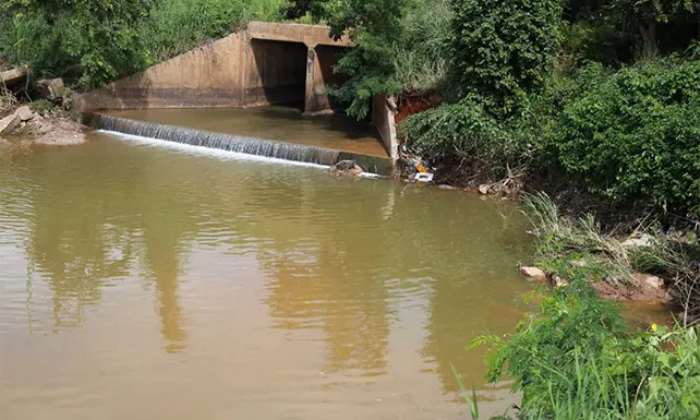
* Erosion and degradation of riverbanks.
These concerns align with findings repeatedly highlighted by flood management experts.
The Ghana Hydrological Authority (HYDRO), the state institution responsible for flood control and drainage engineering, states that effective flood management requires proper stormwater drainage systems, continuous maintenance, hydrological assessments, and protection of waterways from obstruction. The Authority identifies blocked drainage channels and inadequate drainage infrastructure among major contributors to urban flooding in Ghana.
The Hidden Threat: Erosion Now Eating Away at Infrastructure
Beyond the visible flooding, another danger is quietly unfolding beneath the surface.
Mr. Adubofour explained that erosion has worsened over the years, causing retaining walls along riverbanks to collapse while gradually washing away adjoining lands.
The phenomenon has created fears that future rainfall events could trigger larger infrastructure failures.
Several sections of the corridor now show signs of weakened embankments and land degradation.
Environmental engineers often warn that once riverbank erosion becomes established, the cost of intervention increases significantly because authorities must address both drainage deficiencies and structural stabilization simultaneously.
Without intervention, erosion can eventually undermine roads, bridges, utility lines, and private developments.
Strategic Road Under Threat
The Santasi–Ahenema Kokoben road serves as a critical transportation corridor linking growing residential and commercial communities.
Its strategic significance extends beyond transportation.
The road forms part of the boundary between the Kumasi Metropolitan Assembly (KMA) and the Atwima Kwanwoma District Assembly, meaning effective intervention requires coordination between multiple local government authorities.
Residents say continuous flooding has accelerated road deterioration, creating potholes, weakening road shoulders, and increasing risks for motorists.
Transport operators interviewed by local stakeholders reported rising maintenance costs due to recurring damage caused by flooded sections of the road.
For businesses, the consequences are equally severe.
Shop owners and industrial operators say flood events disrupt operations, damage inventory, and discourage customers from accessing the area during heavy rainfall.
Kumasi’s Wider Flood Management Challenge
The Santasi–Ahenema Kokoben situation reflects broader concerns about flood resilience within the Greater Kumasi area.
Just days ago, Kumasi Mayor Mr. Richard Ofori Agyeman Boadi embarked on inspections of flood-prone communities and drainage systems across the metropolis as part of efforts to prevent flooding during the peak rainy season.
The inspections identified choked drains and waterways requiring immediate desilting and maintenance works. According to the Kumasi Metropolitan Assembly, the exercise forms part of efforts to protect lives, property, and infrastructure from flood-related disasters.
Urban planning experts have repeatedly argued that flood management cannot be addressed through isolated interventions.
Instead, they advocate integrated drainage planning that considers entire watersheds and runoff pathways across municipal boundaries.
That recommendation appears particularly relevant for the Santasi–Ahenema Kokoben corridor, where water generated upstream ultimately affects downstream communities.
What the Law Says
Under the Ghana Hydrological Authority Act, 2022 (Act 1085), HYDRO is mandated to plan, design, execute, operate, and maintain flood-control mechanisms and drainage improvement works throughout the country.
The Authority’s responsibilities include identifying flood-prone areas, designing engineering interventions, supporting local assemblies with drainage planning, and developing flood risk reduction strategies.
The persistence of flooding in areas where risks have already been identified raises questions about implementation gaps between planning, engineering recommendations, funding, and project execution.
Infrastructure experts frequently note that many flood disasters are not solely rainfall problems but governance and maintenance challenges involving drainage enforcement, development control, and coordinated infrastructure investment.
DCE Promises Action
Responding to residents’ concerns, Atwima Kwanwoma District Chief Executive Mrs. Grace Agyemang Asamoah acknowledged the seriousness of the situation.
She assured residents that the matter would receive urgent attention and pledged to engage the Mayor of Kumasi, relevant government institutions, and Kofi Job Construction Limited, the contractor working on the road project.
The objective, she said, would be to undertake a detailed assessment of the flooding situation and determine appropriate interventions.
Mrs. Agyemang Asamoah emphasized that collaboration among stakeholders would be essential because of the road’s unique position as a boundary between two major local assemblies.
She further urged motorists and residents to exercise caution during rainfall events while authorities work toward a solution.
The Key Accountability Question
The latest flooding raises a critical question that residents believe authorities must answer.
If the causes of the flooding were identified following the deadly 2022 disaster, why has a permanent engineering solution still not been implemented four years later?
For affected residents, another assessment alone may not be enough.
They argue that years of studies, inspections, and assurances should have already produced tangible results.
What they want now is visible action: expanded drainage infrastructure, riverbank stabilization works, routine maintenance, and long-term flood mitigation measures.
Until that happens, every dark cloud gathering over Santasi, Ahenema Kokoben, and surrounding communities will continue to serve as a reminder of an unresolved crisis.
And for families who remember the lives lost in 2022, the fear remains that without decisive intervention, history could repeat itself.