

By Alex Ababio | Ghanaian Watch | November 17, 2026
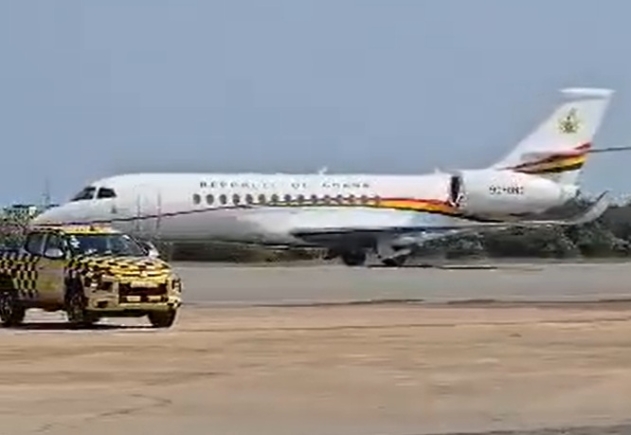
Ghana has taken delivery of a new US$60.68 million Dassault Falcon 6X executive aircraft, replacing its ageing Falcon 900EX, which spent eight months in France undergoing extensive maintenance and repairs in 2025.
The new aircraft arrived at Accra International Airport on Monday, November 16, 2026. Its delivery marks a major development in the government’s military aviation modernisation programme. However, the acquisition also raises important questions about the long-term cost of operating the aircraft, the maintenance capacity of the Ghana Air Force and the government’s ability to demonstrate value for money from the investment.
Minister for Government Communications Felix Kwakye Ofosu announced the arrival on Monday, confirming that the aircraft was manufactured by French aerospace company Dassault Aviation.
The Ghana Air Force has confirmed that it will serve as the custodian and operator of the aircraft. Defence Minister Kenneth Gilbert Adjei, French Ambassador to Ghana Diarra Dimé Labille and members of the Military High Command attended the arrival ceremony.
The aircraft was received with a ceremonial water cannon salute.
Although widely described as Ghana’s new presidential jet, the official Ghana Air Force announcement identifies it as a long-range aircraft operated by the service in support of national requirements.
The US$60.68 million procurement
The acquisition followed parliamentary approval of a procurement agreement presented on December 3, 2025, by then Deputy Minister for Defence Ernest Brogya Genfi.
The agreement between the Government of Ghana, represented by the Ministry of Defence, and Dassault Aviation covered the acquisition of one Falcon 6X for the Ghana Air Force at US$60,680,000.
The purchase formed part of a wider military aviation procurement programme involving four helicopters from Airbus Helicopters SAS of France.
The helicopter agreement was valued at €125,965,974 and covered one H160 and three H175 helicopters.
Together, the two agreements represented major investments in Ghana’s military aviation capabilities.
Parliament’s Committee on Defence and Interior examined the agreements after their presentation to the House under Article 181(5) of the 1992 Constitution and Standing Order 247.
The committee was chaired by James Agalga, Member of Parliament for Bulsa North.
Its report identified the procurement as part of a broader effort to address the deteriorating condition of the country’s military aircraft.
The committee considered the cost, reliability, operational efficiency, safety and technical specifications of the proposed aircraft.
It also recommended that the government provide adequate funding for pilot training, maintenance support systems and the infrastructure required to operate the new fleet.
These recommendations are important because the purchase price represents only one part of the financial commitment involved in maintaining sophisticated military aircraft.
Inside the Falcon 900EX maintenance crisis
The replacement of the Falcon 900EX followed serious maintenance difficulties that exposed weaknesses in the availability and reliability of Ghana’s executive air transport capacity.
The aircraft entered service in 2010 and was sent to Dassault Falcon Service at Le Bourget, France, on March 11, 2025, for mandatory periodic maintenance.
According to parliamentary explanations by Ernest Brogya Genfi, the inspection was required after 24 months or 1,600 flying hours.
The inspection uncovered corrosion in the aircraft’s fuel tanks. Engineers also identified fuel leakages from the right-hand wing’s fuel tanks.
In November 2025, Genfi informed Parliament that the corrosion problems had been repaired but further complications emerged during the reinstallation of a lower panel beneath the aircraft’s wing.
He explained that Dassault Aviation had invited the original equipment manufacturer of the Falcon wing to conduct an assessment and provide technical recommendations.
“The repair from OEM has been successfully carried out, and the right-hand wing repairs have also been completed,” he told Parliament.
The aircraft subsequently underwent fuel tank leak testing, engine ground runs and other technical checks before its return to Ghana.
It was handed back to the Ghana Air Force on November 10, 2025, after spending approximately eight months in France.
The Defence and Interior Committee’s report provided another important explanation for the replacement.
It stated that the Falcon 900EX model was no longer in production, creating significant difficulties in sourcing spare parts.
This raises a wider operational question: whether Ghana’s military aviation maintenance arrangements can adequately support modern aircraft and prevent similar prolonged periods of unavailability.
What the new Falcon 6X brings
The Falcon 6X offers considerably greater long-distance flying capability than the older aircraft.
According to Dassault Aviation’s published technical specifications, the aircraft has a maximum range of 5,500 nautical miles, equivalent to approximately 10,186 kilometres, under specified operating conditions.
It can accommodate between 12 and 16 passengers, depending on configuration.
Its maximum operating speed is Mach 0.90, while its cabin measures approximately 12.30 metres in length and 2.58 metres in width.
The aircraft is powered by two Pratt & Whitney Canada PW812D engines and uses Dassault’s EASy IV flight deck, incorporating Honeywell Primus Epic avionics.
Its long-range capability allows it to connect major international destinations without the frequent refuelling stops associated with shorter-range aircraft.
Felix Kwakye Ofosu explained that the longer operational range would eliminate the need for frequent refuelling stops during long-distance journeys.
The Ghana Air Force has also highlighted the aircraft’s digital flight-control technology, which is designed to improve stability, reduce pilot workload and provide additional safety features.
These capabilities could improve the efficiency of official international travel and reduce some logistical difficulties associated with the previous aircraft.
However, the manufacturer’s published performance figures should not be confused with a guarantee that every international journey can be completed without refuelling. Actual range depends on passenger load, weather, reserves and operating conditions.
The wider military aviation crisis
The parliamentary committee report reveals that the Falcon 900EX was not the only aircraft facing serious operational challenges.
The report identified significant weaknesses across several parts of the Ghana Air Force fleet.
It disclosed that all six Mi-17 helicopters were unserviceable because of overdue overhauls and major component failures.
It also reported that all four Z-9EH helicopters were unserviceable, with one lost in an accident in August 2025.
The committee further identified deficiencies in the Z-9EH fleet, including the absence of important modern safety systems such as Terrain Awareness and Warning Systems (TAWS), Enhanced Ground Proximity Warning Systems (EGPWS) and advanced navigation equipment.
The situation involving the Casa C295M transport aircraft was also concerning.
Of the three aircraft in the inventory, only one was reported to be serviceable.
The committee explained that although the C295M was useful for tactical airlift operations, it was unsuitable for medium-to-long-range executive travel.
These findings provide a broader explanation for the government’s decision to acquire new aviation platforms.
The procurement is therefore not limited to replacing an ageing presidential aircraft. It forms part of an attempt to restore the operational capacity of a military aviation fleet experiencing prolonged maintenance problems.
Parliament’s 30–40 per cent savings projection
One of the most significant financial claims in the parliamentary report concerns the projected lifecycle savings from the new aircraft.
The Committee on Defence and Interior estimated that the total lifecycle cost of the proposed new fleet over a projected 15-year service period would be 30–40 per cent lower than the cost of maintaining and operating the existing ageing aircraft.
James Agalga presented this assessment as part of the justification for the procurement.
The committee argued that continuing to maintain the older aircraft had become financially unsustainable and operationally inefficient.
It also warned that relying on aircraft leased from external providers placed additional pressure on Ghana’s foreign exchange resources and exposed sensitive state movements to third parties.
However, the 30–40 per cent projection relates to the proposed new fleet as a whole. It should not be interpreted as a verified saving attributable to the Falcon 6X alone.
The public report also makes it important to distinguish projected savings from actual savings.
The government will need to demonstrate whether the projected financial benefits are achieved through reduced maintenance expenditure, improved aircraft availability and lower dependence on external aviation services.
The additional costs beyond the purchase price
The US$60.68 million acquisition also raises questions about the recurring costs of operating the aircraft.
These include fuel, routine maintenance, engine servicing, spare parts, insurance, pilot training, technical support and infrastructure.
Dassault Aviation’s worldwide support network provides services intended to help operators manage maintenance and aircraft availability. However, Ghana must still ensure that it has the necessary funding, trained personnel and maintenance arrangements to support the aircraft throughout its service life.
The parliamentary committee recognised this challenge.
It specifically recommended that adequate funding be provided for pilot training, maintenance support systems and associated infrastructure.
The committee also called for stronger coordination between the Ministry of Defence, the Ghana Air Force and other relevant government institutions to ensure transparency, cost effectiveness and operational efficiency.
These recommendations are particularly important given the maintenance difficulties experienced by the Falcon 900EX.
Without a reliable long-term maintenance strategy, the acquisition of a modern aircraft alone cannot guarantee uninterrupted operational availability.
Accountability after delivery
The arrival of the Falcon 6X shifts attention from procurement approval to implementation and long-term accountability.
The Ministry of Defence and the Ghana Air Force will need to demonstrate how the aircraft will be managed, maintained and funded.
The government must also ensure that the associated military aviation investments deliver the operational improvements presented to Parliament.
The questions requiring continued public scrutiny include the total cost of maintaining the Falcon 6X over its projected service life, the funding allocated for pilot and engineering training, the availability of manufacturer-approved technical support and the arrangements for publishing information about the aircraft’s utilisation and maintenance expenditure.
Parliament’s recommendation that funding arrangements be formally documented and reflected in the country’s fiscal framework also remains important.
The acquisition is a substantial public investment, and its long-term value should be assessed against measurable operational and financial results.
For Ghana, the arrival of the Falcon 6X represents an opportunity to improve executive air transport and strengthen military aviation capacity.
But the real test will not be the aircraft’s arrival ceremony or its advertised flying range.
It will be whether the government can keep the aircraft operational, control its long-term costs and address the wider maintenance problems that have left several military aircraft unserviceable.
The US$60.68 million aircraft has arrived. The bigger question is whether Ghana has the financial, technical and institutional capacity to sustain it.