

By Alex Ababio
The attempted arrest of Manhyia South Member of Parliament (MP), Nana Agyei Baffour Awuah, at the Accra High Court has exposed a potentially consequential intersection of anti-corruption enforcement, parliamentary privilege, legal representation and the constitutional protection of personal liberty.
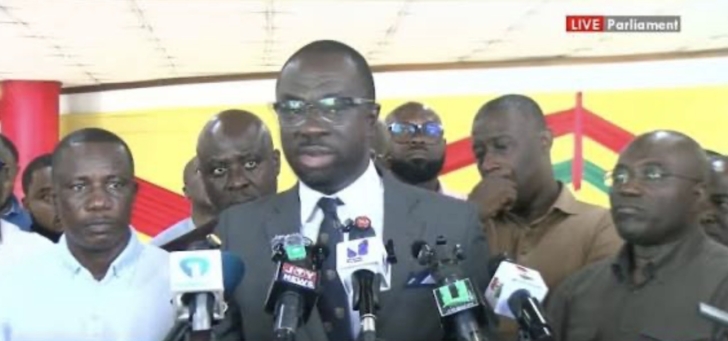
The confrontation on Wednesday, September 23, 2026, occurred shortly after Baffour Awuah had appeared as counsel for detained nurse Salomey Baffoe Awiti in the “Ghana Jollof” case. Video footage circulating online showed a female operative identified as an Economic and Organised Crime Office (EOCO) official confronting the MP around his vehicle before he drove away. The Ghana News Agency independently reported that the officer attempted to open the vehicle door as the MP was leaving.
But the central question is no longer simply what happened outside the court.
It is why EOCO says it needed to arrest a sitting MP in the first place, whether the February correspondence amounted to a personal invitation to him, what happened after his law firm cooperated with the investigation, and what constitutional and procedural safeguards applied to the operation.
EOCO’s version
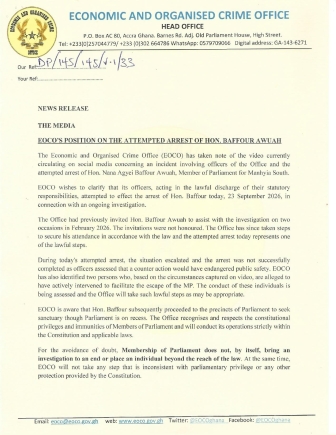
EOCO confirmed that its officers attempted to arrest Baffour Awuah on September 23.
The Office said the action formed part of an ongoing investigation and followed two invitations issued to him in February 2026, which it said he failed to honour.
EOCO described the attempted arrest as a lawful step taken to secure his attendance. It said the operation was discontinued after the confrontation escalated and officers assessed that continuing could endanger public safety.
The agency also said it had identified two people who allegedly intervened to facilitate the MP’s departure and that their conduct was being assessed for possible further lawful action. EOCO added that it recognised parliamentary privileges and immunities but stressed that membership of Parliament does not, by itself, terminate an investigation or place an MP beyond the law.
That position is important because EOCO’s statutory mandate is broad. The Economic and Organised Crime Office Act, 2010 (Act 804) establishes EOCO as a specialised institution responsible for preventing and detecting organised crime and facilitating the confiscation of proceeds of crime.
The existence of that mandate, however, does not by itself answer the separate question of whether this particular operation was conducted according to the applicable constitutional and procedural requirements.
Baffour Awuah disputes the foundation of the arrest
Baffour Awuah has offered a substantially different account.
According to the statement attributed to him, the EOCO letter dated February 10, 2026, was addressed to the Senior Partner of Sarkodie Baffour Awuah & Partners, the law firm that represented SIC Life Savings and Loans Company Limited in the matter under investigation.
He says that, by February 18, he had informed EOCO that he had become a Member of Parliament and had referred the communication to the Clerk to Parliament for advice.
His account goes further.
He says a lawful representative of the firm subsequently cooperated with EOCO on March 4, March 18 and April 30, 2026, providing information requested by investigators, followed by a formal written statement dated April 30.
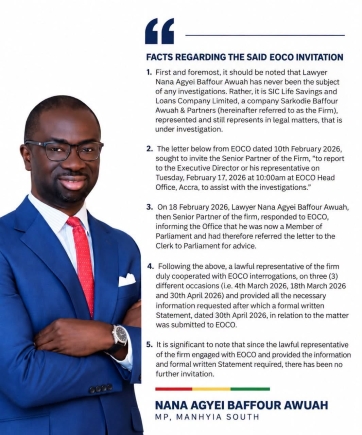
Baffour Awuah therefore disputes the suggestion that he personally ignored EOCO’s investigative process.
The distinction is significant.
Former Majority Leader Osei Kyei-Mensah-Bonsu, commenting on the matter on September 24, said the February invitation was directed to the law firm rather than personally against Baffour Awuah.
«“The matter for the invitation really was not against the person of lawyer Ajii Baffour. It was directed at the office of the law firm at which he operates.”»
Kyei-Mensah-Bonsu also referred to Articles 117, 118 and 123 of the Constitution in discussing protections applicable to Parliament and its members.
This creates one of the most important documentary questions in the controversy: What exactly did the February EOCO letters say, who were they addressed to, and did the agency subsequently issue a separate personal summons to Baffour Awuah after he became an MP?
EOCO’s public statement, as reported, says he was invited twice. Baffour Awuah’s account says the relevant correspondence concerned the firm’s Senior Partner and that the firm subsequently cooperated.
The two positions cannot simply be treated as identical.
What does parliamentary privilege actually protect?
Ghana’s 1992 Constitution provides significant protections for Parliament.
Article 115 states that there shall be freedom of speech, debate and proceedings in Parliament and that such freedom shall not be impeached or questioned in a court or other place outside Parliament. Article 116 further provides protections concerning proceedings against MPs in relation to matters brought before Parliament.
But parliamentary privilege is not synonymous with blanket immunity from criminal investigation.
That distinction is crucial.
EOCO itself acknowledged the constitutional privileges and immunities of MPs while maintaining that parliamentary membership does not automatically place an individual beyond the law.
At the same time, the precise constitutional procedure applicable to the arrest or detention of an MP remains an important legal question in this case.
Legal practitioner Martin Kpebu argued that established parliamentary procedures should have been followed before a sitting legislator was compelled to appear before investigators. He said the incident represented a “retrogression” in Ghana’s democratic development and argued that a state institution seeking an MP’s attendance should engage the Speaker through the appropriate parliamentary channels.
Another lawyer, Kwame Adofo, criticised the manner of the attempted arrest, describing the spectacle as “embarrassing”, “disgraceful” and “shameful” in comments reported by Asaase Radio on September 24.
These are opinions, not judicial findings. No court has, based on the reports reviewed, ruled that EOCO’s operation was unlawful.
The court-premises question
The location of the confrontation adds another layer.
Baffour Awuah was at the High Court in his professional capacity as counsel for Salomey Baffoe Awiti, whose bail application was being heard.
The application was adjourned to September 24 after an Assistant State Attorney requested additional time for the prosecution to respond. The State explained that the Attorney-General’s Office had been served on September 18, while the following Monday was a public holiday and the application had not yet been assigned to the substantive lawyer handling the case.
The attempted arrest therefore unfolded inside the wider environment of active judicial proceedings.
That does not automatically prevent an arrest, but it raises legitimate procedural questions about coordination between law-enforcement authorities, court security, lawyers and Parliament.
The video evidence may become particularly important here because EOCO has itself said it intends to review available footage before determining its next steps.
The unexplained gap between February and September
Perhaps the most important investigative question is the six-month gap.
EOCO says Baffour Awuah ignored two February invitations and that this ultimately led to steps being taken to secure his attendance.
But Baffour Awuah says the law firm cooperated on three subsequent occasions and submitted a formal statement on April 30.
If the two accounts are both accurately reported, investigators will need to clarify whether:
1. the February invitations were personal invitations to Baffour Awuah or communications to his law firm;
2. EOCO accepted or rejected the information supplied by the firm’s representative;
3. the April 30 statement resolved any outstanding requests;
4. EOCO issued another formal invitation after April 30;
5. a warrant or other legal process existed before September 23; and
6. what precise statutory authority was being exercised when the officer attempted to take the MP into custody.
Those documents would move the controversy beyond competing political narratives.
Why the “Ghana Jollof” case matters
The attempted arrest happened against the backdrop of the prosecution of Salomey Baffoe Awiti, a 40-year-old nurse and mother of three, in connection with content attributed to the “Ghana Jollof” TikTok account.
The prosecution has accused her of abetment relating to the publication of false information. Her bail application was adjourned to September 24.
Baffour Awuah has publicly defended her and represented her in court.
The MP told journalists that when the woman who approached him asked him to accompany her to EOCO, he requested identification, evidence that she was an EOCO officer and an arrest warrant. He said none was produced.

He also said he offered to drive himself to EOCO but the officer insisted that he use their vehicle.
«“It became obvious to me that it was one of the recent kidnappings that have been going on, which is sponsored by the state.”»
That is Baffour Awuah’s allegation and interpretation, not an established fact. The available reporting does not establish that the operation was an attempted kidnapping; EOCO officially described it as an attempted arrest carried out in connection with an investigation.
What happens next?
The confrontation has now become larger than the MP and the EOCO officer involved.
It raises questions about how Ghana’s anti-corruption agencies exercise coercive powers, how Parliament’s constitutional protections interact with law-enforcement investigations, and whether law-enforcement operations involving lawyers and MPs should be subject to additional procedural safeguards.
EOCO has said the investigation remains active and that it will review video evidence before deciding its next steps.
Baffour Awuah, meanwhile, has rejected EOCO’s explanation and continues to dispute that he personally ignored its invitations.
The documentary record—particularly the February letters, subsequent correspondence, the firm’s April 30 statement and any later communication—could therefore prove more important than the competing political claims surrounding the confrontation.
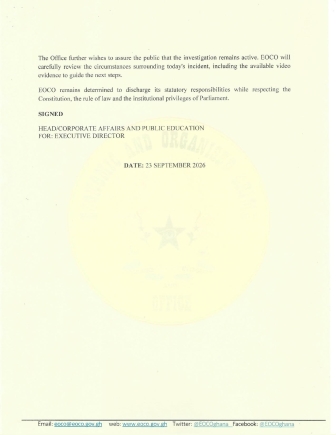
For now, the evidence establishes that EOCOv attempted to take Baffour Awuah into custody at the High Court, that the operation was not completed, and that both sides offer materially different explanations for why it happened.
The unresolved issue is not whether EOCO has an investigative mandate. It plainly does.
The harder question is whether the precise legal authority relied upon, the procedure followed and the timing of the operation can withstand scrutiny under Ghana’s Constitution and applicable law.
That is a question ultimately requiring documentary evidence and, if necessary, judicial determination—not competing versions on social media.