

By Alex Ababio
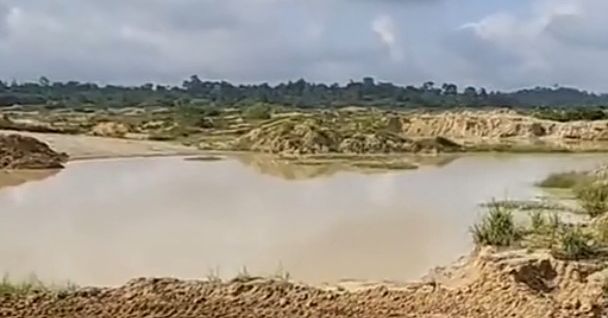
They called it “just another gold rush,” but in Huniso, in the Western Region, the rush has left rivers poisoned, farmlands barren, and people desperate. At dusk, the stream that used to supply clean water for cooking and drinking runs murky. “You can’t drink it, you can’t wash with it,” says Ama Boateng, 37, a cocoa farmer whose land lies just downstream of illegal excavations. “They tell us the water is our birthright—but now it feels like they sold our birthright for a few ounces of gold.”
Ama’s story is one among thousands in Ghana’s mining towns. Beneath the surface, a tangled web of regulation, political patronage, and selective enforcement allows “galamsey” (illegal small‐scale gold mining) to flourish—often benefiting the politically well connected while the poor suffer the consequences.
1. The Scale of Devastation
In the Ashanti Region alone, the problem has exploded. According to Ashanti’s Regional Minister Simon Osei Mensah, 25 out of 43 districts are now affected by galamsey.
Recent studies tell of widespread environmental damage: in the Western Region, industrial-scale contamination by arsenic, lead, chromium, and other heavy metals has been found in water bodies such as the Ankobra River and others used by local communities.
Soil tests in Konongo Zongo (Ashanti) returned average mercury levels around 56.4 parts per million (ppm)—over 500% above the international safety limit for playground soils. Arsenic spikes in the same area reached over 1,000 ppm in many locales.
Meanwhile, economic losses to the state run into the billions. Ghana is believed to lose about US$2 billion annually in foregone revenue, taxes, and environmental costs because of illegal mining.
2. Dual System: Who’s Targeted, Who’s Shielded
The enforcement of laws has become a tale of two Ghanas. On one side: poor, rural miners arrested, prosecuted, equipment seized or destroyed. On the other: large companies and politically connected concession holders whose operations skirt enforcement or are protected by loopholes.
Crackdowns sometimes draw headlines: in June 2025, coordinated police raids in the Western, Ashanti, and Central Regions arrested 30–49 suspects in places like Akrokerri (Ashanti), Huniso, Wassa-Dadieso, and Wassa-Gyapa.
But legal cases are slow and often ineffective: by May 2023, 119 cases involving over 727 individuals had been pending in High Courts and Circuit Courts since 2022. Some suspects remain at large; many cases drag on.
In contrast, powerful mining firms operating under concessions signal growing frustration that their territories are encroached upon by illegal miners—but rarely face symmetric accountability. For example, AngloGold Ashanti reports that galamsey operators now infect streams within their concession boundaries; but the firm, despite warnings, is largely left to absorb costs and to push for regulation rather than benefit from any strong remedial enforcement.
Locals suspect that many illegal operations are backed by MPs, district assembly members (MMDCEs), and chiefs. In Western Region’s Ankobra River basin, Opanin Kofi Adjei claims: “Some MMDCEs and MPs in our communities employ people to engage in galamsey… Chiefs in other communities have also hired workers to mine illegally.”
3. Human Stories: Lives Disrupted
Ama Boateng, Cocoa Farmer, Huniso
Ama lost nearly 2 acres of cocoa farm last year when illegal mining operations moved upstream. “They dug up my land, polluted the streams, and now my trees are dying,” she says, voice trembling. “I borrowed money for fertilizer; the yield has halved. I don’t know how to pay back.”
Yaw Opoku, Student, Akrokerri, Ashanti
Yaw, 17, attends Asare Bediako Senior High School in Akrokerri, near Obuasi. His school lies just 200 metres from blasting illegal mining sites. “At night, the explosions wake us. Sometimes rocks break windows. The dust chokes us. Some classmates stay home.”
Dr. Devine Odame Appiah, Environmental Scientist, KNUST
“We are seeing irreversible damage in soil chemistry and biodiversity. When mercury concentrations are 10-fold what the land can handle, crops absorb it. People eat fish laced with heavy metals. Health systems in these rural areas are unprepared for the illnesses that follow.”
4. The Regulatory Failures & Political Economy
Why does this happen in spite of laws, public outcry, and multiple crackdowns?
Weak enforcement + corruption. Agencies like the Minerals Commission, EPA, Police, and the judiciary do not always follow through. Equipment seized is sometimes returned; cases are withdrawn or delayed. Local authorities sometimes protect illegal operators.
Political protection and patronage. Some community members report that MPs, assembly members, and chiefs tolerate or directly profit from galamsey operations. This creates a disincentive for strong enforcement because powerful people benefit.
Policy gaps and loopholes. Large scale concessions are legal; many artisanal miners do not have formal licensing, but are de facto allowed in some places. Some policies are reactive (raids, arrests) rather than preventive. Recent reforms like the creation of GoldBod (Gold Board) aim to restrict foreigners from trading in small-scale gold, centralize regulation, and improve traceability. These may help—but if not enforced, may become another layer of capture.
Economic desperation. In many affected districts, people say there are few alternatives. Farming yields are low; roads, schools, jobs are under-resourced. To many, galamsey offers path to survival, even if dangerous. Yaw recounts that many of his peers dropped out to join mining crews.
5. Moments of Resistance & Hope
There are flashpoints of pushback.
Community groups and NGOs—e.g., WACAM, A Rocha Ghana—are increasingly vocal, raising awareness and reports.
The government has launched notable operations—Operation Halt, Operation Vanguard. The recent IGP-led raids show crackdowns are possible.
The policy change restricting foreigners from buying artisanal gold via GoldBod is a step toward reducing smuggling and uncontrolled trade.
6. What Must Change: Systemic Reform
To unravel the Golden Web requires changes at multiple levels:
1. Transparent oversight of political connections. Who holds mining licenses and concessions? What are their affiliations? Public disclosure could expose conflicts of interest.
2. Faster, fair judicial process. The long pendency of galamsey cases erodes deterrence. Fast-track courts for environmental crimes could help.
3. Community participation and benefit-sharing. Rather than imposing regulations from Accra alone, local voices must be central. For example, in some districts, community enforcement (“vigilantes”) have been effective when supported properly.
4. Economic alternatives. To stop the lure of illegal mining, there must be viable livelihoods: agriculture, aquaculture, small enterprises.
5. Stronger regulation of chemicals, land restoration, and environmental monitoring. Requiring strict environmental impact assessments (EIAs), setting enforceable water quality standards, removing impunity for polluters.
Conclusion: Costs, Choices, and the Future
Ama Boateng stands by the undercut river that used to serve her home—her hands blackened from trying to clean water with sand; her cocoa trees dying in the dirt. For her, the Golden Web is no theory—it is the soil under her feet, the air she breathes, the future she fears she might lose.
Ghana sits at a crossroads. The promise of its minerals has lifted some, but the cost has been invisibly borne by many. The regulatory framework is in place in law, but capture by elites, weak enforcement, and selective prosecution ensure that those with power gain, while those without pay.
If Ghana allows this Golden Web to continue unravelling its lands, its health, its trust in institutions, then what remains are scars, injustice, and a drained national treasury. But if reformers—activists, scientists, honest officials, and ordinary farmers—can pull at a few forgiving threads, there is a way forward for clean water, restored soils, and a mining sector that benefits all Ghanaians, not just a powerful few.
Sample Interview Quotes (for Context & Attribution)
Ama Boateng (Cocoa Farmer, Huniso): “They dug up my land, polluted the streams, and now my trees are dying. I borrowed money for fertilizer; the yield has halved.”
Yaw Opoku (Student, Akrokerri): “At night, the explosions wake us. Sometimes rocks break windows. The dust chokes us. Some classmates stay home.”
Dr. Devine Odame Appiah (Environmental Scientist, KNUST): “We are seeing irreversible damage in soil chemistry and biodiversity. When mercury concentrations are 10-fold what the land can handle, crops absorb it. People eat fish laced with heavy metals.”
Opanin Kofi Adjei (Community Leader, Ankobra basin): “Some MMDCEs and MPs in our communities employ people to engage in galamsey… Chiefs in other communities have also hired workers to mine illegally.”
Data & Sources
Sample soil and water contamination data from Ashanti & Western Regions showing massive exceedance of safe thresholds.
Arrest & prosecution figures: 30–49 arrests in recent raids; over 119 legal cases pending involving 700+ people.
Economic estimates: ~US$2 billion yearly losses; environmental damage of hundreds of thousands of hectares.