

By Alex Ababio
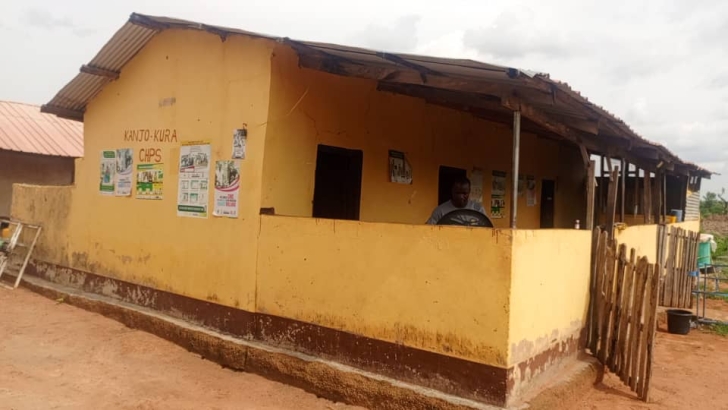
A painted sign stands outside a small square building in Kanjo-Kura, a village in Zabzugu ,and remote settlement in the Egambo Electoral Area of Nanumba South District in the Northern Region
“Community-Based Health Planning and Services (CHPS) Compound.” Inside, everything is empty. Dust covers the examination table. Shelves are bare. The only sound comes from lizards scurrying around. The door is locked, and it has been locked for many days . It is open only a few times a week
For Fuseina Yakubu, who is heavily pregnant and has three children, this locked door is not just a problem—it is a threat to her life. When her labor pains started suddenly, her family rushed her here. They found the clinic closed. They then made a frantic journey over 25 km on rough roads to another health facility—but it was too late.Fuseina delivered a stillborn baby on the side of the road.
Her story shows a terrible betrayal. A 2021 study published in BMJ Open found that only 38% of CHPS compounds in Ghana met basic functionality standards. That means 62% are “ghost facilities”—built and named as clinics, but not working at all, and failing the rural communities they were meant to help.
The Policy Promise vs. The Grim Reality
Over 20 years ago, Ghana started the CHPS program as its main tool for primary healthcare. The goal was to bring services—like maternal care, child immunization, and family planning—to very remote places. The government and donors spent millions of dollars building these small clinics.
But in places like Wassa Akropong (Western Region) and Bongo (Upper East Region), this promise has turned into a lie.
“We have a beautiful building, yes,” says community elder Nana Kwasi in Wassa Akropong. “But it has never had a nurse. Not for one day. It is a white elephant. When our children get malaria, we still have to carry them on our backs for hours. The clinic is a tombstone for a promise that died.”
The Three Layers of Failure: Infrastructure, Staff, and Supplies
This failure is not just one thing—it is three layers of neglect.
1. The Infrastructure Ghost
Some compounds are not complete or are broken. According to one report, many lack water, toilets that work, or electricity. That makes them unfit for medical use.
2. The Human Resource Ghost
The biggest problem: no health workers. “You cannot have healthcare without healthcare workers,” says public health expert Dr. Priscilla Ofori. “The government has failed to post and, crucially, to retain nurses and community health officers in these remote areas. There are no incentives, no proper housing, and they feel abandoned.”
A District Health Director in the Upper East Region (who asked not to be named) confirmed that 15 out of 24 CHPS compounds in his area have no staff. (This comes from journalists and local reports—not official audited data—but it’s a widespread pattern.)
3. The Supply Ghost
Even in places with staff, essential supplies are missing. A nurse in Bongo (called Nurse Rita) showed her empty drug cabinet. “No oxytocin to stop mothers from bleeding out. No oral rehydration salts for children with cholera. We have a blood pressure cuff, but no batteries. We are doctors with no medicine, soldiers with no bullets. We are set up to fail.”
The Human Cost: A National Health Crisis
These failures cause real suffering.
Maternal Mortality: Ghana’s maternal mortality rate has stayed stuck at around 263 deaths per 100,000 live births. This is strongly tied to the collapse of rural health services—women cannot get help quickly enough.
Preventable Deaths: Many people die from treatable illnesses such as malaria, diarrhea, and pneumonia because there is no nearby clinic that works.
Professor Maria Polychronis, who studies Ghana’s health systems, says:
“The CHPS program was supposed to be the backbone of our primary healthcare system. Its collapse is not a logistical failure; it is a failure of political will and accountability. Funds are allocated for construction—which is visible and good for politicians to inaugurate—but not for the less-visible, ongoing costs of staffing, maintenance, and supplies.”
Gaps Between Policy and Implementation
Researchers reviewed the CHPS policy and found many implementation gaps:
Communities and opinion leaders are not involved enough, though the policy says they should be.
Promotions for Community Health Officers are not fair or neutral.
Supplies (medical tools, medicines) are often late or not enough, hurting service delivery.
Another paper on CHPS progress found that many compounds sit idle. In some regions, health workers don’t even have motorbikes. They pay for taxis out of their own money for outreach, so some areas go without service. Only less than half of zones have all required equipment. Though CHPS zones provide over 51% of immunization services, cold boxes and vaccine fridges are in less than half of them.
The operating cost per CHPS zone is estimated at around GHS 36,930 per month (covering utilities, internet, security, volunteer allowances, etc.). The initial investment cost per zone is estimated at GHS 530,020, and operating cost per year is GHS 247,236. These numbers come from a 2019 cost study.
What Real Communities Say
In a survey in Kintampo North Municipality, 73.7% of household heads said they used CHPS compounds. Women and those earning more money were more likely to use them. For example:
81.7% of female heads used them, but only 57.1% of males did.
People earning between GHS 200–300 per month were almost 4 times more likely to use CHPS compared to those earning below GHS 100.
But many barriers remain:
41.5% of respondents reported medicine shortages.
28.7% said they didn’t have enough money to pay for services.
12.3% said CHOs (community health officers) were often absent.
A Glimmer of Hope and a Path Forward
Some communities and programs are trying to help. For instance, more than 3,700 community development monitors (CDMs) have been trained in 50 districts to check the quality of CHPS compounds and other services using community scorecards. This is part of a project called Ghana Strengthening Accountability Mechanisms (GSAM).
Also, the Ada East Health Director urged local residents to take charge of their CHPS compounds—by helping with nurse welfare, power, water, security—to improve health delivery.
Experts say these solutions must be implemented nationally:
1. Stop building new CHPS compounds now. Focus on fixing the ones that already exist.
2. Offer strong incentives—like better pay, housing, career growth—to attract and keep health workers in remote areas.
3. Make supply chains transparent and digital. Track medicines and tools from central stores to local clinics to reduce losses.
4. Empower communities. Fund and support local monitoring committees so they can ensure their clinics work and hold health officers accountable.
Back in Kanjo Kura , the community placed a simple wooden cross near the locked CHPS compound in memory of Fuseina’s lost baby. It is a silent but powerful rebuke—a place that was supposed to be a beacon of hope remains locked and useless, while people suffer and die just outside.
This is not just a policy failure. It is a daily, quiet violence against the rural poor—a reminder that the right to health, if not backed by real action, remains locked behind closed doors.