

By Alex Ababio
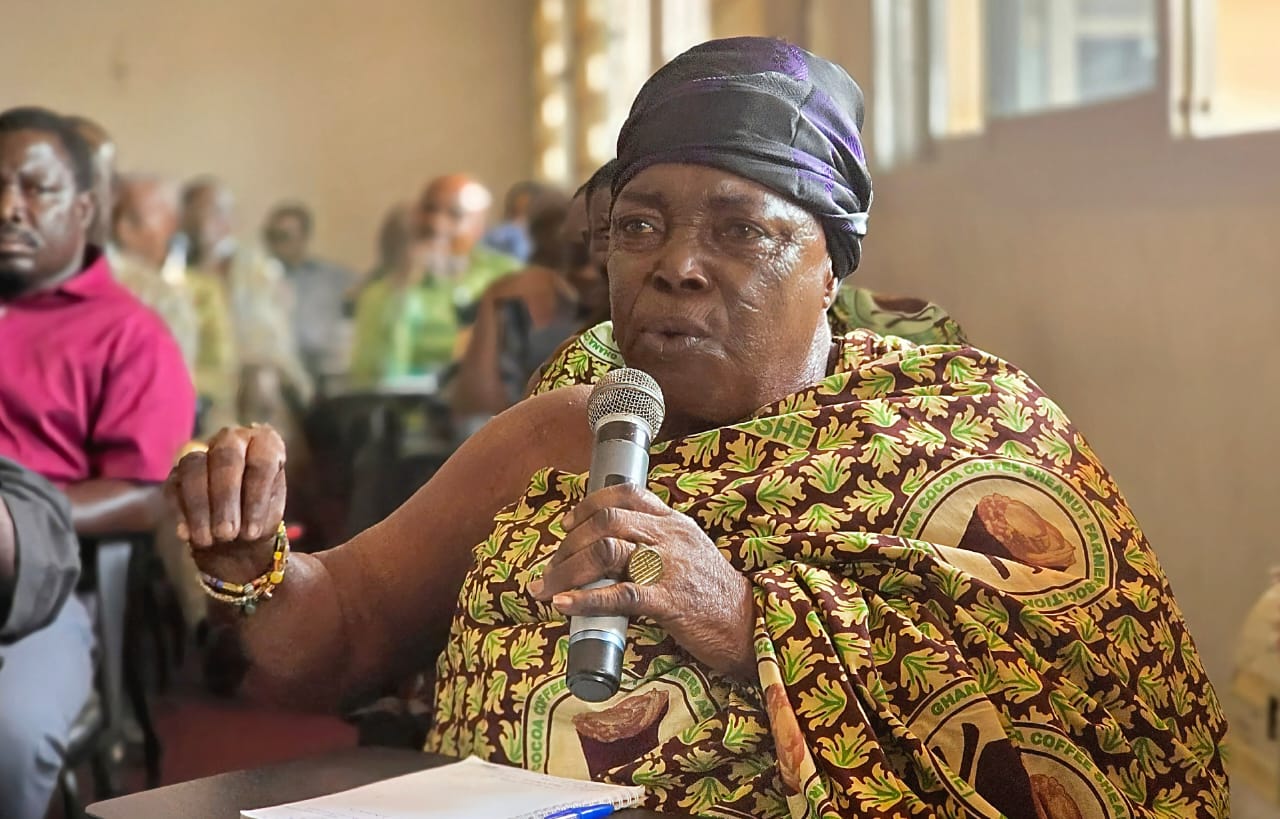
BAREKESE, Ashanti Region — Nana Akyaa Nantie does not count her age precisely. She is 58, perhaps 59. She owns two cocoa farms covering more than 30 acres in total. On a Tuesday morning in March, she walks through her farms with the unhurried authority of someone who has spent three decades managing men, land and money.
She oversees thousands of farmers across 19 cooperative groups stretching from Barekese into parts of Mankranso and Offinso. Roughly ten farmers from her district have won farming awards under her mentorship.
On paper, she represents exactly what Ghana’s cocoa industry wants the world to see: a successful female District Chief Cocoa Farmer in a sector that remains stubbornly dominated by men.
Her journey into cocoa farming began at 25, when financial difficulties forced her to abandon her education at middle school. She took over her grandmother’s farm and gradually built her position in the industry.
She followed the agronomic practices promoted by the Cocoa Health and Extension Division (CHED). Her commitment and farming knowledge earned her the trust of fellow farmers, who selected her as their District Chief Cocoa Farmer.
Beyond farming, she is a traditional leader within the Adu Nana family of the Asenie clan, a certified reproductive health and women’s rights advocate, and a campaigner against child labour.
Her message to women is straightforward: pursue land ownership, participate actively in farming and build financial independence.
Nana Akyaa owns her land.
That ownership is central to her success. It is also what makes her different from many women working in Ghana’s cocoa industry.
The Price That Broke the Households
In January 2026, the government reduced the cocoa farmgate price by 28.6 per cent, from GH¢3,625 to GH¢2,587 per 64-kilogramme bag.
The reduction triggered protests across cocoa-growing communities. In February, hundreds of farmers marched through Sefwi Wiawso, Bekwai, Asunafo and Amenfi, carrying placards and condemning the reduction as a betrayal of campaign promises made before the 2024 general election.
For women, the reduction had consequences beyond the loss of income from cocoa sales. It threatened their ability to feed their families, pay school fees and meet other household responsibilities.
Grace Amponsah, a cocoa farmer from Akyem-Techiman in the Eastern Region, openly questioned the impact of the reduction on women.
“Two-thirds of the nation’s population are women and we use cocoa to take care of our children,” she said. “How do we make up for the shortfall due to the price cut?”
She said she was considering selling her farm to illegal small-scale mining operators, popularly known as galamsey operators.
“If you hire a labourer, you have to pay GH¢120. With this price cut, how do we contract these labourers? We can’t even afford common rice.”
Edward Karaweh, a former general secretary of the General Agricultural Workers Union, said Ghanaian authorities “were not prepared” for a crisis of this scale.
“Preparation allows you to mitigate the crisis,” he said. “It is not that you prevent the crisis altogether.”
The contrast is striking.
While COCOBOD celebrates farmers such as Nana Akyaa as examples of success, the women working in the communities she oversees face growing difficulties in meeting basic household needs.
In Kapora, the consequences of the price reduction are visible in the decisions women have been forced to make about food, education and the tools they use to earn a living.
The Women of Kapora
To understand what Nana Akyaa’s success means for ordinary female cocoa farmers, the investigation moves from Barekese to Kapora, a farming community where she encouraged women to establish a cooperative.
The women cultivate cocoa alongside food crops to support their families. Organising themselves into a cooperative has given them opportunities to share farming knowledge, improve their practices and support one another.
But the existence of a women-led cooperative does not automatically mean its members enjoy equal access to land, agricultural services or financial resources.
The official picture of Ghana’s cocoa industry does not fully explain how much these women earn, whether they legally own the land they cultivate or how their households have been affected by changes in cocoa prices.
Interviews with women in Kapora reveal the gap between participation in cocoa farming and control over the resources and income it generates.
For Akosua Mensah, 47, who has farmed cocoa for 19 years, the question of land ownership remains unresolved.
She cultivates land belonging to her husband’s family. Although she has spent almost two decades working on it, she has no legal claim to the property.
“This land belongs to my husband’s family. His father gave it to him. My name is not on any paper. If my husband dies, his brothers will decide. I have farmed here for nineteen years, but I am farming on their mercy,” she said.
Her account exposes a fundamental problem facing women in cocoa-growing communities: years of agricultural labour do not necessarily translate into ownership or security.
Akosua has invested her time and energy in maintaining the farm. Yet her future on the land depends on decisions made by her husband’s relatives.
The January 2026 price reduction made that insecurity even more difficult to manage.
Before the reduction, Akosua bought a bag of rice every month. The lower cocoa price forced her to change how she fed her household.
“Before, I bought a bag of rice every month. Now I buy it in cups. In February I sold my sewing machine for GH¢400 to pay the labourers. My daughter in JHS 2 has not gone back since January. I owe the school GH¢180,” she said.
The account illustrates how the reduction affected household survival.
A sewing machine, which could have provided another source of income, had to be sold to pay farm labourers. A daughter’s education was interrupted because her mother could no longer meet the school expenses.
For Akosua, the cocoa price reduction was not simply a change in the amount received for a bag of cocoa. It meant selling a household asset, buying food in smaller quantities and falling behind on school fees.
Abena Nyarko, 52, another member of the cooperative, joined after Nana Akyaa encouraged women in the community to organise.
She credits Nana Akyaa’s mentorship with improving her farming knowledge, particularly the techniques used to manage cocoa trees.
“She taught us to prune properly and to space the trees. My yield went up. But the price fell, so the money is the same. I learned better farming and I am still poor. The knowledge did not change the price,” she said.
Her experience raises questions about the limits of agricultural training when farmers cannot control the wider economic conditions affecting their livelihoods.
Improved pruning and tree spacing can increase production. But higher yields do not necessarily guarantee better household incomes when cocoa prices fall and production costs remain a burden.
For Abena, the benefits of training have not translated into the financial security she needs to keep her children in school.
She has four children. Three were attending school last year. This year, only two remain in school.
“I have four. Three were in school last year. This year it is two. The eldest is fifteen and he is on the farm with me now. He was not lazy. The fees were GH¢600 and the cocoa money was not there,” she said.
Her 15-year-old son has had to join her on the farm because the household cannot afford his school fees.
The experience highlights how declining household income can affect children’s education, particularly in farming communities where families depend heavily on seasonal agricultural earnings.
Abena’s account also reveals another barrier facing women cocoa farmers: unequal access to agricultural extension services.
Although she is the person doing much of the farm work, the extension officer who last visited her household did not speak directly to her about farming practices.
“The last time was two years ago. He came and met my husband in the house. He did not come to the farm. He spoke to my husband and gave him the advice. I was in the kitchen. I am the one who farms, but the advice was given to the man,” she said.
Her experience raises questions about whether agricultural extension services are reaching the women who actually work on cocoa farms.
An extension officer’s visit to a household does not necessarily mean that the female farmer receives the information, training or technical support she needs.
In Abena’s case, the advice was directed to her husband, even though she was the person cultivating the farm
The accounts from Kapora point to a pattern that goes beyond individual household difficulties.
These women are not failing because they lack commitment or the willingness to improve their farms. Their experiences expose unequal access to land, agricultural extension services, finance and economic opportunities.
The Evidence That Already Exists
The experiences of the women in Kapora are consistent with findings from academic research into gender inequality in Ghana’s cocoa industry
The accounts from Kapora point to a pattern that goes beyond individual household difficulties.
A 2026 study published in the Journal of Social and Economic Development, based on surveys of 160 female and 40 male cocoa farmers across seven communities in Ashanti and Western North, found that ownership of cocoa plots is “mostly male dominated” because land is transferred through traditional inheritance systems that favour men.
The study also found that when women make farmland ownership decisions, they are “likely to be sole owners”.
This suggests that women who own cocoa farms often acquire land independently rather than through traditional inheritance arrangements.
The researchers concluded that “policies to reduce gender inequality in agriculture by advancing land rights are needed.”
The findings help explain why women such as Akosua can spend decades working on cocoa farms without having secure ownership rights.
Her situation is not simply a matter of individual family arrangements. It reflects wider customary landholding practices that can limit women’s ability to inherit, own and control agricultural land.
The same study published in the Journal of Social and Economic Development,based on surveys of 160 female and 40 male cocoa farmersa cross Ashanti and Western North, found that only 6.6 per cent of female farmers had received loans, compared to 12.4 per cent of men. Only 14.3 per cent of women had accessed input credit, against 21.9 per cent of men. And 56.2 per cent of women had benefited from mass spraying services, compared to 70.8 per cent of men. The gap is not in effort. It is in access
A Humboldt University dissertation based on fieldwork in the same regions also found that women’s access to agricultural extension services is constrained by structural factors that “technicist” interventions often ignore.
The findings suggest that the problem is not necessarily that women are unwilling to adopt improved farming practices. Rather, the systems responsible for delivering agricultural information and support do not adequately reach them.
Elizabeth Owireduwa Asah Allotey, a Gender Coordinator at CHED’s Agona Swedru office with 15 years of experience in the sector, has acknowledged the importance of addressing these inequalities.
She advocates “equal access to land for women”, which she describes as “essential for gender equality and sustainable land management in cocoa-growing areas.”
Her work includes supporting women’s economic activities, including soap making and gari processing, to help diversify their livelihoods.
Such initiatives can provide additional income opportunities. However, a district gender coordinator cannot independently change customary land inheritance practices or guarantee women legal ownership of the farms they cultivate.
Training women in alternative livelihoods is important, but it does not resolve the underlying problem when they lack control over the land on which their primary source of income depends.
The Data That Does Not Yet Exist
Ghana has been exporting cocoa for more than a century. Yet the country is only now building a more comprehensive evidence base to understand women’s actual roles and experiences across the sector.
A Food and Agriculture Organization (FAO) job posting for the Cocoa Gender Policy and Baseline Study, published in August 2026, identifies several areas where important information is still lacking.
These include gender disparities in access to land, agricultural inputs, finance, extension services, leadership opportunities, labour allocation, income control and climate resilience.
The study is expected to align with several national and international frameworks, including Ghana’s National Gender Policy, the National Cocoa Development Strategy, the Sustainable Development Goals, the Convention on the Elimination of All Forms of Discrimination Against Women (CEDAW) and the African Union Gender Strategy.
The need for such a baseline raises an important question: how has a sector that has supported Ghana’s economy for generations operated without sufficiently comprehensive information about the women who contribute to its production?
Without reliable gender-disaggregated data, policymakers cannot fully measure the inequalities affecting women or determine whether existing interventions are improving their circumstances.
The United Nations Development Programme’s Forest and Land Use (FOLUR) Ghana Country Project reports supporting 670 women farmers to restore cocoa farms.
It has also provided 254 women with additional livelihood income through activities such as beekeeping and aquaculture, while more than 1,000 women have received training in hand pollination.
The scale of the gap becomes clear when the numbers are set side by side. UNDP’s FOLUR project reports supporting 670 women farmers to restore cocoa farms, providing 254 with additional livelihood income and training more than 1,000 in hand pollination . Yet women are estimated to make up roughly 20 per cent of Ghana’s 800,000 cocoa farmers—some 160,000 people—with other studies placing women’s share of the cocoa labour force as high as 40 to 45 per cent . Against those figures, 670 is not a programme. It is a pilot. The exception is being funded. The rule is being counted only now.
These interventions demonstrate efforts to improve women’s participation and economic opportunities in cocoa-growing communities.
However, they represent only a fraction of the hundreds of thousands of women involved in Ghana’s cocoa value chain.
Another important development was the formation of the Ghana Cooperative Cocoa Farmers and Marketing Association in 2025, with support from Solidaridad and TrustAfrica.
Its 13-member executive includes six women.
Comfort Kwaasibea, elected second vice president, welcomed the opportunity for women to take on leadership positions within cocoa farmer organisations.
“For too long, women have been disadvantaged in our cooperatives. The training from Solidaridad and the gender-affirmative action they championed has given women like me the courage and opportunity to step forward,” she said.
Having six women among 13 executive members represents progress in women’s participation in cooperative leadership.
But it is not gender parity, particularly in an industry where women provide a substantial share of the labour.
Representation in leadership is important. However, it must be accompanied by meaningful access to land, finance, agricultural services and decision-making power.
The Contradiction in the Certification
Nana Akyaa is recognised for “championing education and the fight against child labour”.
Her advocacy comes at a time when concerns about child labour continue to challenge Ghana’s cocoa industry and the sustainability commitments of international chocolate companies.
In August 2026, the Australian Broadcasting Corporation’s Four Corners programme broadcast undercover footage from Ghana’s cocoa-growing regions showing children as young as ten wielding machetes on farms during school hours.
The investigation also showed a nine-year-old carrying water to a teenage boy spraying pesticides without protective equipment.
Some of the footage came from a community whose entrance sign identified it as a partner community of Mondelēz’s Cocoa Life programme.
The investigation did not film in Barekese. There is no evidence from the reporting presented here that child labour occurs on Nana Akyaa’s farms or within the cooperatives she oversees.
However, the programme raised wider questions about the difference between certification schemes, corporate sustainability commitments and the realities experienced by farming communities.
Robertson Kwadwo Ahanu, an assembly member in the Ahafo-Ano North Municipality, also raised concerns about the persistence of child labour in cocoa-growing areas.
In January 2026, he said child labour remained “persistent in many cocoa growing areas despite some interventions”, adding that “results have been uneven and insufficient.”
The persistence of child labour cannot be separated from the economic difficulties facing cocoa-growing households.
When farmers struggle to pay labourers, meet household expenses and keep their children in school, poverty can increase the pressure on family members to contribute to farm work.
Akosua’s account of her daughter’s interrupted education and Abena’s experience of having her 15-year-old son leave school to work on the farm illustrate the economic pressures confronting farming households.
These accounts do not establish child labour on their farms. They do, however, show why household income, school attendance and access to paid labour matter in efforts to address the problem.
Nana Akyaa’s campaign against child labour is important. But the wider challenge is to address the structural poverty and inequalities that make farming households vulnerable.
What Nana Akyaa Knows
Back in Barekese, Nana Akyaa does not speak in the language of international policy frameworks or development indicators.
She speaks about land.
“Women should pursue land ownership,” she said. “Participate actively in farming. Build financial independence.”
Her message reflects an understanding of the relationship between land ownership and women’s economic independence.
Without secure land rights, a woman may spend years cultivating cocoa without having the authority to make important decisions about the farm or control the income it generates.
She may be treated as a labourer on someone else’s property, even when she is responsible for much of the agricultural work.
The 2026 study published in the Journal of Social and Economic Development found that women who make farmland ownership decisions are likely to be sole owners, suggesting that independent land acquisition can provide an alternative to inheritance arrangements that favour men.
Nana Akyaa inherited her grandmother’s farm.
That inheritance gave her a foundation on which to build her farming career. It also gave her a level of security that many women in cocoa-growing communities do not enjoy.
Her grandmother’s land became the foundation of her success. Many other women have no comparable inheritance to rely on.
Through her work with women in the cooperatives, Nana Akyaa also discusses family planning, domestic violence, women’s rights and the future of their children.
She understands that the gender gap in cocoa farming is not only an economic problem. It is also about power, decision-making and the ability of women to control the resources they work so hard to produce.
But the experiences in Kapora show how much remains unresolved.
The Women Behind the Cocoa Farms
For Akosua Mensah, 19 years of farming have not given her ownership of the land she cultivates.
The land belongs to her husband’s family. Her name is not on any ownership document. Even after nearly two decades of work, her future on the farm remains uncertain.
The January price reduction has also forced her to sacrifice household assets and struggle to keep her daughter in school.
For Abena Nyarko, training has improved her farming practices, but it has not protected her household from falling cocoa prices.
She has seen her children’s education suffer, with her 15-year-old son now working alongside her on the farm.
Her experience with agricultural extension services raises another uncomfortable question about who receives farming advice and who is recognised as the farmer within the household.
She remembers the last visit from an extension officer two years ago.
“The last time was two years ago. He came and met my husband in the house. He did not come to the farm. He spoke to my husband and gave him the advice. I was in the kitchen. I am the one who farms, but the advice was given to the man.”
Back in Barekese, Nana Akyaa walks her farm the way she has for three decades—past trees she inherited, on land she owns, in a sector that celebrates her as proof that the gap can be closed.
But the gap is not closed. It is simply not measured. Ghana has exported cocoa for over a century, and only now—in 2026—is it building the baseline to count what women actually do: the land they farm without title, the loans they are denied, the extension advice delivered to their husbands while they stand in the kitchen.
Nana Akyaa beat the system because her grandmother left her land. The women of Kapora are still waiting for theirs. Until Ghana counts them, the exception will keep being celebrated—and the rule will keep being invisible.