

By Alex Ababio | Special Investigative Report
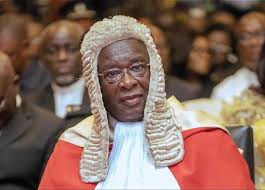
Ghana’s constitutional democracy is facing a fresh test of judicial independence after the opposition New Patriotic Party (NPP) demanded the resignation of Chief Justice Paul Baffoe-Bonnie, accusing him of crossing the line between institutional engagement and partisan politics.
The controversy erupted after comments attributed to the Chief Justice during visits to the Social Security and National Insurance Trust (SSNIT) and the Minerals Income Investment Fund (MIIF) on September 2, 2026.
At MIIF, Justice Baffoe-Bonnie praised the performance of the institution and questioned Ghana’s management over the previous eight years.
“I must congratulate you. I mean, you have done marvellously well. See, because sometimes when we hear the things that you have done, the things that some organisations are doing now, we wonder; some of us keep wondering what really we have been doing in the past eight years,” he said.
The remarks quickly became political.
The NPP, in a statement signed by General Secretary Justin Kodua Frimpong on September 3, said it received the video with “profound shock and disgust” and argued that the language was incompatible with the constitutional responsibilities of Ghana’s Chief Justice.
“Let it be stated plainly: this is not the language of a Chief Justice. It is the language of a party propagandist, of a kind exclusively reserved for NDC communicators and serial callers, and it has no place whatsoever in the mouth of the head of Ghana’s Judiciary,” the party stated.
The party subsequently demanded that Justice Baffoe-Bonnie retract the comments or resign and formally join the governing National Democratic Congress (NDC).
What exactly is the constitutional problem?
The NPP has based much of its argument on Articles 125 and 127 of the 1992 Constitution.
Article 125 states that justice emanates from the people and is administered by an independent Judiciary subject only to the Constitution. It also makes the Chief Justice head of the Judiciary and responsible for its administration and supervision.
Article 127 goes further by providing that the Judiciary, in both judicial and administrative functions, is subject only to the Constitution and cannot be controlled or directed by another person or authority.
The constitutional principle is therefore clear: Ghana’s judges must be institutionally independent.
But the more difficult question is whether a Chief Justice praising the performance of state institutions — even in language that appears politically comparative — amounts to a constitutional breach.
The available evidence does not establish that.
What it does establish is that the remarks have created a perception problem serious enough to trigger criticism from opposition politicians, civil society and legal commentators.
Professor Stephen Kwaku Asare, the Ghanaian legal scholar popularly known as Kwaku Azar, has urged the Chief Justice to exercise restraint in public commentary. He argued that references to the “past eight years” could be interpreted as a political assessment of one administration against another and therefore risk weakening confidence in judicial independence.
That criticism is important because judicial independence is not only about whether a judge actually decides cases impartially. It is also about whether reasonable citizens can have confidence that the institution is impartial.
The Chief Justice pushes back
Justice Baffoe-Bonnie has now responded to the controversy.
According to the Judicial Service, the Chief Justice said his observations were made in good faith and were not intended to undermine judicial independence.
“The observations were made in good faith and were not intended to serve a purpose inimical to judicial independence,” he said.
The Judicial Service also explained that his visit to MIIF formed part of institutional engagement aimed at strengthening collaboration between public institutions and the Judiciary.
MIIF independently confirmed that the September 2 engagement involved discussions about mining, investment, institutional governance and the legal framework surrounding Ghana’s mineral resources.
This context matters.
The Chief Justice was not attending an NDC rally or political party conference. He was visiting a state institution whose work intersects with legal, investment and natural-resource governance.
The controversy therefore rests primarily on the language used during the engagement, rather than evidence that the visit itself was unlawful or partisan.
Was the Chief Justice’s praise completely without factual basis?
This is where the financial records provide important context.
MIIF’s own published figures show that the institution recorded GH¢5.43 billion in mineral royalty receipts in 2025, up from GH¢4.90 billion in 2024.
The Fund also reported an audited profit of GH¢1.1 billion for 2025.
Its performance strengthened further in the first half of 2026, when MIIF reported GH¢5.39 billion in mineral royalty receipts — almost the entire amount collected during all of 2025.
MIIF Chief Executive Officer Justina Nelson attributed the performance to factors including stronger compliance monitoring, improved revenue mobilisation, high international gold prices and increased production.
The Ghana Chamber of Mines has also reported that mining generated GH¢23.11 billion in taxes in 2025, compared with GH¢20.87 billion in 2024, while total fiscal contributions, including dividends, reached GH¢24.22 billion.
There is therefore objective evidence of stronger mineral-revenue performance.
However, that does not automatically prove that the current government is better than the previous NPP administration.
MIIF itself has identified several drivers of its recent performance, including international gold prices and production levels. Its 2025 results also benefited from market conditions.
This distinction is crucial.
A stronger institutional performance can be measured through financial records. A political judgment about which administration governed better is a much broader proposition requiring evidence across the economy, public finances, governance, infrastructure and social outcomes.
CDD-Ghana raises a different warning
The Ghana Center for Democratic Development (CDD-Ghana) has not endorsed the NPP’s demand for resignation.
Instead, it called on the Chief Justice to exercise “the highest possible restraint and discretion” in his public engagements and commentary.
That position is significant.
CDD-Ghana is effectively drawing a line between accusing the Chief Justice of being partisan and warning that his public language could create a perception of partisanship.
Those are not the same thing.
There is currently no verified evidence establishing that Justice Baffoe-Bonnie is a member of the NDC or that he has formally acted on behalf of the governing party.
Indeed, when he was sworn in as Chief Justice in November 2025, Justice Baffoe-Bonnie pledged to uphold the rule of law, respect separation of powers and protect the Constitution.
“I will respect the independence of every Judge and ensure that the Judiciary remains free from improper influence,” he said at his swearing-in.
The Wontumi case: evidence of bias or political perception?
The NPP has also connected the controversy to the prosecution and conviction of its Ashanti Regional Chairman, Bernard Antwi-Boasiako, popularly known as Chairman Wontumi.
Wontumi was sentenced to 20 years’ imprisonment by an Accra High Court after being convicted in an illegal-mining case involving Akonta Mining Limited. The NPP has announced plans to appeal.
The party has alleged that the Judiciary is operating at “two speeds”, arguing that legal processes move with extraordinary speed in cases involving opposition figures.
It specifically cited the incarceration of Wontumi and the issuance of warrants in cases involving NPP-linked accused persons.
There is, however, an important factual distinction.
A bench warrant was indeed issued against Wontumi in October 2025 after he failed to appear in court, but the warrant was subsequently withdrawn after he appeared.
His later imprisonment resulted from a court conviction and sentence, not merely from the earlier bench warrant.
That distinction matters in an investigative report because the existence of a warrant is evidence of a judicial action; it is not, by itself, evidence of political persecution.
The Judiciary’s own problems
The NPP’s criticism of court infrastructure and administrative capacity also deserves examination.
Interestingly, the Chief Justice himself has repeatedly acknowledged weaknesses within the justice system.
In April 2026, Justice Baffoe-Bonnie said Ghana could not claim that everything was working perfectly, pointing to delays, barriers, cost and distance as continuing obstacles to justice.
The Judicial Service has also been pursuing reforms designed to reduce case backlogs, including an afternoon court-shift system, improved ICT infrastructure and specialised courts for areas such as environmental and illegal-mining cases.
The 2026 national budget reported that the E-Justice programme had reached 80 percent completion under its first phase, while more than 18 million legal records had been digitised and 110 additional transcription systems installed nationwide.
Infrastructure challenges nevertheless remain.
In July 2026, the Chief Justice cut the sod for a new 24-court complex in Cape Coast, with specialised divisions and ICT facilities, after concerns about the deteriorating condition of the existing court complex.
The evidence therefore supports a more nuanced conclusion: Ghana’s Judiciary has serious institutional challenges, but there is also an active reform programme.
What does the law say about removing the Chief Justice?
The NPP’s demand for resignation should not be confused with a constitutional removal process.
Under Article 146, a Chief Justice cannot simply be removed because a political party considers his comments inappropriate.
A petition for removal of the Chief Justice triggers a constitutionally prescribed process. The President, acting in consultation with the Council of State, appoints a committee comprising two Supreme Court Justices and three other persons who are not members of the Council of State, Parliament or the legal profession.
The committee investigates the petition and makes a recommendation to the President. The Constitution requires the President to act in accordance with that recommendation.
The constitutional grounds concern stated misbehaviour, incompetence or inability to perform the functions of office arising from infirmity.
Therefore, a political demand for resignation is not itself a legal finding of misconduct.
The latest intervention changes the political equation
On September 6, the Ghana Catholic Bishops’ Conference rejected the NPP’s demand for resignation, describing it as disproportionate.
The Bishops said the available evidence did not establish that the Chief Justice was partisan or that the Judiciary had been compromised. They argued that the Chief Justice could visit public institutions, assess their performance and acknowledge improvements without automatically becoming politically partisan.
That intervention leaves Ghana with a more complicated picture than the simple political narrative of “NPP versus Chief Justice”.
The opposition sees a dangerous erosion of judicial neutrality.
CDD-Ghana sees the need for restraint to protect public confidence.
Professor Kwaku Asare sees a need for political caution in the Chief Justice’s public language.
The Catholic Bishops see insufficient evidence to justify resignation.
And the Chief Justice himself says his observations were made in good faith and were not intended to undermine judicial independence.
The bigger question Ghana must confront
The deeper issue is not whether a Chief Justice is permitted to praise an efficient public institution.
He should be.
The more difficult question is whether the head of the Judiciary should publicly compare the performance of one political administration with another.
That is where the danger lies.
Judges may have personal political opinions. But the authority of the Judiciary depends heavily on public confidence that those opinions do not influence judicial decisions.
Justice Baffoe-Bonnie himself promised, upon assuming office, to protect judicial independence. His current controversy therefore provides an opportunity to test that commitment not through political rhetoric, but through transparency, restraint and demonstrable impartiality.
For the NPP, the challenge is equally serious.
Allegations of selective justice must be supported by comparative evidence: case timelines, bail decisions, warrants, adjournments, judicial assignments and outcomes across cases involving both government and opposition figures.
Without such evidence, accusations of “two-speed justice” remain political allegations rather than established facts.
For Ghanaian citizens, the stakes are much larger than the fate of one Chief Justice.
The Judiciary is the institution to which citizens ultimately turn when political power fails them.
That is why the Constitution declares that the Judiciary belongs to neither the President nor Parliament nor a political party.
The NPP put the principle starkly in its statement:
“The Judiciary belongs neither to the President, nor to the NDC, nor to the Chief Justice; it belongs to the people of Ghana, who are entitled under the Constitution to courts that are blind to politics.”
The real test now is whether Ghana’s political class, legal profession and Judiciary can ensure that those words remain more than a political slogan.
They must become the operating standard of the Republic.