

By Alex Ababio
Ghana and South Korea have officially begun negotiations aimed at extending visa-free travel arrangements to holders of ordinary passports in what analysts describe as a potentially transformative step for trade, tourism, technology transfer, education, and diplomatic relations between the two countries.
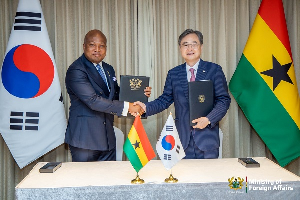
The development follows the signing of a historic Visa Waiver Agreement for diplomatic and service passport holders during the 2026 Korea–Africa Foreign Ministers’ Meeting in Seoul on June 1, 2026. The agreement, signed by Ghana’s Foreign Affairs Minister, Samuel Okudzeto Ablakwa, and South Korea’s Foreign Minister, Cho Hyun, marks the first visa waiver arrangement between Ghana and South Korea in nearly five decades of formal diplomatic relations.
“Negotiations will continue to bring on board holders of Ordinary Passports,” Ablakwa announced in a social media post after the signing ceremony.
The statement, though brief, has triggered significant interest among business leaders, education stakeholders, migration experts, and tourism operators who believe broader visa liberalisation between Ghana and South Korea could reshape bilateral engagement at a time when both countries are seeking new economic and strategic partnerships.
Beyond Diplomacy: Why the Visa Talks Matter
The newly signed agreement currently applies only to diplomatic and service passport holders, allowing eligible government officials and public servants from both countries to travel without visas for official duties.
However, ongoing negotiations targeting ordinary passport holders could affect thousands of Ghanaian entrepreneurs, students, skilled workers, tourists, and investors seeking easier access to South Korea — one of Asia’s leading industrial and technological economies.
The move also aligns with Ghana’s expanding visa diplomacy strategy under President John Dramani Mahama, whose administration has intensified efforts to deepen economic and political ties across Africa, Asia, and the Middle East.
Government sources confirmed that discussions on the visa waiver initiative accelerated after Mahama’s working visit to South Korea in March 2026, where bilateral cooperation in technology, energy, trade, and industrial development featured prominently.
According to Ghana’s Foreign Affairs Ministry, both governments had tasked their foreign ministries earlier this year to conclude negotiations on visa arrangements by June 2026.
The latest agreement is therefore being viewed not as an isolated diplomatic gesture, but as part of a broader geopolitical and economic strategy.
Korea’s Expanding African Footprint
South Korea’s growing engagement with Africa has intensified in recent years as Seoul seeks new markets, strategic mineral partnerships, manufacturing opportunities, and supply chain diversification amid rising geopolitical tensions and global economic uncertainty.
At the Korea–Africa Foreign Ministers’ Meeting held in Seoul, Korean Foreign Minister Cho Hyun emphasized that Africa has become a “key hub for global connectivity and future growth.”
The meeting brought together representatives from more than 50 African countries, alongside institutions including the African Union, African Development Bank, African Continental Free Trade Area Secretariat, and the Africa Centres for Disease Control and Prevention.
According to South Korea’s Foreign Ministry, discussions focused heavily on supply chain resilience, industrial cooperation, science and technology partnerships, health security, and sustainable economic development.
For Ghana, analysts say easier mobility arrangements with South Korea could unlock new opportunities in electronics manufacturing, automobile assembly, education exchanges, artificial intelligence, renewable energy, and digital innovation.
“This is not just about visas. It is about economic positioning,” said Dr. Theo Acheampong, political risk analyst and economist at the European Centre for Energy and Resource Security, in previous interviews on Ghana’s international economic diplomacy.
According to trade experts, South Korea’s globally dominant firms — including Samsung, Hyundai, LG, and Kia — already maintain growing commercial interests across Africa, including Ghana.
Trade and Investment Potential
Official trade figures show that bilateral economic relations between Ghana and South Korea have steadily expanded over the years, though analysts argue the partnership remains underdeveloped relative to its potential.
South Korea imports raw materials and minerals from Africa while exporting electronics, vehicles, machinery, chemicals, and industrial equipment to the continent.
Ghana, on the other hand, continues to seek foreign investment into sectors such as renewable energy, infrastructure, agriculture, industrial processing, digital technology, and mining value addition.
Policy researchers believe a visa waiver for ordinary passport holders could reduce bureaucratic barriers that often discourage business travel and investment exploration.
“Mobility is increasingly becoming a competitive economic tool in global diplomacy,” said Dr. Vladimir Antwi-Danso, Dean of Academic Affairs and Research at the Ghana Armed Forces Command and Staff College, in previous commentary on Ghana’s foreign policy orientation.
“When countries reduce travel restrictions, they create pathways for business confidence, educational exchanges, and strategic trust.”
Tourism and Education Could See Major Boost
Tourism operators say visa-free access could significantly increase cultural exchanges and tourism flows between the two countries.
South Korea’s global cultural influence through K-pop, Korean cinema, technology brands, and digital entertainment has grown substantially among Ghanaian youth over the past decade.
At the same time, South Korea has expanded scholarship opportunities and technical training programmes for African students under initiatives supported by the Korea International Cooperation Agency (KOICA).
Education consultants in Accra say Ghanaian student interest in South Korean universities has increased sharply in recent years, particularly in engineering, information technology, robotics, and medical sciences.
Currently, Ghanaian travelers often face lengthy visa application procedures, documentation requirements, and travel uncertainties when seeking entry into South Korea.
A full visa waiver regime for ordinary passport holders would therefore represent a major breakthrough for mobility and academic collaboration.
Security and Migration Concerns Remain
Despite optimism surrounding the negotiations, migration and border management experts caution that visa liberalisation also comes with security and regulatory considerations.
International visa waiver agreements usually involve complex negotiations around immigration enforcement, overstays, data sharing, border security cooperation, and reciprocal treatment of citizens.
Security analysts say both Ghana and South Korea will likely conduct extensive assessments before finalising any broader arrangement.
South Korea maintains some of Asia’s strictest immigration monitoring systems, particularly regarding labour migration and visa compliance.
At the same time, Ghana has increasingly positioned itself as one of Africa’s more open economies for international mobility and continental integration.
In recent years, Ghana has expanded visa-free or visa-on-arrival arrangements for several African and Caribbean countries as part of wider Pan-African and diaspora engagement policies.
Earlier this year, Ghana and Zambia also signed a visa-free travel agreement aimed at strengthening regional integration and economic cooperation.
A Strategic Shift in Ghana’s Foreign Policy
Foreign policy observers say the Ghana–South Korea visa negotiations reflect a broader recalibration of Ghana’s diplomatic strategy toward economic diplomacy and South-South cooperation.
At the Seoul ministerial meeting, Ablakwa called for a “transformative economic collaboration” between Africa and South Korea that would create jobs, promote technology transfer, and strengthen industrial capacity across the continent.
The Ghanaian minister argued that Africa-Korea relations must evolve beyond traditional aid frameworks toward deeper economic partnerships built on mutual benefit.
That position mirrors ongoing continental efforts under the African Continental Free Trade Area (AfCFTA), whose secretariat is headquartered in Accra.
Economic analysts say Ghana’s strategic importance as a gateway into West Africa, combined with South Korea’s industrial capabilities, makes the relationship potentially significant for future investment flows.
What Happens Next?
While negotiations involving ordinary passport holders are ongoing, officials from both countries have yet to announce a timeline for implementation or details regarding permitted duration of stay, work rights, or entry conditions.
Diplomatic sources indicate that technical discussions are expected to continue over the coming months as both governments work through legal and immigration frameworks.
Still, the symbolism of the agreement is already substantial.
After nearly 50 years of formal diplomatic relations, Ghana and South Korea appear to be entering a new phase of engagement — one driven not only by diplomacy, but increasingly by trade, technology, mobility, and strategic economic cooperation.
If the talks succeed, ordinary Ghanaian travelers, students, entrepreneurs, and professionals could soon gain significantly easier access to one of Asia’s most technologically advanced economies — a move experts say could reshape bilateral relations for decades to come.