

By Alex Ababio
President John Dramani Mahama has used the global stage of the 79th World Health Assembly in Geneva to project Ghana’s cultural identity and growing influence in international health diplomacy, presenting a symbolic Ghanaian cultural plaque to the headquarters of the World Health Organization (WHO).
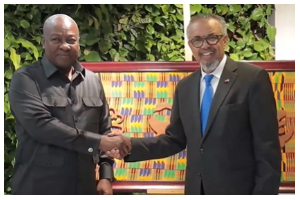
The presentation, held on May 18, 2026, on the sidelines of the Assembly in Switzerland, combined health diplomacy with cultural heritage in what officials described as a historic gesture by Ghana toward the UN health agency.
The plaque, mounted on traditional Ghanaian Kente cloth and adorned with renowned Adinkra symbols, was formally handed over to WHO Director-General Tedros Adhanom Ghebreyesus, who praised Ghana’s recent healthcare reforms and described the country’s message on health sovereignty as one that resonated strongly throughout the Assembly.
Speaking during the symbolic presentation, President Mahama said Ghana’s contribution to the global community extends beyond health policy and medical cooperation.
“We have our cultural identities, we have our artefacts, and aside from just saving lives, we all must also identify with our cultural identity. So today, we are happy to present a gift that will be placed here at the headquarters of the WHO to show what Ghanaian identity is,” President Mahama stated.
Adinkra Symbols Carrying Ghana’s Message to the World
At the centre of the plaque are some of Ghana’s most recognizable Adinkra symbols — visual representations deeply rooted in Akan philosophy, spirituality, governance, and moral teaching.
President Mahama explained the meanings behind the symbols during the presentation, emphasizing that Ghana’s cultural traditions remain relevant in modern global conversations about resilience, humanity, and collective wellbeing.
Among the symbols featured prominently is the “Sankofa Bird,” one of Ghana’s most internationally recognized cultural symbols. The symbol depicts a bird turning backward while carrying an egg in its beak, representing the philosophy of learning from the past to guide the future.
Other symbols included “Nyame Dua,” symbolizing divine protection and God’s presence; “Dwennimmen,” associated with humility, strength, wisdom, and lifelong learning; and “Gye Nyame,” which expresses the supremacy and omnipotence of God.
Cultural historians and researchers have long described Adinkra symbolism as one of West Africa’s most enduring systems of philosophical communication. According to multiple academic and heritage studies, the symbols are widely used in Ghanaian architecture, textiles, governance regalia, pottery, branding, and ceremonial traditions.
Online communities focused on preserving Ghanaian heritage have recently intensified digitisation efforts around Adinkra symbolism. Discussions on Ghanaian technology and culture forums indicate that developers and designers are increasingly building digital libraries and software tools around Ghanaian symbols to preserve cultural identity in the digital era.
WHO Commends Ghana’s Healthcare Reforms
The cultural presentation came at a time when Ghana is receiving growing international attention for its new Free Primary Healthcare programme, one of President Mahama’s flagship healthcare initiatives.
WHO Director-General Dr. Tedros Adhanom Ghebreyesus has publicly praised the initiative, describing it as a major step toward achieving Universal Health Coverage in Ghana.
In a public statement earlier this year, Dr. Tedros said:
“This important milestone brings Ghana closer to achieving Universal Health Coverage. Strong primary health care is essential to improving population health, enabling earlier detection, timely treatment, and more effective disease prevention.”
The Free Primary Healthcare initiative, launched officially in April 2026, is designed to complement Ghana’s National Health Insurance Scheme (NHIS) by eliminating financial barriers at the community healthcare level.
Government documents and Ghana Health Service reports indicate that the programme targets underserved populations through Community-based Health Planning and Services (CHPS) compounds, polyclinics, and district-level health facilities.
According to President Mahama, the programme places strong emphasis on preventive healthcare and early detection of diseases such as hypertension, diabetes, and other non-communicable diseases, which health experts say are becoming a growing burden across Africa.
The Ghanaian government has already procured more than 24,000 pieces of medical equipment valued at over GH¢500 million to support implementation nationwide, according to official reports.
Health Diplomacy and Soft Power
International relations analysts say the Geneva presentation represents more than ceremonial symbolism. It reflects Ghana’s attempt to combine soft power diplomacy with global health engagement.
African countries have increasingly sought to project cultural identity within international institutions as debates around decolonisation, African representation, and cultural sovereignty gain momentum globally.
By placing Ghanaian cultural symbols inside WHO headquarters, analysts say Ghana is positioning itself as both a contributor to global healthcare reforms and a custodian of African heritage.
Officials familiar with the ceremony described the gesture as the first time an African country has presented such a symbolic cultural installation to the WHO headquarters in Geneva.
The move also aligns with broader continental conversations around reclaiming African narratives within international institutions traditionally dominated by Western symbolism and historical influence.
Ghana’s Push for Universal Health Coverage
At the World Health Assembly, President Mahama used his address to outline Ghana’s broader healthcare reform agenda, arguing that African countries can build resilient healthcare systems through strong political commitment and targeted investments.
According to the President, Ghana’s NHIS currently covers approximately 66 percent of the population, while reforms to the scheme have unlocked an estimated GH¢3 billion in additional health funding after the removal of funding caps.
He also disclosed that Ghana is introducing digital systems and artificial intelligence tools to reduce fraud and improve efficiency within the healthcare system.
Public health experts have consistently argued that African countries must strengthen primary healthcare systems to reduce pressure on tertiary hospitals and improve long-term health outcomes.
The WHO has repeatedly emphasized that strong primary healthcare systems are essential for achieving Sustainable Development Goal 3 on universal health coverage and improved public health outcomes globally.
Cultural Identity Meets Global Governance
For many Ghanaian observers, the symbolism of the Geneva presentation extends beyond politics and diplomacy.
The use of Kente cloth and Adinkra symbols at one of the world’s most influential health institutions represents a deliberate attempt to elevate indigenous African knowledge systems and cultural philosophies within global governance spaces.
Cultural advocates in Ghana have frequently expressed concerns that younger generations are becoming disconnected from traditional symbols and meanings due to rapid urbanisation and Western cultural influence. Online discussions among Ghanaian cultural preservation groups reveal growing calls for greater integration of Adinkra education into schools, digital platforms, and international branding.
The WHO plaque presentation therefore arrives at a moment when Ghanaian identity itself is becoming part of a wider national conversation about heritage preservation, cultural branding, and global representation.
For President Mahama’s administration, the event appears to serve multiple purposes simultaneously: reinforcing Ghana’s diplomatic visibility, promoting healthcare reforms, and projecting Ghanaian culture onto one of the world’s largest multilateral stages.
As the plaque takes its place inside WHO headquarters in Geneva, Ghana’s message appears clear — health diplomacy, cultural identity, and African representation can coexist within the same global conversation.