

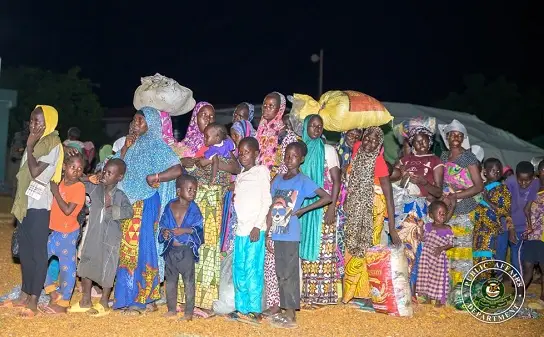
A Quiet Dawn Operation That Exposed a Bigger National Concern
By Alex Ababio
A pre-dawn enforcement operation by the Ghana Immigration Service (GIS) in Kumasi has triggered renewed national attention on child exploitation, irregular migration, and alleged street-begging syndicates operating in major Ghanaian cities.
In the operation, GIS officers reportedly rescued 606 undocumented migrants, including 381 children, from locations suspected to be linked to organized street-begging networks.
The exercise, which took place in the Ashanti Regional capital, is part of a broader national immigration enforcement strategy targeting irregular migration and human trafficking-related activities.
While GIS has not released full biometric breakdowns or nationalities of those rescued at the time of reporting, earlier enforcement patterns in similar operations across Ghana’s urban centres often involve migrants from neighbouring West African countries, reflecting regional mobility under ECOWAS protocols.
What the GIS Operation Reveals About Urban Migration Pressures
The Kumasi operation is not an isolated case.
Over the past decade, Ghana’s major cities—Accra, Kumasi, Tamale, and Takoradi—have witnessed recurring immigration enforcement exercises involving undocumented migrants engaged in street hawking and begging.
According to multiple public reports and assessments by migration agencies, Ghana remains both a destination and transit hub within West Africa due to:
Relative political stability
Economic opportunities in urban centres
ECOWAS free movement protocol allowing regional travel
However, this same mobility framework has also created enforcement challenges when migrants become vulnerable to exploitation or informal networks.
The International Organization for Migration (IOM) has consistently noted in its West Africa migration briefs that irregular migration flows in the sub-region are often shaped by economic hardship, informal recruitment networks, and cross-border trafficking vulnerabilities.
Children at the Centre of the Operation
The most striking detail from the Kumasi exercise is the number of children involved—381 minors, representing more than half of those rescued.
This immediately raises concerns about child protection, trafficking risks, and forced exploitation.
Ghana’s Human Trafficking Act, 2005 (Act 694) criminalizes the exploitation of persons, particularly children, for forced labour or begging.
In similar cases documented by child protection agencies, children found in street-begging environments are often:
Trafficked or transported across borders
Placed under guardians who are not their biological parents
Subjected to forced begging quotas
Living in unsafe, overcrowded conditions
The United Nations Children’s Fund (UNICEF) has repeatedly warned in regional child protection reports that street-connected children in West Africa face heightened risks of exploitation, violence, and long-term deprivation of education and healthcare access.
Although each case is unique, child protection experts generally agree that large-scale presence of minors in informal street systems often signals deeper organized structures rather than purely individual migration decisions.
Ghana Immigration Service Enforcement Mandate
The Ghana Immigration Service operates under the Ministry of the Interior and is responsible for:
Border management
Monitoring lawful entry and residence of foreigners
Detecting and preventing irregular migration
Supporting anti-human trafficking enforcement
Over the years, GIS has intensified urban immigration enforcement operations, particularly in response to growing public concern about street begging networks in major cities.
Former Comptroller-General of Immigration, Kwame Asuah Takyi, previously emphasized in public engagements that Ghana’s immigration enforcement approach increasingly integrates intelligence-led operations rather than routine street sweeps. His tenure focused heavily on strengthening border control systems and inter-agency collaboration.
Although GIS has not publicly confirmed whether arrests or prosecutions will follow the Kumasi operation, standard procedure in such cases typically involves:
Screening and biometric registration
Determination of nationality and immigration status
Referral of minors to the Department of Social Welfare
Possible repatriation or family tracing for foreign nationals
The Hidden Economy of Street Begging Networks
One of the most complex dimensions of such operations is the alleged existence of structured street-begging syndicates.
While Ghanaian authorities have periodically raised concerns about organized exploitation, the phenomenon is widely reported across West African cities, including Lagos, Abidjan, and Dakar.
Investigations by regional media and civil society organizations have described patterns where:
Adults control groups of children in public spaces
Earnings from begging are collected centrally
Children are rotated across locations to maximize visibility
Mobility is tightly controlled to prevent escape
However, it is important to note that proving organized criminal syndicates requires extensive legal investigation, not just immigration enforcement action.
Regional Migration Dynamics: Why Ghana Becomes a Destination
Ghana’s position within ECOWAS makes it a natural destination for intra-regional migration.
Under the ECOWAS Protocol on Free Movement of Persons, citizens of member states can enter Ghana without a visa for up to 90 days.
This policy has supported:
Trade and labour mobility
Regional integration
Cultural exchange
But migration analysts have also warned that gaps in documentation, enforcement capacity, and urban welfare systems can lead to irregular settlement patterns.
The World Bank and IOM have both highlighted that urban informal economies in West Africa absorb large migrant populations who often lack access to formal employment, increasing vulnerability to exploitation.
Child Protection Gaps and Institutional Pressure
The Kumasi operation raises critical questions about Ghana’s child protection infrastructure.
Key institutions involved include:
Department of Social Welfare
Ghana Police Service (Anti-Human Trafficking Unit)
Ghana Immigration Service
Ministry of Gender, Children and Social Protection
However, coordination challenges have often been reported in handling large-scale migrant child cases, particularly when:
Identity verification is difficult
Guardianship is unclear
Cross-border repatriation is required
Child protection advocates argue that enforcement alone is not enough without sustained rehabilitation, education access, and reintegration programmes.
What Happens Next for the 606 Rescued Migrants?
Following standard procedure, the rescued individuals are expected to undergo:
1. Screening and documentation
Determining nationality, age verification, and migration status.
2. Child protection referral
Minors are typically handed to the Department of Social Welfare.
3. Family tracing or repatriation
For foreign nationals, embassies or consulates may be involved.
4. Investigation phase
Authorities may investigate whether trafficking or exploitation networks are involved.
However, outcomes vary depending on resources, diplomatic coordination, and the legal classification of each case.
Broader Policy Implications for Ghana
The Kumasi operation is likely to intensify national debate around three major policy issues:
1. Urban migration control
How Ghana manages informal settlements of foreign nationals in cities.
2. Child trafficking prevention
Strengthening identification and prosecution of exploitative networks.
3. Regional migration governance
Improving ECOWAS implementation while balancing security concerns.
Experts in migration governance often argue that West African states face a dual challenge: maintaining open regional borders while preventing exploitation networks from abusing mobility systems.
Conclusion: A Case That Reflects a Larger Regional Reality
The rescue of 606 migrants in Kumasi, including 381 children, is more than an isolated enforcement operation. It reflects deeper structural challenges tied to regional migration, urban poverty, child protection gaps, and informal economies across West Africa.
While the Ghana Immigration Service continues its enforcement mandate, the long-term solution will likely require coordinated regional action involving migration policy reform, stronger child protection systems, and cross-border intelligence cooperation.
For now, the Kumasi operation stands as a stark reminder that behind street-level enforcement actions lies a complex web of human mobility, vulnerability, and survival across borders.