

By Alex Ababio
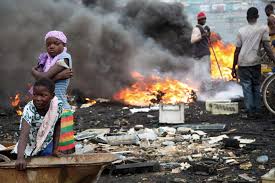
Agbogbloshie, Accra – The smoke rises before dawn, a gray-brown plume that curls from a mountain of burning electronics, plastic waste, and scrap metal. It does not smell like woodsmoke from a village kitchen. It smells acrid, chemical, like something being dissolved. By midday, the entire neighborhood is wrapped in a haze that stings the eyes and catches in the throat.
In the shadow of this toxic cloud, Adiza Mohammed has raised four children. She has lived in Agbogbloshie for eighteen years, in a cramped room she shares with two of her grandchildren. Every morning, she wakes to the same ritual: coughing.
“My chest hurts all the time,” she says, pressing a hand to her sternum. “The children are always sick. Fever, cough, trouble breathing. The hospital at Korle Bu, they say it is the smoke. But where am I supposed to go?”
Across Accra, in the gleaming offices of the Environmental Protection Authority, the official air quality data tells a different story. On most days, the EPA’s reference-grade monitors in Accra record pollution levels classified as moderate. The numbers hover around 21 micrograms per cubic meter of PM2.5, the fine particulate matter that lodges deep in the lungs and enters the bloodstream. By the standards of many global cities, this looks acceptable.
But Adiza Mohammed is not breathing the air at the EPA’s monitoring stations. She is breathing the air where she lives. And the gap between these two realities is a matter of life and death.
The Numbers That Do Not Tell the Whole Story: Ghana’s 28,000 Silent Deaths
In 2025, Ghana ranked as the 32nd most polluted country in the world, according to the IQAir World Air Quality Report. The national annual average PM2.5 level stood at 21.3 micrograms per cubic meter, more than four times higher than the World Health Organization’s recommended guideline of 5 micrograms per cubic meter.
The WHO estimates that 28,000 premature deaths occur in Ghana every year as a result of air pollution . That is one death approximately every nineteen minutes. But a more recent study by PSS Urbania Consult, released in September 2025 with technical support from the Clean Air Fund, found that air pollution now accounts for over 30,000 annual deaths in Ghana, making it the leading cause of death in the country, surpassing HIV/AIDS, malaria, and road traffic accidents combined .
Air pollution is now the highest health risk factor for death and disability in the country. Young children and adults over fifty are most at risk of disease and premature death . Pollution sources include vehicular emissions, open waste burning, use of firewood, pesticides from farming activities, and dust from road construction .
But these national figures obscure a deeper, more troubling pattern. The pollution is not evenly distributed. Low-income communities, particularly those near industrial zones, landfills, and open burning sites, breathe air that is significantly more toxic than the official averages suggest.
A peer-reviewed study published in Contemporary Social Science in 2025, co-authored by Nana O. Bonsu and colleagues, investigated ambient air pollution in urban Ghana using citizen science methods and real-time monitoring with low-cost sensors. Measurements taken at three urban hotspots revealed concentrations of PM2.5, PM10, and Nitrogen Oxides exceeding WHO guidelines, with direct links to respiratory illnesses, reduced productivity, and increased healthcare costs. The study concluded that citizen science effectively bridges data gaps and raises public awareness about air quality, particularly in areas where official monitoring infrastructure is sparse.
For Adiza, these studies confirm what she has known for years. “The smoke does not care if you are rich or poor,” she says. “But it knows where to find you.”
Where Are the Monitors? The Geography of Neglect
Ghana’s official air quality monitoring network is concentrated in a handful of locations. The EPA operates reference-grade monitors in Accra, Kumasi, Takoradi, and Tarkwa. In August 2025, the EPA established a permanent air quality monitoring network in Tema, the country’s main port and industrial city, installing seven low-cost sensors at Kpone, Bethlehem (Tulaku), Communities Three, Seven and 25, Tema Manhean, and the Tema Port .
Selina Okaebea Amoah, Head of the Environmental Quality Unit at the EPA, explained the rationale for the Tema expansion.
“Air pollution has become a major environmental issue with public health consequences, contributing to health challenges including respiratory and cardiovascular diseases,” she told the Ghana News Agency in August 2025 . “The level of pollution and efficiency of interventions can only be determined by monitoring, making the project critical in establishing pollution levels in Tema.”
But even this expanded network remains thin. Amoah acknowledged that “the number of sensors is inadequate as compared to the ideal case of one monitor at every four kilometer radius. There is the need to add more sensors, considering the size of the industrial hub and adjoining communities” .
The question of where monitors are placed is not merely technical. It is a question of environmental justice. Wealthier neighborhoods, with greater political influence and fewer pollution sources, are less likely to host monitors that might produce alarming readings. Poorer communities, where the pollution is worst, are often the least measured.
Dr. Henry Kokofu, then Executive Director of the EPA, described the situation as dire during the inauguration of three new monitoring stations in Accra in a partnership with the American Embassy. “One hundred percent of the entire population, both in urban and rural areas, is exposed to particulate matter concentrations levels exceeding the WHO guidelines,” he said. The World Bank estimates the cost of air pollution in Ghana’s two largest cities, Accra and Kumasi, at 264 million dollars per year.
Professor Nana Ama Klutse, Acting Chief Executive Officer of the EPA, has stated that pollution costs Ghana nearly USD 2.49 billion annually, underscoring the urgency of tackling the issue . “Air, water, and chemical pollution have direct public health consequences—ranging from respiratory and cardiovascular diseases to neurological impacts,” she said. “This is why pollution has been identified as one of the three planetary crises, alongside climate change and biodiversity loss” .
The Human Toll at Korle Bu Teaching Hospital
At the Korle Bu Teaching Hospital, Ghana’s largest tertiary referral center, pulmonologists are seeing the consequences of this invisible crisis in their wards every day. Dr. Yaw Ampem Amoako, a senior specialist in respiratory medicine, has watched the pattern shift over his fifteen years of practice.
“We are seeing younger patients with chronic respiratory diseases that we used to associate with old age,” he says, seated in his cramped office overlooking the hospital’s busy courtyard. “Asthma, chronic obstructive pulmonary disease, even lung cancers. And almost always, when you ask about their living environment, they describe the same things. A home near a landfill. A workplace beside a busy, unpaved road. A neighborhood where open burning is a daily occurrence.”
The academic literature supports his observations. A 2025 study evaluating coastal resilience policies across six Anglophone West African countries found that while Ghana has the most extensive policy supporting environmental resilience in the region, the policy was strong on themes of data gathering and conservation but weak on the themes of alternative livelihoods and inclusion of indigenous knowledge.
In the context of air pollution, this means the data is being collected. But the question of what communities can actually do about the pollution they breathe is not being adequately addressed.
For Adiza, the hospital has become a familiar place. “My grandson, he is five years old, he has been to Korle Bu three times this year,” she says. “Each time, they give him medicine for the coughing. They tell me to keep him away from the smoke. But the smoke is everywhere. It is in my room. It is in his lungs. There is no away.”
The Low-Cost Solution That Reveals the Truth
Across Africa, a quiet revolution in air quality monitoring is underway. Organizations like AirQo, based at Makerere University in Uganda, are deploying low-cost solar-powered sensors that can operate off-grid, even in areas with unreliable electricity and patchy internet connectivity .
Richard Sserunjogi, AirQo’s Data Science Lead, explained the transformative potential of this technology in an October 2025 interview.
“Low-cost sensors open entirely new possibilities for cities,” he said . “Unlike reference-grade monitors, the low-cost sensors are far more affordable, enabling wider deployment at a fraction of the cost. Their scalability allows cities to install multiple monitors across neighborhoods, generating a hyperlocal view of pollution hotspots” .
In Ghana, this technology is beginning to fill the gaps left by the official network. The EPA’s Tema network uses low-cost sensors, and the data is publicly accessible through OpenAQ.org . But coverage remains uneven. Twelve African countries continue to rely exclusively on low-cost sensors, which provide preliminary data that must be refined over time through a process called collocation, where low-cost sensors are placed alongside reference-grade monitors for calibration .
The gap between official and citizen-collected data can be striking. A study published in Frontiers in Malaria in 2025 examining ITN use in poorly urbanized and slum areas of Accra found that less than 2 percent of children in these areas sleep under fully functional insecticide-treated nets. The same neighborhoods that lack malaria protection are also those most exposed to air pollution. The pattern is consistent across multiple health indicators: the poor are always the most exposed.
Dr. Lawrencia Osae-Nyarko of the Public Health Research Unit of the CSIR-Water Research Institute has called on the government to channel part of the Ghana Medical Care Trust Fund, popularly known as ‘Mahama Cares,’ into air quality monitoring . She proposed that five per cent of the Fund, amounting to about GH¢2.9 billion, be dedicated to purchasing high-grade monitors to safeguard citizens against rising health risks .
The Smoke Never Rises Evenly: What the Science Says About Agbogbloshie
The scientific evidence from Agbogbloshie is devastating. A 2025 study published in Process Safety and Environmental Protection examined soil, air, and livestock milk samples across different functional zones of the e-waste scrapyard . The findings revealed severe heavy metal contamination with soil concentrations in burning areas reaching 17.6 grams of copper per kilogram and 6.6 grams of lead per kilogram, far exceeding FAO thresholds .
Air quality measurements demonstrated significant temporal variations, with PM2.5 levels in herding areas reaching 496 micrograms per cubic meter, 33 times above WHO guidelines . Livestock milk analysis showed significant heavy metal contamination, with 41 milligrams of zinc per liter in cattle, 44 milligrams per liter in goats, and 28 milligrams per liter in sheep, exceeding WHO and FAO thresholds .
Most alarmingly, dioxin (PCDD/F) and PCB concentrations in milk from burning areas reached 32 picograms WHO-TEQ per gram of fat, substantially exceeding global safety standards . This indicates severe risks of contamination transfer through the food chain, particularly for children, with hazard indices 8.3 times higher than for adults .
Pure Earth Ghana has conducted Blood Lead Level studies which revealed dangerously high lead exposure in children living near e-waste hotspots . Studies have shown that soil and air samples from Agbogbloshie contain lead concentrations up to 100 times higher than international safety limits, exposing residents, especially children, to severe health risks .
Adiza does not know these numbers. But she sees the children in her neighborhood. “There is a boy, three doors down, he is seven years old,” she says. “He cannot walk properly anymore. His legs shake. The doctors say it is the lead. His mother sells scrap metal. What is she supposed to do? Stop working? Let her children starve?”
A New Law, But Will It Work? Ghana’s Regulatory Response
In September 2025, Ghana took a significant step forward. The EPA introduced the Air Quality Management Regulation, a landmark policy that replaces a voluntary reporting system with mandatory air quality reporting and establishes centralized data systems to improve accuracy, transparency, and policy planning.
In July 2025, Ghana launched the Ghana Online Continuous Emissions Monitoring System (GOCEMS), a real-time monitoring system to track industrial emissions and discharges nationwide . The initiative marks a decisive departure from the former self-reporting regime, enabling swift detection of environmental threats and immediate alerts to industries on non-compliant parameters .
Dr Ibrahim Murtala Muhammed, Minister for Environment, Science, Technology and Innovation, noted that rapid industrialisation had intensified air pollution, contributing to severe health conditions and premature deaths . He emphasized that traditional monitoring methods, while useful, are reactive and do not provide timely data to prevent pollution incidents .
Additionally, Ghana is finalising a draft bylaw for implementation by Metropolitan, Municipal and District Assemblies to complement national efforts to reduce air pollution . The bylaw, once enforced, will impose a fine of up to 100 penalty units (GHS 1,200), a prison term of 30 to 180 days, or both, on individuals or vehicles found polluting the air through prohibited activities such as open burning, vehicular emissions, construction dust, and small-scale industrial pollution .
Emmanuel Appoh, the local focal person and WHO Temporary Advisor on Air Quality Guideline Development, noted that Ghana has already made progress. “With combined efforts, Ghana has been able to reduce pollution levels from 78 particulate matter to 44 over a 15-year period,” he said at the inauguration of the Accra monitoring stations. “But we have to work harder to get to the 35 under target three and then 25 under target two of the WHO requirement.”
The 2025 IQAir report offered a glimmer of hope. After years of rising pollution, Ghana’s PM2.5 level dropped to 21.3 micrograms per cubic meter in 2025, a significant reduction from 35.8 in 2024. This suggests that the measures being implemented may be starting to work.
But for the residents of Agbogbloshie, Tulaku, and countless other pollution hotspots across Ghana, the improvement in national averages does not translate into cleaner air in their lungs.
Dr. Elvis Kyere-Gyeabour, Portfolio Manager at Breathe Cities, noted that in areas like Kaneshie and Tetteh Quarshie, levels could spike to as high as 200 microgrammes per cubic metre within 24 hours, posing serious health risks . He encouraged the adoption of electric vehicles and other eco-friendly transport options as part of the solution .
The Climate Connection: Why Warming Means Sicker Air
As climate change intensifies, the problem will only worsen. Higher temperatures accelerate the chemical reactions that produce ground-level ozone and other harmful pollutants. Extreme weather patterns, including the unseasonable rainfall that has disrupted Ghana’s traditional seasons, can trap pollution close to the ground, creating stagnant air masses that do not disperse.
The WHO has warned that between 2030 and 2050, climate change is expected to cause approximately 250,000 additional deaths per year globally from malnutrition, malaria, diarrhea, and heat stress alone. Air pollution deaths are not yet included in that estimate, but the intersection is clear. A hotter planet means dirtier air. And dirtier air means more Ghanaians will die before their time.
Dr. Frank Lule, World Health Organization Officer in Charge in Ghana, speaking at a workshop on climate change and health vulnerability assessment in Accra in December 2025, emphasized the interconnected nature of the climate crisis. “This assessment is a vital tool that helps us understand how climate change is affecting the health of Ghanaians, from increased disease burden to impact on service delivery, and how we can adapt.”
For Adiza, climate change is not a theory. “The heat is worse now than when I first came to Agbogbloshie,” she says. “The smoke sits on the ground. It does not rise. It stays in our throats. The children cannot play outside in the afternoon. The air is too thick.”
EPILOGUE: Still Breathing Poison, Still Waiting for the Monitors to See
Back in Agbogbloshie, Adiza Mohammed has stopped checking the air quality apps on her phone. “There is no point,” she says. “They tell me the air is fine. But I can see the smoke. I can taste it. My grandchildren wake up coughing. The app does not live in my room.”
She gestures toward the burning dump in the distance, where workers in worn sandals pick through smoldering piles of electronic waste, extracting copper and aluminum to sell by the kilogram. An estimated 150,000 tons of discarded electronics are processed at Agbogbloshie each year, much of it through open burning and informal recycling .
“The men who work there, they do not live long,” she says quietly. “They cough blood. They die young. But what can they do? They have families to feed. The smoke does not care if you are poor. But it knows where you live.”
In September 2025, a high-level validation workshop for Air Quality Action Plans developed for 13 Metropolitan, Municipal and District Assemblies within the Greater Accra Region took place . The workshop brought together key stakeholders from the Ministry of Local Government, the Greater Accra Regional Coordinating Council, the National Development Planning Commission, and the Ghana Institute of Planners . The findings presented identified key pollution hotspots across 15 municipalities in the Greater Accra Metropolitan Area .
The Director of Policy Planning at the Ministry of Local Government, Usama Iddrisu Samu, emphasized the urgency of addressing air pollution as a national development priority. “Cleaner air is not just an environmental aspiration, but a development priority that must be at the heart of our national agenda,” he said
But in Agbogbloshie, these words feel distant. Adiza does not attend validation workshops. She does not read policy documents. She wakes up every morning, coughs, and wonders if this will be the year her grandchildren can breathe freely.
“I want my grandchildren to grow up,” she says, pulling a thin cloth over her mouth as another gust of wind carries the smoke toward her doorway. “I want them to breathe. Is that too much to ask?”
The answer, for now, is written in the air itself. And the air is not clean. Not in Agbogbloshie. Not in Tulaku. Not in the places where Ghana’s poorest citizens live and work and cough and die.
The monitors may not see it. But Adiza Mohammed does. And she is still waiting for the data to catch up to her reality.
Behind her, the smoke continues to rise. Somewhere in Accra, a screen displays a number: 21.3 micrograms per cubic meter. Acceptable. Moderate. Safe.
In Agbogbloshie, a grandmother holds her coughing grandchild and knows the truth that no monitor can measure. The cost of clean air is not a number. It is a life. And for now, that cost remains too high.
Key Statistics from the Article
Over 30,000 premature deaths annually in Ghana from air pollution, making it the leading cause of death, surpassing malaria and HIV/AIDS combined
Ghana ranked 32nd most polluted country in the world in 2025, with national average PM2.5 at 21.3 micrograms per cubic meter, more than four times WHO’s recommended guideline of 5 micrograms per cubic meter
Air pollution costs Ghana an estimated USD 2.49 billion annually
The World Bank estimates the cost of air pollution in Accra and Kumasi alone at 264 million dollars per year
28,000 premature deaths recorded every year as a result of air pollution in Ghana according to WHO
Air pollution is the highest health risk factor for death and disability in Ghana, after malnutrition
Young children and adults over 50 are most at risk of disease and premature death
PM2.5 levels in herding areas of Agbogbloshie reached 496 micrograms per cubic meter, 33 times above WHO guidelines
Soil concentrations in burning areas reached 17.6 grams of copper per kilogram and 6.6 grams of lead per kilogram, far exceeding FAO thresholds
Lead concentrations in soil and air samples from Agbogbloshie are up to 100 times higher than international safety limits
Dioxin concentrations in milk from burning areas reached 32 picograms WHO-TEQ per gram of fat, substantially exceeding global safety standards
Hazard indices for children from contamination transfer through the food chain are 8.3 times higher than for adults
An estimated 150,000 tons of discarded electronics are processed at Agbogbloshie each year
The EPA has installed seven low-cost sensors in Tema, with the number acknowledged as inadequate compared to the ideal of one monitor at every four kilometer radius
Ghana reduced pollution levels from 78 particulate matter to 44 over a 15-year period, but needs to reach 35 and then 25 under WHO requirements