

INVESTIGATIVE SPECIAL REPORT | GHANA | NOVEMBER 26, 2026
President John Dramani Mahama is preparing to hand over three newly acquired aircraft to the Ghana Air Force, marking a significant milestone in the country’s military aviation modernisation programme. But behind the arrival of the aircraft lies a bigger public-interest question: how much will Ghana ultimately spend to acquire, operate and maintain its new aviation fleet, and what measurable security benefits will taxpayers receive?
The acquisition comprises an Airbus ACH175 helicopter, an Airbus ACH160 helicopter and a Dassault Falcon 6X long-range business jet. Together, the aircraft form part of two defence procurement agreements approved by Parliament in December 2025, involving €125.97 million for four Airbus helicopters and US$60.68 million for the Falcon 6X.
The handover ceremony is scheduled for 9 a.m. on Thursday, November 26, 2026, at the Air Force Base in Accra. President Mahama, in his capacity as Commander-in-Chief of the Ghana Armed Forces, will lead the ceremony.
According to the Ghana Armed Forces’ November 25 media advisory, the event is expected to attract Cabinet ministers, Members of Parliament, foreign diplomats, service chiefs and Chief of the Defence Staff, Lieutenant General William Agyapong.
However, the procurement has generated political debate over the distinction between military operational requirements and presidential transportation, the condition of existing aircraft, procurement transparency and the long-term financial obligations attached to the purchases.
The central issue is no longer simply whether Ghana needs modern aircraft. It is whether the government can demonstrate that the substantial expenditure represents value for money and delivers the operational capabilities promised to the country.
1\. Inside the three-aircraft acquisition
The procurement involves five aircraft in total: one H160, three H175 helicopters and one Falcon 6X. The three aircraft being handed over on November 26 are therefore only part of the larger acquisition programme.
The distinction between the helicopter models is important because their intended functions are not identical.
Airbus ACH175: Search and rescue, medical evacuation and disaster response
The first helicopter arrived at the Air Force Base in Accra on March 5, 2026, after being ferried from Marignane, France, through Spain and North-West Africa.
The Ghana Air Force announced the delivery on March 6, describing the aircraft as an important addition to its aviation capabilities.
Its stated operational responsibilities include search and rescue, medical evacuation, humanitarian assistance and disaster response. The aircraft is also expected to support maritime surveillance, troop movement and logistical transportation, according to the Air Force’s delivery information.
However, an important distinction emerges from the manufacturer’s procurement announcement.
On January 15, 2026, Airbus Helicopters announced that Ghana had ordered two military-configured H175M helicopters, one corporate-configured ACH175 and one ACH160.
The manufacturer specifically identified the two H175Ms as the multi-mission aircraft intended for transport, search and rescue, emergency medical services and disaster relief. The ACH175 and ACH160 were designated for transport.
This distinction matters because the aircraft’s corporate configuration should not automatically be confused with a military combat helicopter.
Arnaud Montalvo, Head of Africa and Middle East Region for Airbus Helicopters, described the agreement as an important return of the manufacturer to Ghana, highlighting the H175M’s versatility for defence and security missions. Airbus +1
Airbus ACH160: Executive transport and national assignments
The second helicopter, an Airbus ACH160, arrived in Accra on Friday, November 20, 2026.
According to the Ghana Air Force, the delivery flight began in Marignane and involved scheduled stops in Spain, Morocco, Western Sahara, Mauritania, Senegal, The Gambia, Guinea, Liberia and Côte d’Ivoire.
The ACH160 is equipped with Airbus’s Helionix digital cockpit, which provides pilots with enhanced situational awareness and flight-management capabilities. Its low-noise rotor system is designed to improve passenger comfort and reduce operational noise.
The aircraft also features a spacious cabin intended for executive transportation and other designated national assignments.
The Ghana Air Force has confirmed that it will serve as custodian and operator of the helicopter, responsible for its management, maintenance and deployment. Ghana Air Force +1
The remaining two helicopters under the Airbus agreement are the military-configured H175Ms. Their eventual delivery will determine when Ghana receives the complete four-helicopter package
2\. Falcon 6X: The US$60.68 million long-range presidential aircraft
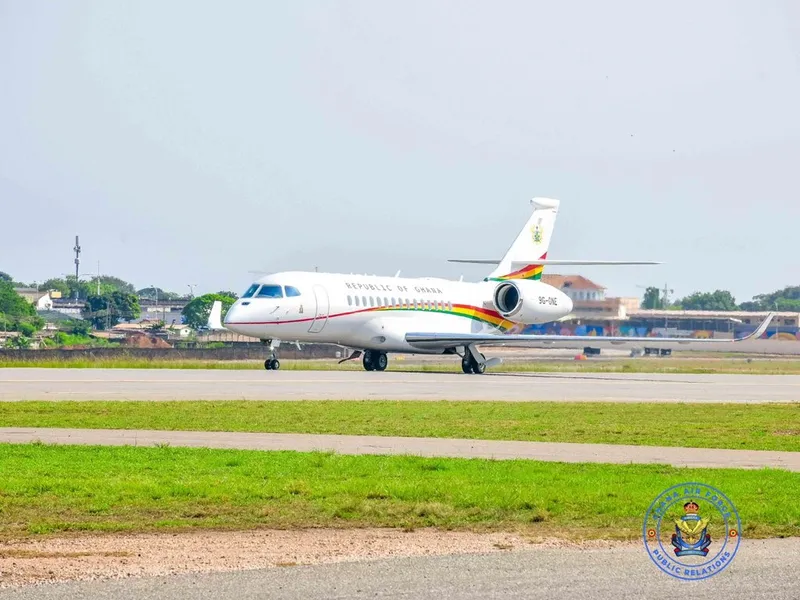
The most politically contentious aircraft in the acquisition is the Dassault Falcon 6X, which arrived at Accra International Airport on Monday, November 16, 2026.
The aircraft received a ceremonial water cannon salute attended by Defence Minister Kenneth Gilbert Adjei, French Ambassador to Ghana Diarra Dimé Labille and senior military officials.
The Ghana Air Force is the aircraft’s designated custodian and operator.
Manufactured by French aerospace company Dassault Aviation, the Falcon 6X is a long-range, twin-engine business jet designed for intercontinental transportation.
Its technical specifications make it substantially different from the helicopters being delivered under the same modernisation programme.
According to Dassault Aviation’s published technical specifications, the aircraft has a maximum advertised range of 5,500 nautical miles, equivalent to approximately 10,186 kilometres, at Mach 0.80 under specified passenger, crew and fuel-reserve conditions.
It is powered by two Pratt & Whitney Canada PW812D engines and has an EASy IV flight deck incorporating advanced avionics.
The aircraft can accommodate between 12 and 16 passengers, depending on configuration, with a cabin divided into separate living and working areas.
Its maximum operating speed is Mach 0.90, while its certified maximum altitude is 51,000 feet.
These specifications make the Falcon 6X suitable for long-distance government travel, diplomatic engagements and other strategic transportation assignments. dassault-aviation.com +2
Why Ghana is replacing the Falcon 900EX
The Falcon 6X is intended to replace Ghana’s older Falcon 900EX, which entered service in 2010.
Government Communications Minister Felix Kwakye Ofosu has said the older aircraft experienced maintenance difficulties and that the new jet’s extended range would reduce the need for frequent refuelling stops.
The replacement argument, however, has become a subject of disagreement.
The government’s position must be considered alongside the findings presented in Parliament’s Defence and Interior Committee report, which identified corrosion, fuel leakage and difficulties obtaining replacement parts for the existing Falcon 900EX.
The report stated that the aircraft’s model was no longer in production, creating additional maintenance challenges.
The committee’s assessment provides an official documentary basis for the government’s argument that replacing the aircraft is necessary.
Nevertheless, the disagreement over the Falcon 900EX’s condition remains significant and requires further clarification through maintenance records, inspection reports and independent technical assessments.
3\. The parliamentary report: What taxpayers are paying for
The financial details of the acquisition are contained in the Report of Parliament’s Committee on Defence and Interior, signed by its chairman, James Agalga.
The two agreements are:
| Aircraft acquisition | Approved contract value |
| —————————————— | ———————– |
| One Airbus H160 and three H175 helicopters | €125,965,974 |
| One Dassault Falcon 6X | US$60,680,000 |
The agreements were presented to Parliament by Deputy Defence Minister Ernest Brogya Genfi on December 3, 2025, and referred to the committee for consideration under Article 181(5) of the 1992 Constitution and Parliament’s Standing Order 247.
Parliament subsequently approved the agreements in December 2025. Ghana Fact +1
But the contract prices are only part of the financial picture.
The committee’s report says the helicopter acquisition will be fully financed from Government of Ghana resources over four years.
The payment schedule begins with an initial €62.5 million instalment in December 2025, followed by further payments in May 2026, March 2027 and December 2028.
The report also records that the Finance Minister informed the committee that budgetary provisions had been made to support the payments.
Importantly, the committee urged the Finance Minister to formally document the budget allocations and ensure that the amounts were reflected in the fiscal framework submitted to Parliament.
This raises an important accountability question: how much has already been paid, how much remains outstanding, and which specific budget lines will finance the remaining obligations?
The published committee report provides the helicopter payment timetable, but the public needs a similarly clear account of the Falcon 6X financing arrangements, including the payment schedule, associated services and any additional financial obligations.
The distinction is important because the US$60.68 million contract value should not automatically be treated as the complete lifetime cost of owning and operating the aircraft.
Insurance, maintenance, spare parts, technical support, pilot training, fuel and eventual major inspections will also have financial implications.
For a government operating under competing fiscal demands, these recurring costs deserve as much scrutiny as the original purchase price. Ghana Fact +1
4\. The 30–40% savings claim: What Parliament actually established
One of the strongest arguments supporting the acquisition is the projected reduction in long-term operating expenditure.
According to the Defence and Interior Committee’s report, the proposed aircraft fleet is expected to cost between 30% and 40% less over a projected 15-year service life than maintaining and operating the ageing aircraft it is intended to replace.
The committee attributed the expected savings to improved reliability, reduced maintenance requirements and greater operational efficiency.
It also raised concerns about Ghana’s dependence on leased aircraft, arguing that leasing places additional pressure on foreign exchange resources and potentially exposes sensitive government movements and security operations to external providers.
However, the 30–40% figure must be understood correctly.
It is a projection contained in Parliament’s committee report, not evidence that Ghana has already achieved those savings.
To establish whether the forecast is realistic, the Ministry of Defence should publish the underlying lifecycle-cost assessment, including projected maintenance expenditure, fuel consumption, spare-parts requirements, training costs and technical support agreements.
There should also be a clear comparison between the cost of maintaining the existing aircraft and the total cost of operating the replacement fleet.
Without those details, taxpayers cannot independently establish whether the projected savings will materialise.
The committee itself recognised the importance of this issue, recommending adequate funding for pilot training, maintenance infrastructure and support systems to protect the aircraft’s long-term value. Ghana Fact
5\. What the new aircraft mean for Ghana’s national security
The acquisition also has implications beyond presidential transportation.
The Defence and Interior Committee identified several national security threats requiring improved air mobility, including terrorism, violent extremism, illegal mining, drug trafficking, human smuggling and maritime crimes.
These threats place considerable demands on the Ghana Armed Forces, particularly in areas where rapid deployment, aerial observation, logistical support and emergency response are necessary.
Ghana’s northern borders, coastal waters and remote communities present different operational challenges that require suitable aviation platforms.
For instance, helicopters equipped for medical evacuation and search and rescue could improve emergency responses in communities with limited access to specialised medical facilities.
Similarly, multi-mission military helicopters could support troop transportation, disaster relief and logistical operations.
The Falcon 6X, meanwhile, is principally a strategic transport asset. Its long-range capabilities can facilitate international government travel and other designated national assignments.
It should not, however, be confused with a dedicated combat aircraft or a replacement for military surveillance and attack platforms.
The January 2026 Airbus announcement is particularly relevant here because it identifies the two H175M helicopters as the military-configured platforms intended for multi-mission defence and security operations.
That means the effectiveness of the entire acquisition should ultimately be assessed against the operational roles of all five aircraft, rather than the ceremonial arrival of the three currently being handed over. Airbus +1
The committee also highlighted serious weaknesses in the existing fleet.
Its report stated that all six Mi-17 helicopters were unserviceable because of overdue overhauls and major component failures.
It further reported that all four Z-9EH helicopters were unserviceable, with one lost in an accident in August 2025.
Of the three CASA C295M aircraft in the inventory, only one was reported to be serviceable.
These findings provide a substantial operational justification for modernisation. They also underline why aircraft availability, rather than simply the number of aircraft purchased, should become a key measure of the programme’s success. Ghana Fact
6\. Minority challenges Mahama government over presidential aircraft spending
Despite Parliament’s approval of the contracts, the acquisitions have become politically controversial, particularly following the arrival of the Falcon 6X.
Damongo MP and former Lands and Natural Resources Minister Samuel Abu Jinapor has demanded full disclosure of the financial and procurement arrangements.
In a statement reported by Graphic Online on November 17, 2026, Jinapor questioned why the government had proceeded with the purchase despite previous opposition criticism of plans to acquire a new presidential aircraft.
He argued that the Minority had previously been given the impression that the procurement process would take several years.
Questioning the timing, he asked: “Yet, yesterday, barely a year later, the aircraft has been delivered. How does the government explain this remarkable turn of events?”
He also argued that the government’s expenditure priorities should be examined against the economic difficulties facing ordinary Ghanaians, particularly unemployment and the cost of living.
Jinapor said the Minority would demand documentation covering the total cost to taxpayers, financing arrangements, procurement and approval processes, and the justification for the acquisition.
He concluded: “Public expenditure of this magnitude demands transparency, accountability and rigorous parliamentary scrutiny.”
His position introduces an important accountability issue: parliamentary approval of a procurement contract does not eliminate the government’s responsibility to disclose how public money is spent. Graphic Online
Dominic Nitiwul questions whether the Falcon 900EX needed replacement
Former Defence Minister and Bimbilla MP Dominic Nitiwul has also challenged the government’s explanation for purchasing the Falcon 6X.
During the parliamentary debate on the 2027 Budget Statement in November 2026, he argued that the existing Falcon 900EX remained operational.
He told Parliament:
“The current jet, Falcon 900 EX, is serviceable. That means that it’s working. It is working because we, led by myself, took it to the South of France and serviced it for 12 months. Your government further serviced it for another six months.”
Nitiwul also questioned the acquisition of the Airbus H175, describing it as a civilian helicopter rather than a military aircraft.
He argued that the government had effectively acquired two VIP aircraft for presidential use within one year.
However, a member of the Majority leadership rejected that characterisation, arguing that the helicopter was an Air Force transport aircraft.
The disagreement highlights the need to distinguish between civilian-origin aircraft, military-configured platforms and their actual operational assignments.
Airbus itself confirms that the ACH175 is a corporate-configured helicopter, while the two H175Ms in Ghana’s procurement package are military-configured multi-mission aircraft.
Nitiwul’s assertion about the Falcon 900EX also needs to be assessed against the Defence and Interior Committee’s documented findings of corrosion, fuel leakage and difficulties sourcing replacement parts.
The conflicting positions make an independent technical assessment of the old aircraft particularly important. MyJoyOnline +3
7\. The unanswered questions government must address
The November 26 handover provides an opportunity for the Mahama administration and the Ministry of Defence to address outstanding questions surrounding the acquisition.
First, government should publish the full financing arrangements for the Falcon 6X, including payment schedules, associated costs and any additional contractual obligations.
Second, the Ministry of Defence should make available the technical inspection and maintenance records that informed the decision to replace the Falcon 900EX.
Third, the government should explain how the projected 30–40% lifecycle savings were calculated and publish the assumptions supporting that estimate.
Fourth, there should be a clear timetable for delivering the remaining two H175M helicopters, together with details of pilot training, maintenance facilities, spare-parts availability and operational readiness.
Finally, the Ghana Air Force should periodically disclose measurable information about aircraft availability, maintenance expenditure and the missions undertaken, subject to legitimate national security restrictions.
These are not unreasonable demands. They are essential elements of responsible defence procurement and public financial accountability.
Conclusion: Modernisation must deliver measurable value for money
Ghana’s acquisition of the Airbus helicopters and Dassault Falcon 6X represents a major investment in military aviation and national transportation infrastructure.
The parliamentary report identifies genuine operational weaknesses in the existing fleet, while the manufacturers’ specifications demonstrate the capabilities of the replacement aircraft.
However, modern equipment alone does not guarantee stronger national security.
The real test will be whether the aircraft remain operational, whether maintenance costs are controlled, whether the military receives the necessary technical support and whether the promised security benefits are delivered.
For President Mahama’s administration, the November 26 ceremony should therefore represent more than a symbolic presentation of new aircraft.
It should mark the beginning of a transparent and measurable programme in which taxpayers can assess what their money has purchased.
The government has secured parliamentary approval for the contracts. It must now demonstrate that the investment delivers the operational capacity, financial savings and national security benefits used to justify the expenditure.