

By Alex Ababio
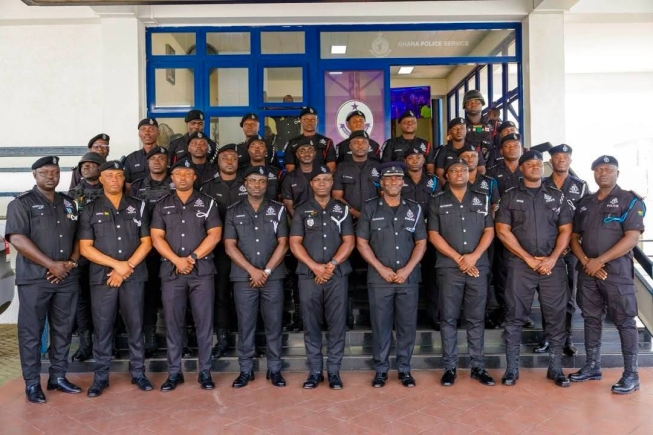
The Ghana Police Service has rewarded 25 officers after three separate crime-fighting operations — including the interception of 866 parcels of a white powder suspected to be cocaine at the Tema Port enclave, the recovery of GH¢300,000 allegedly stolen in a highway robbery, and the arrest of four suspects linked to a robbery syndicate in the Western Region.
But behind the commendations and promotions lies a more complicated question: what do these arrests tell us about the sophistication of criminal networks operating through Ghana, particularly the country’s major commercial port?
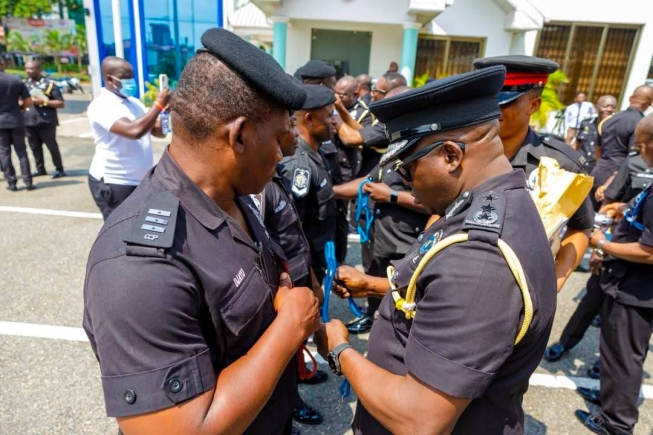
The promotions, announced on Monday by the Ghana Police Service on August 10, 2026, involved officers who participated in the three operations in Tema, Bono East and the Western Central Police Region.
The development also comes at a time when Ghana’s anti-narcotics authorities are reporting a significant expansion in drug enforcement activity and warning that the country’s drug challenge can no longer be viewed simply as a law-enforcement problem.
The Tema seizure: 866 parcels hidden in gari
The most high-profile operation occurred at the Tema Port enclave on Wednesday, August 5, 2026.
According to the police account , officers conducted an intelligence-led operation at about 8 p.m. and intercepted 866 parcels of a white powdered substance suspected to be cocaine concealed inside sacks of gari. Three suspects — including a Dutch national and two Ghanaians — were arrested.
Sources close to the operation noted that the suspects were allegedly supervising workers loading sacks of gari and konkonte into a 40-foot container for export from a warehouse within the Tema Port enclave. The suspects, truck and suspected narcotics were subsequently taken into police custody.
That detail is significant.
The consignment was not reportedly discovered in an abandoned location or on an isolated road. It was allegedly being prepared for export from a warehouse inside the port enclave — precisely the type of controlled commercial environment where cargo documentation, inspection, scanning and multi-agency security procedures are expected to operate.
And this is where the case becomes bigger than the 866 parcels.
The police were sufficiently confident in the operation to reward the officers almost immediately. However, the promotions came before formal confirmation that the substance was actually cocaine.
That distinction matters.
Until laboratory or legally admissible forensic testing establishes the identity of a seized substance, responsible reporting should continue to describe it as suspected cocaine. The seizure itself is confirmed; the ultimate chemical identity and evidential status are matters for the investigative and judicial process.
Why the port matters
Ghana has spent years trying to strengthen security at its ports against narcotics trafficking and other forms of organised crime.
In April 2025, the Narcotics Control Commission, led by Director-General Brigadier General Maxwell Obuba Mantey, held a high-level meeting with the Ghana Ports and Harbours Authority specifically to strengthen cooperation against illicit drug trafficking.
The discussions focused on port-security challenges, streamlining operations at export points, reinforcing container inspections and improving intelligence sharing.
That makes the latest Tema interception particularly important.
It suggests that intelligence-led policing can identify suspicious activity even within complex cargo environments. But it also raises questions about how the shipment reached the point of loading before being intercepted.
Was the cargo selected through intelligence profiling?
Were the sacks scanned or physically inspected?
Were the export documents genuine?
Who owned or controlled the warehouse?
Who arranged the container?
Where did the suspected cocaine enter Ghana?
Was the intended destination known?
And, most importantly, was the Tema operation the end of the trafficking chain or merely the discovery of its local logistics arm?
Those questions have not yet been answered publicly.
Ghana’s drug problem is changing
The broader national picture makes the Tema seizure even more significant.
In April 2026, NACOC Director-General Brigadier General Maxwell Obuba Mantey said Ghana’s 2025 drug situation demonstrated that enforcement alone could not solve the problem.
“While NACOC recorded a 197 percent increase in drug-related arrests, seized nearly 1,500 kilograms of narcotic substances, disrupted trafficking networks, and expanded operations to 40 new district commands across all 16 regions, these achievements represent only one side of the national response,” Mantey said.
His warning is crucial because a successful seizure does not necessarily mean a trafficking network has been dismantled.
A shipment can be intercepted while financiers, organisers, warehouse operators, transporters, exporters, recruiters and international buyers remain outside the immediate investigation.
NACOC’s own approach increasingly reflects this reality. In February 2026, Mantey said the fight against organised crime and illicit drug trafficking required collective partnership among stakeholders, including international law-enforcement agencies.
That is particularly relevant in a case involving a Dutch national and a shipment apparently intended for export.
West Africa has long been recognised as a strategic corridor for cocaine moving from South America toward European markets. UNODC research has documented the region’s role in transnational cocaine trafficking, while more recent regional analysis continues to identify West Africa’s Atlantic coastline as an important corridor exploited by organised criminal networks.
The presence of a Dutch suspect therefore does not, by itself, establish a Dutch trafficking network. But it is a legitimate investigative lead that Ghanaian authorities may need to examine through international cooperation.
The port-security warning from another major drug case
There is another recent development that deserves attention.
In June 2026, Graphic Online reported that NACOC admitted established export procedures were not followed in a case involving 320 kilogrammes of methamphetamine concealed in charcoal that was shipped from Ghana and intercepted by Australian authorities.
The Australian Federal Police said the drugs had a street value of about US$208 million. Ghanaian authorities subsequently investigated how the shipment passed through the country’s export system.
The two cases involve different drugs and circumstances and should not be conflated.
But together they demonstrate why cargo security, intelligence sharing and compliance at export points deserve sustained scrutiny.
A port is not simply a place where goods arrive and leave. It is a critical part of the country’s trade infrastructure — and, potentially, an attractive target for international criminal networks seeking to exploit legitimate commerce.
The GH¢300,000 highway robbery
The second group of officers rewarded by the IGP helped arrest six suspects in connection with the robbery of GH¢300,000 on the Portor-Gurumpe stretch of the Kintampo-Buipe Highway on July 19, 2026.
According to the Bono East Regional Police Command, officers at the Portor Police Barrier received intelligence at about 8:30 p.m. that a robbery was underway.
The response was swift.
One suspect, Abdul Sadat Ali, 24, was arrested while four others initially fled into the bush. Police later arrested the remaining suspects, recovering the entire GH¢300,000 allegedly stolen from the victim.
Police investigations alleged an inside-job element.
The victim, Yahaya Seidu, 35, had instructed his driver to transport him to Buipe to purchase cattle. Police alleged that the driver knew his employer was carrying a substantial amount of money and conspired with five others to rob him.
According to the police account, the suspects allegedly used a toy pistol and trailed the vehicle from Offinso before intercepting it near Portor.
The case illustrates another dimension of modern policing: intelligence can be as important as physical patrols.
The police commended the “alertness and professionalism” of personnel at the Portor Police Barrier and the Counter Terrorism team for their role in the arrests.
The Western Region operation
The third group of promoted officers was involved in the arrest of four suspects linked to a robbery syndicate at Wassa Akropong in the Western Central Police Region.
The original police promotion announcement identified the operation as one of three that contributed to the 25 promotions. Graphic Online reported that the operations took place across the Bono East, Tema and Western Central Police Regions.
The Western Central Region has previously recorded significant police operations against robbery networks.
In March 2026, for example, police arrested five suspects following an armed robbery at Velotop Company Limited at Asankrangwa. Investigators said the suspects allegedly robbed the Chinese-owned company of GH¢200,000 after holding workers hostage. Police recovered firearms, ammunition, handcuffs, CCTV equipment and GH¢198,200.
The pattern suggests that highway and commercial robberies remain a serious security concern in parts of the Western mining belt.
Who has been promoted?
Among those promoted are Chief Inspectors Bede Nwinbomeh and Joe Tetteh; General Sergeants Elijah Ndaga Yinimi and Kaifan Sulemanna; General Corporals Owusu Ansah Evans and Tansang Jonathan; and General Lance Corporals Osei Christopher Bonny, Kyei Francis, Ofori Francis, Anim Dominic and Asante Isaac.
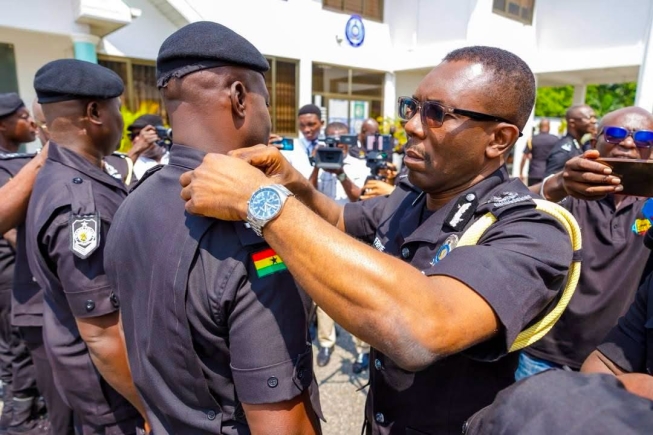
General Constables Adam Bakari Alhassan and Bakai Mark were also promoted.
The detective officers include Detective Chief Inspector Frank Dzah; Detective Inspectors Edem Ametowoga, Abroso and Vincent Dankwah; and Detective Sergeants Salifu Yakubu and Samuel Mordzifa.
Six other personnel were also promoted to their next ranks. Chief Inspectors Nwinbomeh and Tetteh were granted automatic entry into the Police Academy.
The Police Service said the promotions were in recognition of the officers’ “professionalism and courage in combating crime.”
Rewarding officers — but following the evidence
The promotions are not unprecedented under IGP Christian Tetteh Yohuno, who was sworn in as Ghana’s 31st Inspector-General of Police in March 2025.
In April 2026, Yohuno also promoted seven officers from the Tema Regional Police Command after their response to a robbery attack on a mobile-money vendor.
The policy sends a clear message: officers who demonstrate courage and operational effectiveness can be recognised.
But the Tema cocaine case demands another message — recognition must not replace investigation.
The real measure of success will not be the number of officers promoted or parcels seized.
It will be whether investigators can establish where the suspected cocaine came from, who financed it, who arranged its movement, who controlled the warehouse, who was intended to receive it, whether other consignments passed through the same channel and whether the network behind the shipment can be dismantled.
For Ghana, that is the difference between intercepting a shipment and defeating a trafficking network.
And as Brigadier General Mantey has warned, enforcement is only one side of the drug-control equation.
The 866 parcels may have been stopped at Tema.
The more important question now is: how far can Ghana’s investigators follow the trail behind them?