

By Alex Ababio | Special Investigative and Accountability Report
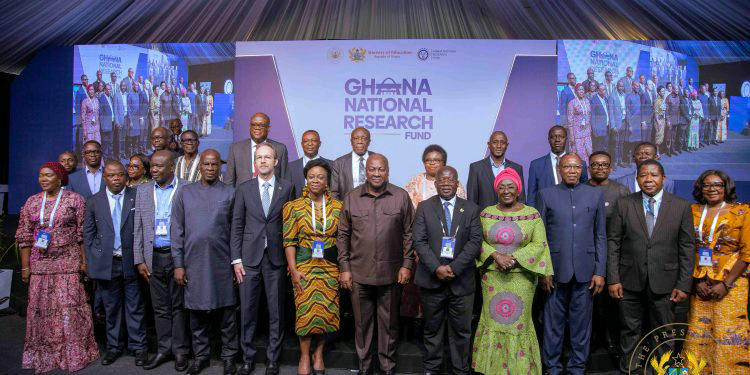
President John Dramani Mahama has officially launched the Ghana National Research Fund (GNRF), announcing an immediate catalytic allocation of GH¢100 million to support its operational take-off in 2026. The move is being presented as a historic intervention aimed at strengthening Ghana’s research ecosystem, supporting innovation, and accelerating economic transformation.
At the launch ceremony, President Mahama declared that research could no longer be treated as a secondary national concern.
«“Research is no longer a peripheral activity. It might become one of the engines that drive our economic growth, our social progress, and our national competitiveness,” he stated.»
The announcement has been welcomed across academia and the scientific community. However, accountability questions remain: Will the new Fund receive sustained financing? How will the money be managed? Can Ghana translate research into commercial products, jobs and industrial growth? And will the country finally close its long-standing gap in research and development (R&D) investment?
This report examines the promises, opportunities, risks and accountability challenges surrounding the new Fund.
A Vision Decades in the Making
President Mahama linked the Fund to the vision of Ghana’s first President, Dr. Kwame Nkrumah, who believed that scientific research and locally generated knowledge were essential for national development.
According to the President, Nkrumah understood that no nation could industrialize by relying indefinitely on imported technologies and foreign expertise.
Mahama also credited the late President Professor John Evans Atta Mills for championing the idea of a dedicated national research financing mechanism.
«“The Ghana National Research Fund vision was a central dream of Professor John Evans Atta Mills, and on this day, we acknowledge him and remember him, that his vision has come to fruition,” he said.»
The President further acknowledged the role of former President Nana Addo Dankwa Akufo-Addo’s administration in facilitating the passage of the law that created the Fund.
«“That architecture came in Act 1056 of 2020, and we acknowledge the previous administration of Nana Akufo-Addo for piloting it through Parliament and passing it into law.”»
The reference is to the Ghana National Research Fund Act, 2020 (Act 1056), which established the legal framework for financing scientific research, innovation and knowledge production in Ghana.
Why the Fund Matters
Research and development spending is widely regarded as a major indicator of a country’s innovation capacity.
The African Union has repeatedly urged member states to allocate at least 1 percent of Gross Domestic Product (GDP) to research and development as part of Africa’s science and innovation agenda. The recommendation is embedded in the African Union’s Science, Technology and Innovation Strategy for Africa (STISA-2024), which places science and innovation at the center of economic transformation.
President Mahama noted that Ghana’s current legal framework limits research funding to 0.5 percent of GDP.
«“The African Union’s target of investing at least 1% of GDP in research and development must be viewed not merely as a spending target, but as a strategy for competitiveness, productivity, and ultimately sovereignty.”»
The President’s argument reflects a growing global consensus that countries increasingly compete through innovation, technology, data, patents and scientific discoveries rather than through natural resources alone.
The Accountability Question: Is GH¢100 Million Enough?
The immediate allocation of GH¢100 million has been described by government as a catalytic investment rather than a complete solution.
According to President Mahama, the money will finance:
– Competitive research grants;
– Doctoral and postdoctoral training programmes;
– Digital grant management systems;
– Strategic innovation initiatives;
– Research projects aligned with national priorities.
However, policy analysts note that the real test will not be the initial allocation but whether future governments maintain predictable annual funding.
Historically, many African research institutions have depended heavily on foreign grants from international organizations, development partners and philanthropic foundations.
This dependence often means that research priorities are shaped externally rather than by local development needs.
President Mahama acknowledged this challenge.
«“Ghana cannot aspire to industrial transformation while underinvesting in knowledge creation.”»
The accountability issue therefore shifts from announcing money to ensuring long-term sustainability, transparency and measurable impact.
What Problems Is the Fund Expected to Solve?
The government says the Fund will adopt a mission-based approach focused on solving practical national challenges.
Among the priority areas identified are:
– Food systems transformation;
– Agricultural resilience;
– Health innovation;
– Biosecurity;
– Digital transformation;
– Industrial development;
– Climate sustainability;
– Governance systems;
– Data infrastructure.
President Mahama pointed to specific agricultural challenges including:
– Fall armyworm infestations affecting maize production;
– Cocoa swollen shoot disease;
– Boll weevil attacks on cotton farms;
– Post-harvest losses caused by storage pests.
These problems continue to cost Ghana millions of cedis annually through reduced yields and lower farmer incomes.
The President also highlighted the need to commercialize scientific discoveries, including locally developed organic pesticides and agricultural technologies.
«“The objective is not simply to produce more research. The objective is to produce research that solves problems, informs policy, creates jobs, strengthens industries, and improves the lives of Ghanaians.”»
Lessons from Ghana’s Existing Research Success Stories
One of the strongest arguments for the Fund comes from institutions that have already demonstrated the impact of research investment.
President Mahama specifically cited the West Africa Centre for Crop Improvement (WACCI), the West Africa Centre for Cell Biology of Infectious Pathogens (WACCBIP), and the West African Genetic Medicine Centre.
WACCBIP, based at the University of Ghana, has become one of Africa’s leading biomedical research centres. Its mandate includes advanced training, disease surveillance, molecular biology research and innovation in infectious and non-communicable diseases. The Centre was initially supported through World Bank funding and has since attracted major international research grants.
According to WACCBIP, its research supports the development of new approaches to disease diagnosis, prevention and control while training the next generation of African scientists.
Similarly, the West African Genetic Medicine Centre has gained international recognition for its work on genetic disorders and sickle cell disease. In a 2026 publication in Nature Genetics, Professor Solomon F. Ofori-Acquah and colleagues described the Centre as a model for addressing genetic disorders across Africa while strengthening local scientific capacity.
These institutions provide evidence that sustained investment can produce globally competitive scientific outcomes.
Can Research Drive Mahama’s 24-Hour Economy Agenda?
Government officials argue that the Fund aligns closely with the administration’s broader economic transformation agenda, including the proposed 24-hour economy policy.
The logic is straightforward.
Industrial expansion requires innovation.
Agricultural modernization requires scientific breakthroughs.
Digital transformation requires research capacity.
Healthcare improvement requires locally generated solutions.
Renewable energy development requires technological innovation.
Without domestic research capacity, Ghana may continue importing solutions designed elsewhere at significantly higher costs.
The Fund is therefore being positioned not simply as an education initiative but as an economic development instrument.
Transparency and Governance Will Determine Success
Perhaps the most important part of President Mahama’s speech was his directive regarding accountability.
The President instructed the Ministry of Education, the GETFund and the Fund’s governing board to ensure transparent and accountable management of public resources.
This is likely to become one of the most closely watched aspects of the initiative.
Public finance experts argue that the Fund’s credibility will depend on:
– Independent oversight;
– Competitive grant allocation;
– Public disclosure of beneficiaries;
– Annual impact assessments;
– External audits;
– Parliamentary scrutiny.
Without these safeguards, critics warn that even well-intentioned funding programmes can lose public confidence.
The Bigger Picture
Beyond the immediate GH¢100 million allocation lies a broader national question.
Can Ghana build a knowledge economy capable of competing globally?
Countries that dominate advanced manufacturing, artificial intelligence, biotechnology, pharmaceuticals and digital innovation typically invest heavily in research and development.
For decades, Ghanaian researchers have complained about inadequate funding, fragmented support systems and dependence on foreign grants.
The launch of the Ghana National Research Fund represents one of the most ambitious attempts to address those concerns.
Whether it becomes a transformative national institution or another underfunded public initiative will depend on political commitment, governance standards and sustained investment.
For now, the Fund has generated optimism across Ghana’s scientific community.
As President Mahama concluded:
«“Let history record that on this day, Ghana chose to invest deliberately in knowledge creation. Let history record that we strengthened the foundations of our knowledge economy.”»
The coming years will determine whether that historic declaration translates into laboratories producing breakthroughs, startups creating jobs, farmers adopting new technologies, and universities generating solutions that directly improve the lives of millions of Ghanaians.
For accountability advocates, the question is no longer whether Ghana needs a National Research Fund.
The question is whether the Fund can deliver measurable results and prove that public investment in knowledge is capable of driving national development in the twenty-first century.