

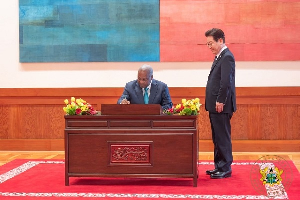
By Alex Ababio — March 12, 2026 — Seoul, Republic of Korea & Accra, Ghana
President John Dramani Mahama’s five‑day state visit to the Republic of Korea (South Korea) this March has underscored one of the most consequential pivots in Ghana’s agricultural policy in years: deepening cooperation with Seoul to tackle staple food insecurity and add value to the country’s most valuable commodity crop, cocoa.
Mahama, the first African leader to be hosted by Korea’s President Lee Jae‑myung since Lee took office in June 2025, used the rare high‑level summit to place agriculture and agribusiness cooperation at the center of Ghana’s foreign economic strategy. His aim: to reduce rice import dependence, stimulate local agrifood industrialization, and expand Ghana’s position in global value chains.
Rice: From Import Dependency to Domestic Production
“Rice has become a staple food in Ghana, and we want to reduce the amount we import by increasing domestic production,” Mahama said during bilateral talks in Seoul — a statement that reflects longstanding national concerns. Ghana currently spends hundreds of millions of dollars annually on rice imports, and domestic output has struggled to keep pace with demand.
This conversation has evolved into a concrete program known as the K‑Ricebelt Project, a Korean government‑led initiative executed in partnership with the Korea International Cooperation Agency (KOICA) and the Rural Development Administration (RDA) of Korea.
According to Korean agricultural data, 3,562 tonnes of high‑yield rice seeds were produced across seven African countries — including Ghana — under this initiative in 2024, with Ghana’s share contributing significantly to these deliveries.
A landmark for the initiative, the project is not simply about handing over rice seed. It includes technology transfer, training Ghanaian farmers in seed production, and realigning agricultural infrastructure for climate‑adapted food systems. Local scientists from Ghana’s Council for Scientific and Industrial Research — Crops Research Institute (CSIR‑CRI) have begun producing breeder and foundation seeds to scale certified seed distribution. At a farm field day in Dawhenya, CSIR officials announced plans to exceed 400 metric tonnes of certified seed distribution this season — a jump from 300 tonnes delivered last year.
These achievements are taking stock against broader policy shifts in Ghana. The Ministry of Food and Agriculture announced that from 2026, it will prioritize locally sourced seeds and reduce dependency on imports — a move spearheaded through Korean partnerships in irrigation, seed production, and mechanization.
At the core of rice ambitions is irrigation infrastructure. Decades of rain‑fed agriculture have left production inconsistent. A Korean partner, Korea Rural Community Corporation (KRC), is leading a 100‑hectare irrigation development project at Dawhenya, backed by a Korean 1‑megawatt solar installation to power irrigation systems — an energy‑efficient model that could slash production costs and contribute to stable pricing for Ghanaian farmers.
Analysts see such cooperation as far more than symbolic. “If Ghana can expand reliable irrigation, increase high‑yield seed adoption, and link these to downstream processing, the country could substantially reduce imports and create export‑ready rice,” says Dr. Kwesi Mensah, an independent agribusiness analyst in Accra.
The Cocoa Imperative: Value Addition, Not Raw Exports
Parallel to rice, President Mahama’s agenda in Seoul placed heavy emphasis on value addition in Ghana’s cocoa sector. Ghana and neighboring Côte d’Ivoire produce roughly two‑thirds of global cocoa beans, yet the West African producers capture only a small fraction of the multi‑billion‑dollar profits from chocolate and derivative products — a long‑standing structural imbalance that Ghana’s policymakers have pledged to change.
“We want to process more of our cocoa into products such as cocoa liquor and cocoa butter rather than exporting it in raw form,” Mahama told Korean officials. Such vertical integration could significantly enhance export receipts and create higher‑skilled industrial jobs within Ghana.
South Korean officials have welcomed these goals, noting that Korean technology and Ghana’s abundant natural resources could form “win‑win partnerships.” President Lee referenced Ghana‑made cocoa chocolates during the summit, noting the product’s longstanding popularity in Korea since its introduction in the 1970s.
This strategic push aligns with broader agro‑industrial goals under the AfCFTA (African Continental Free Trade Area), whose secretariat is based in Accra. African markets, Africa’s combined consumer base of 1.4 billion people, and tariff‑free trade regimes present an opportunity for Ghana to build regional distribution networks for processed agricultural products — rice products included.
Beyond Agriculture: A Holistic Strategic Partnership
While agriculture dominated the headlines, Ghana and Korea also signed three strategic Memoranda of Understanding (MOUs) covering maritime security, climate‑change cooperation, and digital technology — areas that, analysts say, reinforce agricultural objectives:
Maritime Security: With piracy in the Gulf of Guinea threatening regional trade flows, the maritime agreement seeks joint approaches to securing shipping lanes critical to Ghana’s export routes.
Climate Resilience: Given the increasing vulnerability of agricultural production to climate variability, a climate cooperation pact could tie into agricultural research and water‑management projects.
Technology & Digital Innovation: Digital solutions for supply chains, weather forecasting, and market integration were also agreed upon — technology that experts say is key to modernizing Ghana’s agricultural landscape.
President Lee, in remarks to Ghanaian media, described Ghana as a “bridgehead” for Korean expansion into African markets, praising Accra’s strategic geographic position and its longstanding diplomatic ties with Seoul since 1977.
Expert Perspectives: Opportunities and Challenges
Despite the broad optimism in diplomatic circles, independent experts caution that the scale of transformation will require sustained investment and policy coherence.
“Diplomacy can open doors and build frameworks, but the real test is in implementation — farmer training, logistics, credit access, and infrastructure,” says Professor Yaw Agyeman, a development economist at the University of Ghana. “Rice and cocoa sectors have deeply rooted structural challenges — from soil quality to processing bottlenecks — that will require multi‑stakeholder financing and institutional reform.”
Local farmer associations have echoed these points, advocating for access to markets, credit, and guaranteed prices to make new production targets meaningful on the ground.
What’s Next: From Frameworks to Results
Back in Ghana, the MOUs signed in Seoul are expected to return with accompanying implementation roadmaps, including:
Expanded seed distribution networks and farmer extension services, to build Ghana’s internal capacity for seed self‑sufficiency.
Processing facilities for cocoa and rice, with technology transfer from Korea.
Enhanced irrigation infrastructure across key rice belts, moving production away from climate‑dependent patterns.
These efforts, South Korean diplomats say, align with Seoul’s broader objective of promoting food security in Africa while supporting Korean agritech exports — a strategy that has seen private Korean agribusinesses secure export contracts with Ghanaian distributors for eco‑friendly farm inputs.
For President Mahama, the visit demonstrates a broader diplomatic strategy: leveraging international partnerships to domesticate food production, industrialize agricultural value chains, and diversify Ghana’s economic base away from raw commodity exports.
“We have natural and human resources,” Mahama told Korean counterparts, “and with Korea’s technology and innovation, we can build a strong win‑win partnership.”
As Ghana pursues these initiatives, the next 24 months — from seed production to value‑added exports — will test the real impact of this high‑profile diplomatic engagement.