


By Alex Ababio
THE POISONING
The Price of Impunity : Children Paying in Blood
SAMREBOI, Ghana —
The afternoon heat sits heavy over Samreboi, a dusty mining town in Ghana’s Western Region. Inside a ramshackle structure of wooden planks and rusted zinc, thirteen-year-old Kwaku pulls two objects from a black polythene bag: a small 500 ml water bottle, and a flask.
He opens the flask carefully. From inside, he removes tiny balls of mercury wrapped in cling-film—plastic sachets no bigger than his thumb. He peels one open, and the silvery liquid glints harshly in the sunlight streaming through the gaps in the wall.
This is mercury. This is what Kwaku uses daily in his work: processing gold.
Two years ago, he dropped out of primary school. His mother needed help caring for his three younger siblings. His father is absent. So at eleven years old, Kwaku entered the informal economy of illegal small-scale mining—galamsey, as it’s known here—where children are cheap labor and safety is a foreign concept.
His hands are perpetually stained. His clothes carry the faint metallic smell of the ore he crushes. And his lungs, day after day, fill with invisible poison.
“I use my hand to mix and spread the mercury in the ore,” Kwaku whispers, as if confessing a secret. “Then I burn it on my own, wherever I get fire.”
He does not know that the vapors he breathes are a ticking time bomb. He does not know that mercury is a neurotoxin. He does not know that scientists link it to irreversible brain damage, heart defects, kidney failure, and a slow, debilitating decline that steals cognition, coordination, and eventually, life itself.
He only knows that this is how his family survives.

This image was created using AI and does not depict an actual scene.
The Science of Slow Death: What Mercury Does to a Child’s Brain
To understand what is happening inside Kwaku’s body, one must understand methylmercury—the organic form mercury takes once it enters living organisms.
When Kwaku burns the mercury-gold amalgam over an open fire, the heat vaporizes the mercury. He inhales it. The vapor passes from his lungs directly into his bloodstream. From there, it crosses the blood-brain barrier with terrifying ease.
In the brain, mercury destroys neurons. It binds to proteins and enzymes, disrupting cellular function. It accumulates in the cerebellum—the region controlling coordination—and the cerebral cortex, seat of memory, attention, and language.
For a child whose brain is still developing, the damage is compounded. Every exposure chips away at cognitive potential that can never be recovered.
Dr. Opoku Sampane knows this reality intimately. He is a forensic histopathologist, former Head of Pathology at the Kwame Nkrumah University of Science and Technology (KNUST) and Komfo Anokye Teaching Hospital (KATH). Over his career, he has examined more than 4,000 placentas from women across Ghana.
What he found inside them haunts him.
“I have examined over 4,000 placentas from different regions in Ghana,” Dr. Sampane says, his voice measured but heavy. “In them, I found heavy metals present in both the cord and the placenta itself. I have about 500 cases where women have come to hospital and aborted their babies because of heavy metal concentration.”

He explains the mechanism with clinical precision: a fetus absorbs 90 percent of any pollutant present in the mother’s bloodstream, including mercury. The consequences cascade—spontaneous abortions, babies born with deformities, children condemned to lifelong disabilities.
“Doctors from Prestea, Bogoso, and Wassa Akropong tell me they are recording many deformities in babies,” Dr. Sampane adds. “Most of them are afraid to come out publicly because they fear for their lives.”
The Woman with Trembling Hands
In a different room in Samreboi, not far from where Kwaku works, a 32-year-old woman sits with her one-year-old baby boy. She worked with mercury at galamsey sites for two years.
Now her hands tremble—a classic sign of mercury poisoning, a tremor that emerges when the toxin damages the cerebellum. She cannot hold a cup steadily. She cannot write.
Her baby boy is sick. Doctors have told her he has a hole in his heart.
She does not want her name published. She is afraid. But she wanted to tell her story.
“I didn’t know it would affect him,” she says, gesturing toward the child. “I only knew I needed money.”
Private physicians in Samreboi and the neighboring Aowin district in Western North Region, speaking on condition of anonymity, confirm a terrifying trend: the number of children presenting with illnesses linked to mercury and lead exposure is rising rapidly. Respiratory infections, neurological abnormalities, congenital heart defects—the cases accumulate like mercury in sediment, invisible until the burden becomes too great to ignore.
The Chain of Contamination: From Rock to River to Womb
Mercury does not stay where it is released. It travels.
When miners like Kwaku burn mercury-amalgam, approximately 72 percent of it is released directly into the air, according to Ghana’s Minamata Initial Assessment Report. The invisible vapor drifts on wind currents, settling on soil, vegetation, and water bodies.
Rain washes it into streams and rivers. In the water, microorganisms transform inorganic mercury into methylmercury—the most toxic form, which bioaccumulates up the food chain. Small organisms absorb it. Fish eat them. Humans eat the fish. Pregnant women pass it to their fetuses.
This is the journey of a single atom of mercury: from a child’s hands in Samreboi, to a river, to a fish, to a placenta, to the developing brain of an unborn child.
The Pure Earth-EPA investigation conducted across 11 artisanal small-scale gold mining (ASGM) sites in 2025 quantified the catastrophe:
– At Konongo Zongo in Ashanti, mercury in soil exceeded safety guidelines by over 560 percent
– Arsenic levels reached 10,060 parts per million in soil—levels measured in percentages, not parts per million, signaling acute toxicity
– Water at Konongo Odumase showed arsenic at 3.30 mg per liter—well above drinking water standards
– Air mercury vapor at Wassa Kayianko peaked at 150 micrograms per cubic meter during smelting
– Crops and fish from Akwaboso tested positive for lead, arsenic, and cadmium contamination.
This is not pollution. This is poisoning, systematic and widespread.
The contamination does not stop at soil and water. It enters the food chain—and the homes of Ghanaians.
In 2022, the Food and Drugs Authority (FDA), in collaboration with UNICEF, released the National Summary Report on Heavy Metal Contaminant Assessment in selected food and cosmetic products on the Ghanaian market. The surveillance, conducted across all sixteen administrative regions, assessed levels of Lead (Pb), Cadmium (Cd), and Mercury (Hg) in turmeric, cereal mixes, among others.
Turmeric recorded a 42.09% failure rate for lead , with the Greater Accra and Central regions showing the highest contamination levels.
Cereal mixes had a 29% failure rate for cadmium , with the North East, Western North, and Oti regions most affected.
These are not abstract figures. They represent a direct threat to human health.
Dr. Albert Kobina Mensah, a scientist at the CSIR–Soil Research Institute in Kumasi ,cautions that these figures represent a direct threat to human health. He points to the disturbing levels of arsenic, lead, and mercury found in soils and water bodies, stressing that such toxic substances can lead to severe illnesses, including skin cancer and other long‑term health complications
The Man Who Used His Teeth
When Mercury Enters the Mouth—and the State Is Nowhere to Be Found
At Manso Abore, in the Amansie West District of the Ashanti Region, a 29-year-old man named Akwasi told our investigation team something that stopped us cold.
He used to tear open plastic sachets of mercury with his own teeth.
“I would hold the sachet in my mouth and bite down to open it,” he said, demonstrating. “Then I would empty the mercury into the ore.”
He did this for years. He did not know—as Dr. Opoku Sampane’s research shows—that mercury absorbs through mucous membranes, the inside of the mouth, directly into the bloodstream. He did not know that each sachet he opened with his teeth was delivering neurotoxins straight to his brain.
He stopped only when a friend became violently ill. He does not know if the damage is already done.
The Interconnected Crisis
One Health: The Framework That Explains Everything
There is a concept in public health called One Health . It recognizes that human health, animal health, and environmental health are not separate domains—they are one system, inextricably linked. Pathogens cross between species. Toxins move through ecosystems. The same mercury vapor that damages Kwaku’s brain settles on forest floor, contaminates soil, enters waterways, and accumulates in living tissue.
This is not three crises. It is one crisis with three faces.
Nowhere is this truth more devastatingly illustrated than in the fate of Ghana’s last chimpanzees.
The Silence in the Forest: Ghana’s Last 60 Chimpanzees
In the dense, biodiverse Tano-Nimiri forests of Ghana’s Western Region, an ominous silence is falling. It is the silence left by disappearance.
“When we conducted our national survey, we found only 34 chimpanzees in the Bia National Park,”says Richard Ofori-Amanfo, Park Manager for the Wildlife Division in Takoradi, Western Region. His voice carries the weariness of someone watching extinction unfold in real time.
“We found about five in the Krokosua Forest Reserve, and about three in Goaso. When you put them all together, the population will not exceed 60.”
Sixty. That is all that remains of Ghana’s Western chimpanzees—a subspecies found in only eight West African nations. Just years ago, estimates placed the population near 300. The decline has been catastrophic, and it is accelerating.
“The intensity and widespread illegal mining in recent times have become a major factor hindering our efforts to reintroduce endangered subspecies like chimpanzees,” Ofori-Amanfo says.
The chimpanzee’s world is shrinking. Where forest once stretched unbroken, now there are pits, trenches, and clearings—the signature scars of galamsey operations. Where primate calls once echoed, now the only sounds are excavators and the rush of silt-laden water.
What is the human cost — and who pays the price?
One Health — the idea that human, animal and environmental health are interconnected and must be protected together — frames this crisis: the same toxic exposures and pathogens cross borders between people, wildlife and ecosystems.
The mercury poisoning Ghana’s rivers and forests reflects a deadly ‘One Health’ crisis, where the same toxic vapors pushing chimpanzees toward extinction are causing a sharp rise in child deformities and chronic diseases, tying the survival of humans and wildlife to one fragile and uncertain future
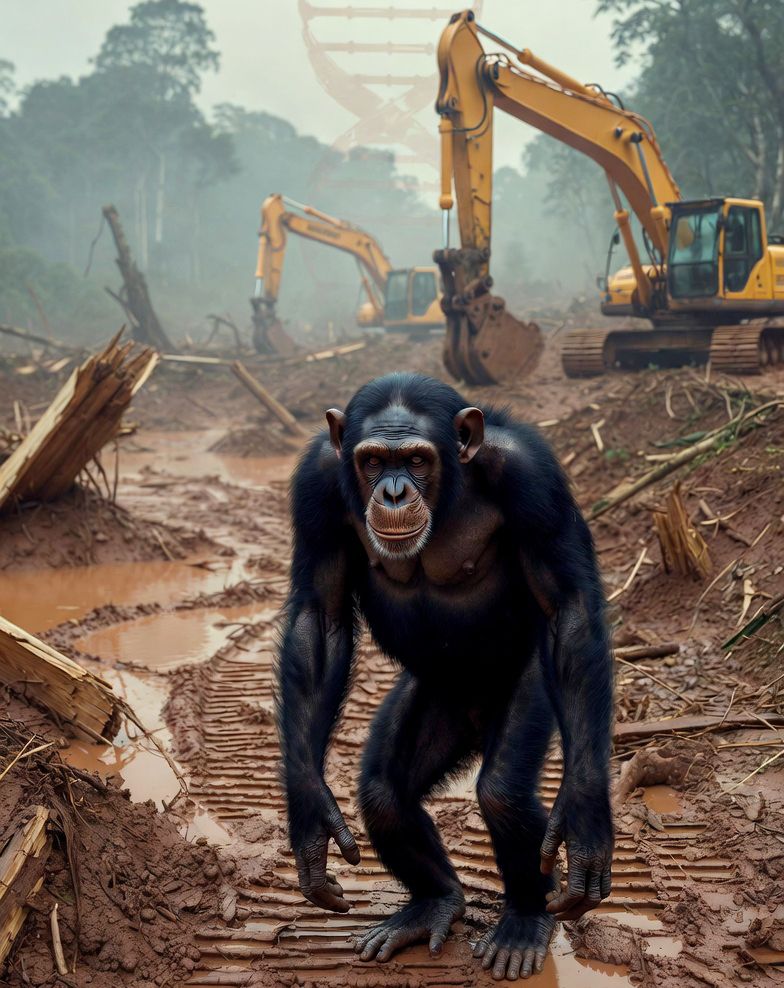
This image was created using AI and does not depict an actual scene.
Chimpanzees are easily infected by human diseases such as tuberculosis, measles, and COVID-19. They are also at risk from toxic chemicals used in mining. “They don’t have resistance to hard metals like mercury and lead and cyanide,” warned Ofori-Amanfo. “These substances can severely affect them, so if we don’t take care and allow these substances to get to them, it will affect the left population of chimpanzees.”
Chimpanzees don’t have resistance to heavy metals like mercury, lead and cyanide. Their DNA is 98 % close to humans, so these substances will cause more harm to them.”,he stressed
The Tano-Nimiri forest enclave, along with Bui and Ankasa reserves — once vibrant habitat for our primate cousins — has become proof of this habitat destruction. Where primate calls once echoed, now the only sounds are excavators and the rush of silt-laden
The 5,252 Hectare Wound
The Forest Reserves Ghana Let Die
The numbers are staggering, but they represent something simpler: land that chimpanzees will never inhabit again.
The Ministry of Lands and Natural Resources reports that 5,252 hectares of forest reserves have already been destroyed by galamsey. Out of 288 forest reserves in Ghana, 45 have been affected. Nine have been completely ruined—rendered biologically sterile, incapable of supporting the complex ecosystems they once housed.
A 2025 scientific study published in a peer-reviewed journal confirmed what conservationists have long feared: illegal mining causes “significant reductions in plant species richness and diversity.” In many heavily mined areas, researchers documented “complete absence of vegetation” and “total carbon loss.”
These are not forests anymore. They are moonscapes.
The Ghana Coalition Against Galamsey (GCAG) has called on the government to revoke L.I. 2462, the legislative instrument that regulates mining, end police protection for miners, and punish all officials involved in facilitating the destruction. Its convener, Kenneth Ashigbey, issued a stark warning: “If this government does not act decisively, no one is safe.”
What Chimpanzees Mean: More Than Just Apes
Chimpanzees are not merely charismatic megafauna—photogenic subjects for wildlife documentaries. They are ecological engineers.
As they travel through the forest, feeding on a wide range of fruit, they disperse seeds across their territory. Seeds pass through their digestive systems and are deposited far from parent trees, often with natural fertilizer attached. This process regenerates canopy cover and sustains tree diversity. A forest with chimpanzees is a healthier, more resilient forest.
They are also our closest living relatives. We share approximately 98 percent of our DNA with them.
“When we want to test drug or medicine efficacy on humans, chimpanzees are the first animals that you can use,”* Ofori-Amanfo explains. Their physiological similarity makes them invaluable for medical research—a fact that has, paradoxically, reduced local appetite for chimpanzee bushmeat.
“The majority of consumers are hesitant,”* he says. *“When they identify the meat to be that of chimpanzee, they will not eat it because they perceive chimpanzees as very much resembling humans.”
But resemblance to humans has not protected them from what humans do to the environment.
The Toxic Inheritance: Chimpanzees and Mercury
Here is where the One Health framework becomes not abstract, but urgent.
Chimpanzees, like humans, are vulnerable to the toxins that mining releases. Their physiology, so similar to ours, processes mercury and lead in comparable ways. But unlike humans, they have no choice about where they live. They cannot move to a cleaner neighborhood. They cannot filter their water.
They don’t have resistance to heavy metals like mercury and lead and cyanide,”* Ofori-Amanfo warns. “These substances can severely affect them, so if we don’t take care and allow these substances to get to them, it will affect the left population of chimpanzees.”
Dr. Paulin Mungongo, a wildlife veterinarian and lecturer at the University of Kinshasa who has studied mining impacts across Central and West Africa, explains the dangerous synergy with clinical precision:
“Heavy metals and cyanide can cause chronic immunosuppression, neurological and reproductive harm, and bioaccumulate up the food chain. Combined with high susceptibility to human respiratory and other pathogens, this creates a silent emergency: even if habitat area remains, populations may decline from disease and toxicant stressors before habitat loss alone would cause extinction.”

In plain language: the chimpanzees are being poisoned, and we are only just beginning to measure the damage.
The Threat Multiplier: Climate Change Makes Everything Worse
Dr. Mungongo offers another layer of analysis. Even if mining stopped tomorrow, even if the forests were allowed to regenerate, another force is gathering strength: climate change.
He calls it a “threat multiplier.”
“Climate impacts—changes in rainfall patterns, longer dry seasons, altered fruiting phenology—intensify the effects of fragmentation by reducing carrying capacity,” he explains.
The forests themselves are shifting. Trees are fruiting at the wrong times, or not fruiting at all. Streams and water sources stay dry for longer periods. The natural seasonal rhythm that chimpanzees have relied on for millennia is breaking down.
This leads to food shortages and nutritional stress, which in turn “raise susceptibility to disease.” Furthermore, “changes in vector distributions and stress-related immunosuppression increase disease risk.”
The climate crisis is starving the last survivors, weakening their immune systems, and making them more vulnerable to pathogens.
Even the conservation tools designed to save them are being undermined. “Translocation becomes harder because suitable recipient sites become rarer and uncertain under future climate,” Dr. Mungongo warns. There may soon be no truly “safe” place left to take them.
The Global Context: Africa’s Great Apes Facing Catastrophe
Ghana’s chimpanzee crisis is not isolated. It is part of a continental emergency.
A 2021 study published in the journal Diversity and Distributions issued a chilling warning: African great apes may lose 90 percent of their habitat in the next 30 years. The drivers are the same across borders—growing human populations, increasing resource extraction, accelerating climate impacts.
“It’s a perfect storm for many of our closest genetic relatives, many of which are flagship species for conservation efforts within Africa and worldwide,”said study leader Joana Carvalho, a biologist at Liverpool John Moores University. “If we add climate change to the current causes of territory loss, the picture looks devastating.”
Ghana is on the front lines of this perfect storm. The choices made here—about mining, about enforcement, about conservation—will echo far beyond the country’s borders.
The Hunters and the Rituals
Chimpanzees face threats beyond habitat loss and poisoning.
“Previously our research showed that some hunters also killed these animals,” Ofori-Amanfo says. Although subsistence hunting has decreased, he adds, “Some few hunters in recent times kill the chimpanzees to use them for ritual purposes.”
Younger hunters are generally more educated and reluctant to kill chimpanzees, but greed and superstition continue to fuel the practice. The animals are killed not for food, but for body parts believed to possess spiritual power—a demand that persists even as the population plummets.
The irony is bitter: creatures whose resemblance to humans protects them from being eaten cannot escape being killed for what humans imagine they represent.
What the Primatologist Says: A Warning from Jessica Junker
Dr. Jessica Junker is one of the world’s leading primatologists, specializing in great apes across Africa. Her assessment of Ghana’s chimpanzees is sobering.
She explains that Ghana’s chimpanzees now live in “small, highly fragmented patches of habitat”and that most of the land where they once lived “has been converted to farmland or used for industrial agriculture and mining.”

But she pushes beyond the environmental narrative to address something deeper:
“The crisis facing chimpanzees is not only about forests and wildlife. It is also about economic decisions, development needs, and social issues. Farmers clear land for crops, mining companies dig for minerals, and communities struggle to survive.”
“So conservation must look at human needs too. Research on illegal hunting shows that poverty alone does not explain why people hunt. Issues like lack of power, prestige, voice, and the ability to shape one’s future also matter.
“True conservation requires addressing these deeper human needs so that communities and chimpanzees can both benefit.”
This is the uncomfortable truth at the heart of the crisis: the people destroying chimpanzee habitat are often the same people struggling to survive. Kwaku’s mother did not send him to work in the mines because she hates chimpanzees. She did it because her family was hungry.
The Impact of Chemical Pollution: A Silent Emergency
Dr. Junker also addresses the toxin threat directly.
“The impact of chemical pollution on chimpanzees is far less well studied and represents an important knowledge gap,” she says.
“Although we do not yet understand the full long-term consequences for ape populations, it is reasonable to assume that the effects may mirror those documented in humans: reduced physical fitness, weakened immune systems, reproductive problems, and increased mortality.”
She adds a warning that connects directly to the situation in Ghana:
“If chimpanzees are already stressed by fragmented habitat, hunting pressure, or disease, the additional burden of toxic contamination could push small and isolated populations toward rapid decline.”
The chimpanzees of Bia, Krokosua, and Goaso are already stressed. They are the last survivors, clinging to fragments of forest. The mercury accumulating in their environment may be the weight that finally breaks them.
What One Health Demands: Monitoring Across Species
Dr. Mungongo offers a concrete recommendation: implement One Health monitoring.
This means regularly testing chimpanzee samples—hair and feces—for heavy metals, while simultaneously conducting pathogen surveillance and monitoring the health of people living in mining communities.
“Hydrological changes—heavy rains, floods, changing water tables—increase mobilization of mercury and transformation to methylmercury, which is more bioavailable and toxic,” he explains. “Warmer temperatures and altered wet/dry cycles can increase methylation rates and change the bioaccumulation dynamics in food webs.”
In other words: as climate change accelerates, the mercury already released becomes more dangerous. Monitoring is not optional; it is essential.
But monitoring costs money. And in Ghana, the agencies responsible for wildlife conservation are chronically underfunded, understaffed, and outgunned.
THE FAILURE
The Policy Gap and the Impunity
The Promise Ghana Made: Minamata Convention, 2017
In 2013, nations gathered in Kumamoto, Japan, to sign the Minamata Convention on Mercury—a global treaty named for the city where industrial mercury poisoning caused a public health catastrophe in the mid-20th century. The convention aims to protect human health and the environment from anthropogenic emissions and releases of mercury.
Ghana ratified the convention in 2017. The country made legally binding commitments.
Under Article 7, concerning artisanal and small-scale gold mining (ASGM), nations must “reduce and where feasible eliminate the use and release of mercury.”
Under Article 8, on emissions control, parties must “control mercury air emissions” from major industrial sources.
Ghana’s Minamata Initial Assessment Report (MIA) identified mercury used in ASGM as the major release source, estimating 45,150 kilograms of mercury per year used in gold extraction—with 72 percent released to the air . The report also estimated that over 500,000 people are at risk from large-scale gold mining activities.
A Flood of Toxins, A Failure of Governance: When Environmental Poisoning Meets State Neglect
Despite the catastrophic evidence, the flow of mercury and cyanide into mining communities remains largely unimpeded. Our investigation found mercury being sold openly in shops at Kumasi’s Alabar market, often smuggled across porous borders.
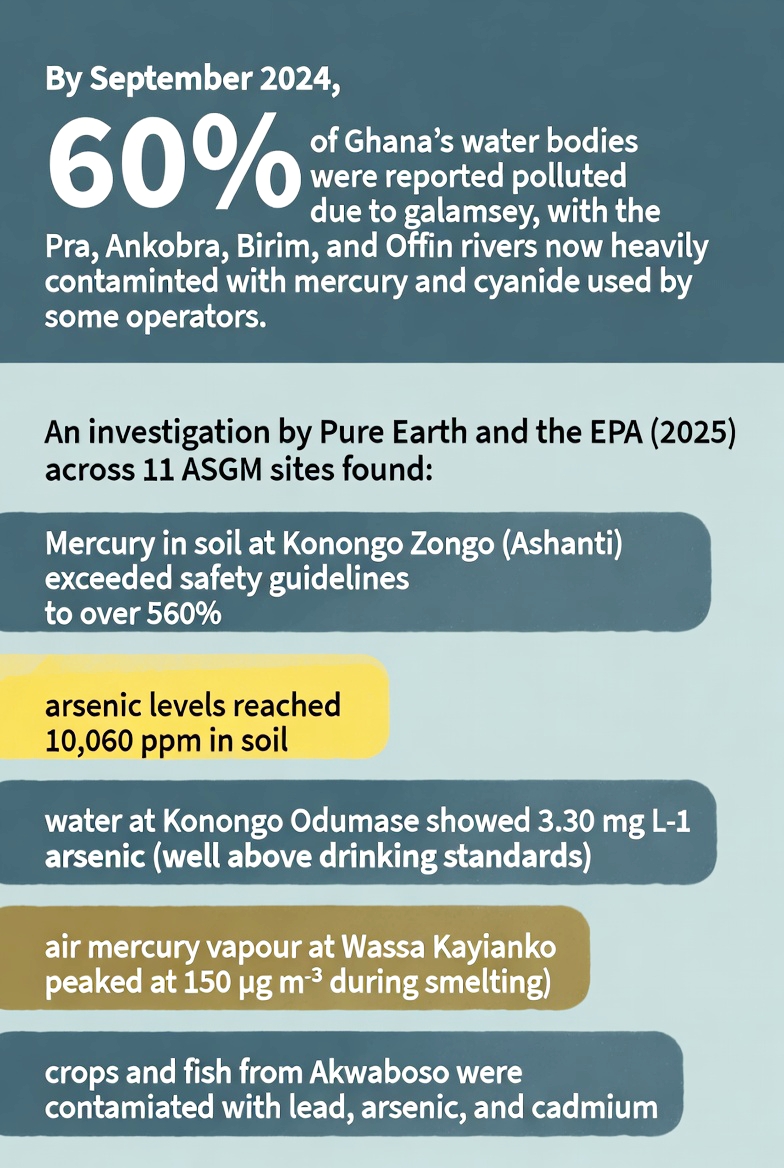
By September 2024, 60 % of Ghana’s water bodies were reported polluted due to galamsey, with the Pra, Ankobra, Birim and Offin rivers now heavily contaminated with mercury and cyanide used by some operators. An investigation by Pure Earth and the EPA (2025) across 11 ASGM sites found shocking results: mercury in soil at Konongo Zongo (Ashanti) exceeded safety guidelines by over 560 %; arsenic levels reached 10,060 ppm in soil; water at Konongo Odumase showed 3.30 mg L-1 arsenic (well above drinking standards) air mercury vapour at Wassa Kayianko peaked at 150 µg m-3 during smelting; and crops and fish from Akwaboso were contaminated with lead, arsenic and cadmium
The Ministry of Environment, Science, Technology and Innovation has reaffirmed the country’s commitment, establishing a multi-stakeholder Minamata Implementation Committee to deliberate on how to reduce and eliminate mercury use.
Yet here is the contradiction at the heart of Ghana’s mercury crisis: the laws exist on paper, but enforcement does not exist on the ground.
Open Air, Open Market: Mercury for Sale
Our investigation found mercury being sold openly in shops at Kumasi’s Alabar market, a sprawling commercial hub. Vendors display it alongside cooking oil, soap, and second-hand clothing. It arrives in plastic sachets, smuggled across porous borders, and sells for prices that make it accessible to any miner.
This trade is illegal under Ghana’s Minerals and Mining Act. It violates the commitments of the Minamata Convention. But the sellers operate without fear, because the buyers operate without oversight, and the enforcers operate without capacity.
The EPA’s Confession: Unarmed Against Armed Syndicates
Professor Nana Ama Browne Klutse is the Chief Executive of the Environmental Protection Agency (EPA). Her position places her at the center of Ghana’s environmental enforcement apparatus. Her assessment of the agency’s capacity is startlingly candid.
“When we go to the field, we sometimes meet illegal miners wielding powerful, sophisticated weapons and guns,” she told our investigation team.
“The laws do not permit us to use guns. So within our capacity, we only engage them in conversation.”

Let that sink in: the nation’s primary environmental enforcement agency sends its officers to confront heavily armed illegal miners with conversation. They carry no weapons. They have no backup. They rely on persuasion.
“When we go there, we do not carry guns, let alone attempt to fire at these illegal miners destroying our water bodies,” Professor Klutse says.
Her officers are left to confront well-armed syndicates with nothing but words—a dangerously unequal battle for the nation’s survival.
When asked about the open sale of mercury—the toxin that fuels the entire illegal industry—Professor Klutse’s answer is stark:
“The situation is overwhelming—it has become uncontrollable. The sale of mercury is so widespread that we can no longer manage it piecemeal. That is why, as a nation, we must clamp down on illegal mining entirely. There is no other way.”
The Attorney General’s Admission: “A Signal of Impunity”
But Where Are the Prosecutions?
The failure of enforcement extends beyond the field to the courtroom.
Dr. Dominic Akuritinga Ayine, Ghana’s Attorney General, does not mince words when asked about past failures.
“Yes, I absolutely accept that the lack of prosecutions against the financiers and kingpins has, in the past, sent a signal of impunity,” he admits.
This admission is significant: the highest legal officer in the land acknowledging that the state’s own inaction has encouraged the very behavior it seeks to stop.
He also confirmed that in October 2025, his office filed six new charges at the High Court in Accra against Mr. Antwi Boasiako—known popularly as Wontumi—the Ashanti Regional Chairman of the opposition New Patriotic Party, and his company Akonta Mining Limited, for alleged illegal mining activities.
The move signals intent to hold powerful individuals accountable. But critics note that one high-profile arrest does not constitute systemic enforcement.
The Political Patronage Problem
A 2023 report by the Ghana Integrity Initiative, the local chapter of Transparency International, revealed the deeper structural problem: political patronage continues to protect the financiers behind galamsey.
The report documented how powerful individuals with connections to political elites operate with impunity, shielded from prosecution by their relationships. Those arrested and charged are disproportionately small-scale operators—the foot soldiers of the illegal mining economy, not the generals who finance and direct it.
Opposition leaders describe the government’s approach as a “cosmetic crackdown”—a campaign marked by highly publicized arrests of low-level operators, often those aligned with the opposition, while leaving untouched the politically connected kingpins.
The recent arrest of Wontumi, an opposition figure, has been cited as an example of this selective enforcement. Critics argue that it masks a systemic failure to dismantle the powerful networks driving the destruction, and exposes the government’s lack of political will to arrest and prosecute its own members.
The Economic Trap: $8 Billion and One Million Jobs
Here is the uncomfortable reality that complicates every enforcement effort: illegal mining persists because it is underwritten by brutal economic logic.
Artisanal small-scale mining contributes over $8 billion annually to Ghana’s economy. It provides direct employment for over one million Ghanaians. A World Bank assessment described the sector as “too lucrative to easily surrender.”
For families like Kwaku’s, the choice is not between mining and a clean environment. The choice is between mining and hunger. Between sending a child to the pits or watching that child starve.
This is not an excuse for inaction. It is an explanation for why simple solutions fail. Any effective intervention must address not only the environmental damage and health crisis, but also the economic desperation that drives people into the mines.
Experts argue that any solution must target the financial architecture—”hitting the kingpins where it hurts—their wallets”—through aggressive asset seizures and freezing the accounts of the backers. But such measures require political will that has so far been lacking.
The Water Crisis: When Rivers Run Brown
The environmental damage has direct human consequences beyond mercury poisoning.
Seth Eric Atiapa, Chief Manager (Special Duties) at the Ghana Water Company Limited, explains that pollution has forced the company to spend millions on dredging and expensive chemicals to produce safe water.
“Because illegal mining had destroyed the water source at the Bonsa Water Treatment Plant,” he says, “any time we abstract the water and treat it, we get just about fifty percent of the water.”
Half the water. Wasted because the source is too contaminated to process efficiently.
He warns that if nothing is done about water pollution, the nation will struggle to access potable water. The cost of inaction will be measured not just in environmental damage, but in the basic human right to clean drinking water.
By September 2024, 60 percent of Ghana’s water bodies were reported polluted due to galamsey. The Pra, Ankobra, Birim, and Offin rivers—once lifelines for communities—are now heavily contaminated with mercury and cyanide.
The Laws That Are Not Enough
Because No One Is Enforcing Them
The Wildlife Resources Management Act (Act 1115, 2024) introduced tougher punishments for wildlife crimes. But Ofori-Amanfo argues this is not enough.
“I want Ghana to make specific laws,” he says. “If you kill chimpanzees, they should give you a sentence of twenty to thirty years.”
He cites stricter penalties in Uganda and Tanzania, where wildlife crimes carry sentences commensurate with the gravity of pushing a species toward extinction. A comparative analysis of penalty severity across countries shows Ghana lagging significantly behind regional peers in the legal protection of its most endangered species.
A legal framework is only as strong as the political courage to enforce it. Ghana’s fight against galamsey is failing not because the nation lacks laws, but because impunity, corruption, and weak institutions keep getting in the way.
The Spiritual War: When Communities Fight Back
In the Western North Region, the Aowin Traditional Council has taken matters into its own hands—through spiritual means.
Chiefs performed rituals, sacrificing a ram and fowls, to invoke the wrath of the gods against illegal miners. They declared a spiritual war to protect Jema—the only community in the area still free from galamsey.
The Chief of Nkwanta, Nana Ntow III, explained their intervention: *”We are the custodians of the land, entrusted by our ancestors to preserve it for future generations. The gods will not spare those who defy their warnings and destroy our heritage.”
This is what happens when the state fails: communities turn to the spiritual realm for protection because the secular realm offers none.
The Technology That Could Help: Nano-Ozone and Borax
Professor Klutse of the EPA is championing “nano-ozone” technology to cleanse rivers of heavy metals. The science is promising—ozone bubbles at the nanoscale can oxidize and precipitate metals, removing them from the water column.
“If I get US$200,000 today, we will do the pilot for every Ghanaian to see,” she says.
Two hundred thousand dollars. A small sum to prove a scalable solution. It remains unfunded.
Then there is borax.
About thirty years ago, Filipino innovators developed a mercury-free gold extraction method using borax—a common household chemical. The process uses gravity to create a heavy mineral concentrate, then adds borax to lower the melting point of gold, allowing smelting with simple equipment.
Field demonstrations between 2013 and 2014 in Le Suerte, Bolivia, and Gaang and Kias in the Philippines showed that the borax method recovers up to twice as much gold and is 10 to 30 percent faster than traditional mercury amalgamation.
Several successful projects—funded by the Global Alliance on Health and Pollution (GAHP), Geocenter Denmark, and the European Union—have demonstrated the method in Indonesia, Tanzania, and Zimbabwe. The projects proved that the borax method works on different types of ores and can be adopted without investment in expensive equipment.
Yet globally, small-scale gold mining still releases about 1,690 tons of mercury into the atmosphere every year—almost twice the amount released from coal burning.
So why is Kwaku, in Samreboi, still using mercury?
Because the borax method has not been adopted in Ghana. Because there is no program to train miners in safer techniques. Because the mercury supply chain is entrenched and profitable. Because enforcement of existing laws is nonexistent. Because the same forces that protect illegal mining also protect the mercury trade that feeds it
The Numbers That Haunt: 45,150 Kilograms
The Minamata Promise Ghana Broke
Let us return to the Minamata Initial Assessment Report.
45,150 kilograms of mercury per year. Used in gold extraction. Released into the environment.
72 percent to the air. Inhaled by children like Kwaku. Settling on soil and water.
Over 500,000 people at risk. Directly. From large-scale gold mining activities. The actual number, when downstream effects are considered, is certainly much higher.
36.5 tonnes of mercury to air annually. From mining and related sectors.
6.5 tonnes to water.Poisoning rivers, accumulating in fish, contaminating drinking water.
6 tonnes remaining on land. In soil, in sediment, in the bodies of organisms, slowly moving through the food chain.
These are not abstract statistics. They are the measurements of a nation systematically poisoning itself.
THE PRICE
Back in the Room with Kwaku—Still Breathing Poison
Evening falls over Samreboi. The heat begins to lift, replaced by the damp coolness that settles after sunset. Inside the ramshackle structure of wooden planks and rusted zinc, Kwaku sits on the floor.
His small 500 ml water bottle and flask are beside him. The tiny balls of mercury, wrapped in cling-film, are back in the flask. Tomorrow he will unwrap them again. Tomorrow he will mix the silvery liquid with ore. Tomorrow he will burn it over an open fire and inhale the invisible poison.
His mother is somewhere in the compound, preparing the evening meal. His three younger siblings are playing outside, their voices drifting through the gaps in the wall. They do not know what their brother breathes. They do not know that the gold he processes, which helps feed them, is slowly stealing his future.
Kwaku does not know the name of his condition. He does not know about methylmercury or bioaccumulation or the blood-brain barrier. He does not know about the Minamata Convention or Article 7 or the commitments his country made in 2017. He does not know about the 60 chimpanzees in Bia, sharing 98 percent of his DNA, being poisoned by the same mercury that now accumulates in his tissues.
He only knows that he is tired. That sometimes his hands shake. That he has not been to school in two years. That this is how his family survives.
In a health ministry conference room in Accra, policy documents sit in folders. Discussions continue about enforcement strategies. The EPA awaits funding for nano-ozone technology. The Attorney General’s office has filed charges against one high-profile figure. The Minamata Implementation Committee meets to deliberate.
In this room in Samreboi, there are no folders. There are no discussions. There is only a thirteen-year-old boy, alone with his mercury, in a country that has forgotten him.
The gold beneath Ghana’s soil has been called a blessing. But blessings do not poison children. Blessings do not push species to extinction. Blessings do not turn rivers brown and fill placentas with heavy metals.
This is not a blessing. This is a curse, measured in kilograms of mercury released, in hectares of forest destroyed, in chimpanzees disappearing into silence, in children whose potential is stolen before they ever have a chance to use it.
Sixty chimpanzees remain. Kwaku is one of over a million children breathing poison. The mercury continues to flow. The rivers continue to run brown. The impunity continues to protect the powerful.
And in a small room in Samreboi, as night falls completely, a thirteen-year-old boy sits in the darkness, waiting for tomorrow, when he will mix mercury again.
3 million Ghanaians estimated to be at risk from large-scale gold mining activities
– 45,150 kilograms of mercury used annually in Ghana’s ASGM sector
– 72 percent of mercury used released directly into the air
– 36.5 tones of mercury released to air annually from mining
– 6.5 tones of mercury released to water annually
– 6 tones of mercury remaining on land annually
– Over 560% exceedance of mercury safety guidelines in soil at Konongo Zongo
– 10,060 arsenic levels in soil at some mining sites
– 60% of Ghana’s water bodies polluted due to galamsey as of September 2024
– 5,252 hectares of forest reserves destroyed by galamsey
– 45 forest reserves affected by mining
– 9 forest reserves completely ruined
– 60 Western chimpanzees remain in Ghana (down from approximately 300 in recent years)
– 4,000+ placentas examined by Dr. Sampane, with heavy metals present in cord and placenta
– 500+ cases of pregnancy loss linked to heavy metal concentration
– $8 billion annual contribution of artisanal mining to Ghana’s economy
– 1 million+ Ghanaians directly employed in artisanal mining
– 1,690 tons of mercury released globally from ASGM annually
– 90% of pollutants absorbed by fetus from mother’s bloodstream
– 98% DNA shared between humans and chimpanzees
What Must Change: The Experts’ Prescriptions
Dr. Jessica Junker, Primatologist:
“The most effective conservation strategy is protecting and restoring remaining habitat, reducing hunting pressure, and addressing the socio-economic drivers of habitat loss, rather than attempting to move chimpanzees after the damage has already occurred. Conservation must be designed and implemented in a way that benefits both the wildlife and the local communities.”
Dr. Paulin Mungongo, Wildlife Veterinarian:
“Implement One Health monitoring—regular testing of chimpanzee samples for heavy metals, pathogen surveillance, and health monitoring of human populations in mining communities. Create larger, connected natural areas to build resilience against climate change. Protecting climate refugia, restoring corridors, and prioritizing larger, connected areas for conservation increases resilience.”
Richard Ofori-Amanfo, Wildlife Division:
“Strengthen penalties for wildlife crimes. Specific laws with sentences of twenty to thirty years for killing chimpanzees. Increase patrols and surveillance in protected areas. Continue community engagement to educate people on the importance of protecting chimpanzees.”
Professor Nana Ama Browne Klutse, EPA:
“Fund and implement nano-ozone technology to cleanse rivers of heavy metals. Review mining laws to close loopholes. Provide enforcement agencies with the capacity—including security—to confront illegal miners effectively.”
Dr. Dominic Akuritinga Ayine, Attorney General:
“Prosecute financiers and kingpins, not just low-level operators. End the signal of impunity. Target the financial architecture through aggressive asset seizures and freezing accounts.”
Professor Edward Wiafe Debrah, Environmentalist:
“Explore innovative financing mechanisms: Payment for Ecosystem Services (PES), Conservation Trust Funds, Green Bonds and impact investing, tourism levies to support conservation.”
The question is no longer whether Ghana can afford to address this crisis.
The question is whether Ghana can afford not to.
Because every day mercury is released, a child inhales poison.
Because every hectare of forest destroyed pushes chimpanzees closer to extinction.
Because every policy delay, every unfunded solution, every unenforced law is not just a regulatory failure.
It is a childhood slipping away.
It is a species disappearing.
It is a nation’s future, slowly, silently, poisoned.
In a small room in Samreboi, Kwaku breathes.
In the forests of Bia, the last chimpanzees fall silent.
The mercury does not stop.
Neither should we.
This story was produced with support from Internews’ Earth Journalism Network.