

By Alex Ababio | Special Investigative Report
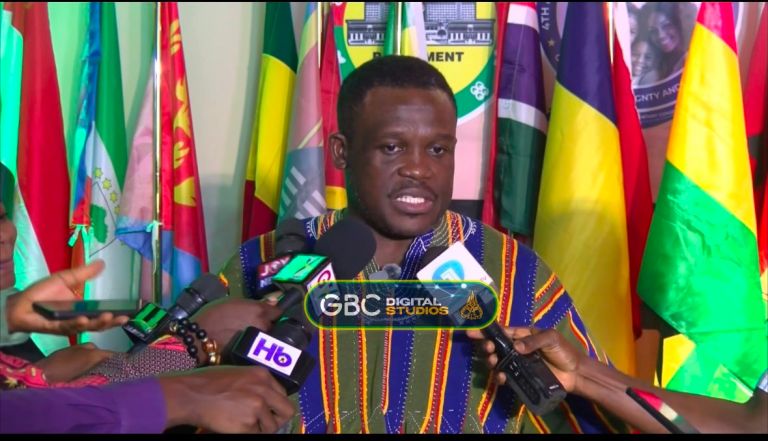
The debate over family values, cultural sovereignty, gender identity and sexuality has once again moved to the center of Ghana’s political discourse following remarks by Ghana’s Minister for Communication, Digital Technology and Innovations and Member of Parliament for Ningo-Prampram, Samuel Nartey George.
Speaking on the sidelines of the 4th African Inter-Parliamentary Conference on Family, Sovereignty and Values in Accra, Sam George defended what he described as Africa’s responsibility to preserve its cultural identity and resist external ideological pressures.
“The International Court of Justice has passed a landmark ruling on gender, saying that there are only two genders, male and female,” he stated.
He further argued:
“Until 1976 in the United States, homosexuality was considered a mental illness. The decision to remove it as a mental illness was not based on science; it was based on a social campaign.”
He added:
“You don’t change scientific facts with social campaigns.”
The comments came as hundreds of lawmakers, religious leaders, academics and policymakers from more than 30 countries gathered in Accra for the four-day conference, which seeks to advance a proposed African Charter on Family, Sovereignty and Values. The conference is being championed by Speaker of Parliament Alban Sumana Kingsford Bagbin and other African legislators who argue that the continent must protect its cultural traditions from what they view as external ideological influence.
However, several of the scientific and historical claims made during the debate remain fiercely contested.
What Does the Historical Record Show?
A review of public records from the American Psychiatric Association (APA), academic literature and the World Health Organization (WHO) shows that homosexuality was indeed classified as a psychiatric disorder in parts of the twentieth century.
However, experts note that the timeline cited by Sam George is not entirely accurate.
According to historical records, the American Psychiatric Association removed homosexuality from the Diagnostic and Statistical Manual of Mental Disorders (DSM) in 1973, not 1976. The decision was subsequently affirmed by a vote of APA members in 1974.
A peer-reviewed historical review published in the journal Behavioral Sciences states:
“In 1973, the American Psychiatric Association removed the diagnosis of homosexuality from the second edition of its Diagnostic and Statistical Manual.”
Likewise, the APA’s action was later recognized as a landmark moment in psychiatric history because emerging scientific evidence increasingly challenged earlier assumptions that same-sex attraction was inherently pathological.
The World Health Organization followed years later, officially removing homosexuality from its International Classification of Diseases in 1990. WHO continues to maintain that homosexuality is not a mental disorder.
Was the Decision Driven by Science or Activism?
This question lies at the heart of Sam George’s argument.
The minister contends that homosexuality was removed from psychiatric classifications primarily because of social activism rather than scientific evidence.
Historians of psychiatry and medical researchers generally describe the process as more complex.
Dr. Jack Drescher, a psychiatrist and researcher who has extensively studied the history of homosexuality in psychiatric classifications, wrote that the APA’s decision followed years of debate involving scientific studies, clinical observations and challenges to earlier theories that pathologized homosexuality. Researchers compared competing scientific explanations before concluding that homosexuality alone did not meet the criteria of a mental disorder.
The encyclopedia Britannica similarly notes that the APA’s 1973 decision emerged from a combination of “the weight of empirical data,” evolving scientific understanding and changing social attitudes.
This historical record suggests that activism played a role in drawing attention to the issue, but it was not the sole factor cited by psychiatric organizations. Scientific reviews, clinical evidence and professional debate were also central to the decision-making process.
The Conference Driving the Debate
Sam George’s remarks were delivered during the 4th African Inter-Parliamentary Conference on Family, Sovereignty and Values, a gathering that has become increasingly influential in shaping discussions on family policy, cultural identity and sexuality across Africa.
According to organizers, the conference seeks to strengthen cooperation among African legislatures while promoting policies that protect family structures, cultural values and national sovereignty. Delegates are also discussing the proposed African Charter on Family, Sovereignty and Values.
Speaker Bagbin has argued that Africa faces growing pressure to adopt legal and social frameworks that do not necessarily reflect African traditions.
“We are meeting at a moment when African values face a dual assault,” Bagbin said ahead of the conference, warning against what he described as external ideological pressures.
The conference agenda includes discussions on family resilience, cultural preservation, digital governance, youth development and legislative responses to emerging social issues.
Human Rights Groups Raise Alarm
The conference has also attracted strong criticism from human rights organizations.
Several advocacy groups have expressed concern that the proposed charter could undermine existing commitments on gender equality, reproductive rights and protections for LGBTQ+ persons.
A recent analysis by the pan-African feminist legal organization Initiative for Strategic Litigation in Africa (ISLA) argued that some provisions of the draft charter risk subordinating individual rights to collective family interests.
Kenyan lawyer Gilbert Mitullah, a board member of the Queer African Network, told The Guardian that the proposed framework could become “a licence to oppose, regress on or refuse to implement existing commitments” relating to sexual and reproductive health rights.
Organizers of the conference, however, reject such criticisms and maintain that the initiative is intended to protect Africa’s sovereignty and cultural identity rather than diminish human rights.
The Gender Question
Another major point raised by Sam George concerns gender identity.
The minister claimed that recent international legal developments support the position that there are only two genders.
However, available public records do not show a recent International Court of Justice ruling that universally defines gender exclusively as male and female. While courts and governments around the world continue to debate gender recognition policies, no widely recognized ICJ judgment matching the description provided by the minister was identified in publicly available records reviewed for this report.
Meanwhile, international medical bodies continue to update classifications relating to gender identity.
The WHO, for example, revised its International Classification of Diseases (ICD-11), moving “gender incongruence” out of the chapter on mental disorders and into a sexual health category. WHO said the change reflected modern scientific understanding and was intended to reduce stigma while preserving access to healthcare.
A Debate Far From Over
The controversy surrounding Sam George’s remarks highlights a broader struggle unfolding across Africa and beyond.
On one side are policymakers and religious leaders who argue that African societies have the sovereign right to define family, morality and social norms according to local traditions.
On the other are medical bodies, human rights advocates andv international organizations that emphasize evolving scientific evidence and universal human rights standards.
What is clear from the historical record is that homosexuality was once classified as a psychiatric disorder in parts of the world. It is also clear that major international medical institutions—including the American Psychiatric Association and the World Health Organization—no longer classify homosexuality as a mental illness. The evidence further shows that the change emerged through a combination of scientific review, professional debate and social advocacy rather than activism alone.
As African lawmakers continue deliberations in Accra, the conference is likely to shape future debates on sovereignty, family values, gender and sexuality across the continent. Whether those discussions lead to greater consensus or deeper divisions remains one of the most consequential policy questions facing Africa today.