

By Alex Ababio
President John Dramani Mahama has called for a fundamental reset in Ghana’s relationship with the European Union (EU), arguing that the era of donor-recipient relations must give way to a new partnership built on trade, industrialisation, technology transfer, investment and shared prosperity.
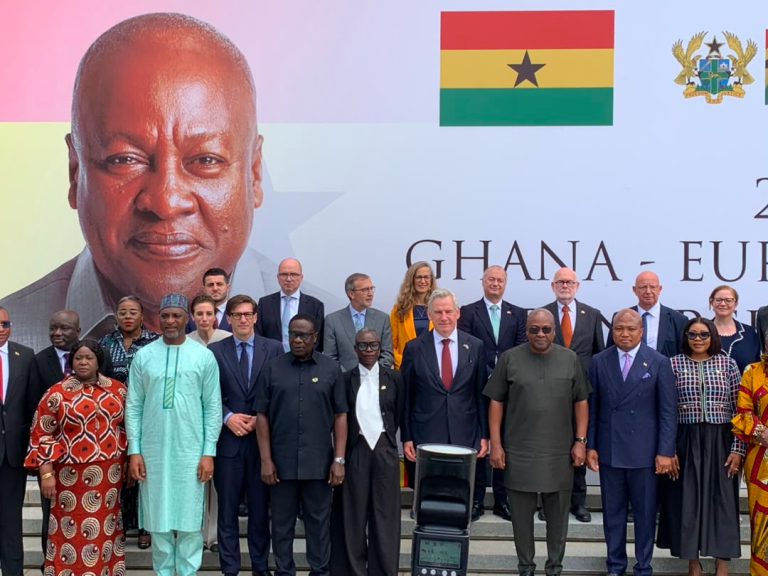
Speaking at the opening of the 2026 Ghana-EU Partnership Dialogue in Accra, President Mahama delivered what analysts describe as one of the clearest policy statements yet on Ghana’s economic diplomacy agenda.
“The rapidly changing global environment, characterised by geopolitical tensions, economic uncertainty, climate change and emerging security threats, makes strong international partnerships more important than ever,” President Mahama said.
His remarks come at a time when Ghana is emerging from one of the most severe economic crises in its recent history and is seeking to reposition itself as a manufacturing, export and digital hub within Africa.
FROM AID TO INVESTMENT: A NEW DIRECTION
According to President Mahama, the Ghana-EU relationship has evolved from a traditional development assistance framework into a strategic partnership anchored on democratic values, mutual respect and common interests.
“Our objective is not simply to preserve existing cooperation but to elevate it,” the President stressed, adding that future cooperation should support industrial growth, innovation, technology transfer and job creation.
The significance of the statement extends beyond Ghana.
The European Union remains Ghana’s largest export destination and one of its most important development and investment partners. The relationship is governed by the Ghana-EU Economic Partnership Agreement (EPA), which has facilitated trade between both sides for a decade.
Speaking at the same dialogue, President Mahama emphasized that future cooperation must focus on helping African countries create value locally rather than exporting raw materials and importing finished products.
Economic experts have long argued that Africa’s dependence on raw commodity exports has left many economies vulnerable to global price shocks.
According to the United Nations Conference on Trade and Development (UNCTAD), Africa continues to capture only a fraction of the value generated from its natural resources because much of the processing and manufacturing occurs outside the continent.
For Ghana, the challenge is particularly evident in sectors such as cocoa, gold, bauxite and lithium.
GHANA’S ECONOMIC RECOVERY: FACTS BEHIND THE OPTIMISM
President Mahama told delegates that Ghana’s economy is showing encouraging signs of recovery, citing declining inflation, improving foreign exchange reserves and renewed investor confidence.
Recent assessments by the International Monetary Fund (IMF) support this claim.
In its May 2026 review, the IMF stated that Ghana’s economic programme had delivered “substantial stabilization gains,” highlighting sharply lower inflation, stronger reserves, improved confidence in the cedi and significant progress in debt restructuring. IMF mission chief Ruben Atoyan noted that growth had exceeded expectations and that Ghana had made remarkable progress in restoring macroeconomic stability.
The IMF further revised Ghana’s 2026 growth projection upward to 4.8 percent, citing stronger-than-expected economic performance, fiscal discipline and improving macroeconomic conditions.
President Mahama attributed these gains to government reforms and the resilience of Ghanaians who endured painful economic adjustments.
However, economists caution that stabilization alone is not enough.
The critical challenge now is translating macroeconomic improvements into jobs, higher incomes and industrial growth.
THE 24-HOUR ECONOMY: GHANA’S INDUSTRIAL BET
Central to President Mahama’s economic strategy is the flagship 24-Hour Economy Initiative and the Accelerated Export Development Programme.
According to the President, these programmes are intended to increase production across agriculture, manufacturing, logistics, transportation, tourism and digital services.
The broader objective is to transform Ghana from a consumption-driven economy into a production-driven economy capable of competing within the African Continental Free Trade Area (AfCFTA).
The AfCFTA represents a market of more than 1.4 billion people and is widely regarded as the world’s largest free trade area by membership.
President Mahama urged European investors to view Ghana not merely as a domestic market but as a strategic gateway into this continental marketplace.
Industry observers say that attracting long-term investment into manufacturing, logistics infrastructure and export processing will be essential if Ghana is to take full advantage of AfCFTA opportunities.
COCOA: THE BATTLE FOR VALUE ADDITION
Perhaps the most ambitious element of President Mahama’s address concerns Ghana’s cocoa sector.
Despite being one of the world’s leading cocoa producers, Ghana has historically earned far less from chocolate and cocoa products than countries that process the beans.
To address this imbalance, President Mahama announced plans to introduce a new Cocoa Bill that would guarantee cocoa farmers at least 70 percent of the world market price.
“We will honour our promise to pay our hardworking farmers 70 per cent of the world market price of cocoa,” Mahama previously stated.
Finance Minister Dr. Cassiel Ato Forson has also confirmed that government intends to introduce legislation guaranteeing farmers a minimum of 70 percent of the gross Free On Board (FOB) price through an automatic pricing mechanism linked to international markets.
The proposed reforms come amid significant turbulence in global cocoa markets.
Reuters reported that Ghana recently adjusted producer prices following a sharp decline in international cocoa prices and announced plans to increase local cocoa processing from approximately 30-40 percent to at least 50 percent.
President Mahama reiterated that Ghana intends to ensure at least 50 percent of its cocoa beans are processed locally.
Experts argue that such a move could create thousands of jobs, increase export earnings and reduce Ghana’s vulnerability to volatile commodity markets.
However, challenges remain.
A recent Financial Times analysis highlighted persistent poverty among many cocoa farmers despite periods of record global cocoa prices, pointing to structural weaknesses including low productivity, aging farms, climate pressures and inadequate rural infrastructure.
DIGITAL TRANSFORMATION AND ARTIFICIAL INTELLIGENCE
Another major pillar of Ghana’s proposed partnership with the EU is digital transformation.
President Mahama said Ghana is positioning itself as a leading digital hub in Africa and is seeking deeper collaboration with Europe in digital infrastructure, cybersecurity, artificial intelligence, innovation and startup development.
The emphasis reflects growing recognition that future economic competitiveness will depend increasingly on digital technologies.
The European Union has become a major global actor in technology regulation, AI governance and digital infrastructure investment.
For Ghana, partnerships in these sectors could help accelerate innovation, strengthen cybersecurity capacity and create new opportunities for technology startups.
Industry experts note that Africa’s digital economy is expected to become one of the fastest-growing sectors on the continent over the next decade, making technology cooperation strategically important for both Ghana and the EU.
SECURITY, THE SAHEL AND REGIONAL STABILITY
President Mahama also used the dialogue to highlight rising security concerns across West Africa.
He described growing instability in the Sahel as a threat that cannot be separated from economic development.
“Security and development are inseparable,” the President emphasized.
His concerns mirror growing international anxiety about terrorism, violent extremism and political instability across parts of the Sahel region.
In March 2026, Ghana and the European Union signed a Security and Defence Partnership aimed at strengthening cooperation on regional security, counterterrorism, cyber threats, maritime security and defense collaboration. The agreement was signed on behalf of the EU by High Representative for Foreign Affairs and Security Policy Kaja Kallas and on behalf of Ghana by Vice President Professor Naana Jane Opoku-Agyemang.
Security analysts argue that addressing unemployment, poverty and governance deficits will be just as important as military responses in preventing instability from spreading southward into coastal West Africa.
DEMOCRACY, GOVERNANCE AND MIGRATION
President Mahama reaffirmed Ghana’s commitment to democratic governance, transparency and accountability.
He disclosed that Cabinet is expected to finalize government’s position on proposed constitutional reforms while Parliament continues consideration of the Conduct of Public Officers Bill.
On migration, the President called for expanded legal migration pathways and stronger skills partnerships.
He argued that migration should not be viewed solely as a challenge but as a development opportunity when properly managed.
The issue remains a key area of engagement between African countries and the European Union, particularly as both regions seek solutions that balance economic needs, labour mobility and border management.
THE BIG QUESTION: CAN GHANA LEAD AFRICA’S INDUSTRIAL FUTURE?
President Mahama’s message to the European Union was unmistakable.
Ghana wants a partnership based not on aid but on investment; not on dependency but on innovation; not on exporting raw materials but on building industries.
The success of that vision will depend on whether Ghana can sustain economic reforms, attract productive investment, strengthen institutions and create the conditions necessary for industrial growth.
For many analysts, the stakes extend far beyond Ghana.
If successful, the Ghana-EU model could become a blueprint for a new generation of Africa-Europe relations—one focused on manufacturing, technology, value addition and shared prosperity.
As global competition for Africa’s markets, minerals, talent and strategic partnerships intensifies, Ghana is positioning itself at the center of a larger debate about the future of African development.
The question now is whether those ambitions can be transformed from policy declarations into factories, jobs, exports and lasting prosperity for millions of Ghanaians.This version is optimized for high-value business, investment, trade, industrialization, AfCFTA, EU relations, cocoa value-addition, digital economy, AI, governance, and economic policy keywords that typically attract higher CPC advertising rates and stronger search visibility.