

By Alex Ababio
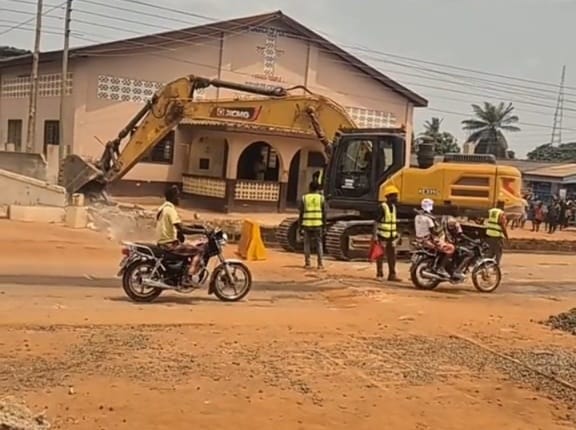
A demolition exercise has commenced in Dzodze in the Ketu North Municipality to clear roadside properties and structures to pave the way for the dualisation of the Dzodze stretch under Lot 8 of the government’s “Big Push” road project.
The exercise, which began on Thursday, affected a number of structures situated within the right-of-way of the proposed road expansion.
These included some churches, portions of fuel stations, and sections of public facilities such as the police station.
Prior to the official demolition, several affected property owners had undertaken self-demolition of their structures after receiving compensation
A Road at the Heart of Cross-Border Trade
Dzodze, the capital of the Ketu North Municipality in Ghana’s Volta Region, sits along a critical corridor linking Ho to the Aflao border enclave, a key gateway between Ghana and Togo. The stretch earmarked for dualisation forms part of the eastern transport spine that facilitates cross-border trade, agricultural transport, and passenger movement.
Government officials describe the dualisation as part of a broader national infrastructure acceleration agenda branded as the “Big Push.” The policy, first articulated during recent budget presentations, aims to fast-track strategic road, health, and educational infrastructure through a mix of domestic revenue mobilisation and borrowing.
Public records from the Ministry of Roads and Highways show that Ghana’s road network spans over 94,000 kilometres, yet only about 42 percent is in good condition, with several regional corridors experiencing congestion and deterioration. The Dzodze stretch, local drivers say, has long suffered from narrow lanes, encroachment, and poor drainage.
“The road is too tight,” said a commercial driver at the lorry station. “When heavy trucks pass, smaller cars have to veer off. Accidents are common during peak market days.”
Road safety data from the National Road Safety Authority indicates that the Volta Region consistently records hundreds of crashes annually, with speeding and poor road geometry cited among contributing factors. Infrastructure experts argue that dual carriageways, when properly designed, reduce head-on collisions and improve traffic flow.
The January Town Hall and Assurances
In January, a town hall meeting and sensitisation exercise was organised for residents and project-affected persons.
The engagement was led by Mr Edem Agbana, the Member of Parliament for Ketu North, in collaboration with the Ketu North Municipal Assembly headed by Rev. Martin Amenaki, Municipal Chief Executive.
Officials from the Regional Highways Authority, the Volta Regional Minister, Mr James Gunu, and the project contractors were also present.
At the meeting, affected persons were advised on the scope of the project and assured of due compensation before the commencement of demolition works.
Participants who attended the forum told this reporter that engineers presented layout maps indicating the new right-of-way boundaries and explained valuation methodologies for compensation.
“We were shown the lines,” one church elder recounted. “They told us clearly which portions would go. They promised compensation before any bulldozer moves.”
Compensation: Relief for Some, Anxiety for Others
Some of the affected persons who spoke to the Ghana News Agency (GNA) confirmed that they had received their compensation packages, which informed their decision to begin dismantling their structures ahead of the exercise.
Under Ghanaian law, Article 20 of the 1992 Constitution requires prompt and fair compensation when property is compulsorily acquired in the public interest. The Lands Commission typically undertakes valuation based on market rates, replacement cost, and depreciation.
Several property owners interviewed confirmed receipt of payment into their bank accounts weeks before demolition.
“I received my package, so I decided to remove my roofing sheets myself,” said a fuel station manager whose forecourt had partially encroached into the road reserve. “It is painful, but development must come.”
However, a few residents expressed concern that compensation amounts might not reflect full reconstruction costs amid rising prices of cement, steel, and labour. Ghana’s inflation, which peaked above 50 percent in 2023 before easing, has significantly increased building material costs, according to data from the Ghana Statistical Service.
An independent quantity surveyor based in Ho explained that delays between valuation and payment can erode real value. “If valuation was done last year and payment is made months later, inflation affects replacement cost unless adjustments are made,” he said.
Municipal officials maintain that all payments were processed in line with approved government rates and that no demolition commenced without prior settlement.
Public Facilities in the Line of Fire
The inclusion of sections of public facilities such as the police station has raised eyebrows. Engineers confirmed that only portions within the legally demarcated right-of-way would be removed and reconstructed where necessary.
Urban planners argue that such encroachments often reflect decades of weak enforcement of planning regulations. A former official of the Land Use and Spatial Planning Authority noted that many towns grew organically along trunk roads without strict adherence to buffer zones.
“What we are seeing in Dzodze is not unique,” he said. “Across Ghana, road reserves have been built over for years. When expansion finally comes, it becomes socially and politically sensitive.”
The Economics of Dualisation
The dualisation of the Dzodze stretch is expected to ease traffic congestion, enhance road safety, and facilitate smoother movement of people, goods and transit vehicles along the corridor.
Transport economists say improved roads lower vehicle operating costs, reduce travel time, and attract investment. The Aflao corridor, in particular, is strategic for the movement of agricultural produce, textiles, and petroleum products between Ghana and Togo.
Data from the Ghana Revenue Authority indicates that the Aflao border post is among the country’s busiest land entry points, generating significant customs revenue annually. Traders interviewed at Dzodze market believe faster travel times will increase daily turnover.
“When the road is good, buyers from Ho and even Accra will come more often,” said a tomato wholesaler.
Yet analysts caution that dualisation alone does not guarantee economic transformation. Maintenance funding, traffic enforcement, and proper drainage are critical to sustaining gains.
Ghana’s road sector has faced funding constraints in recent years, with the Ghana Road Fund struggling to meet maintenance needs. The Auditor-General’s reports have repeatedly flagged arrears owed to contractors, raising questions about long-term sustainability of large-scale expansion projects.
Political Stakes and Public Trust
Infrastructure projects in election cycles often attract scrutiny. Civil society groups have called for transparency in procurement, contractor selection, and cost disclosure under the Big Push framework.
While government officials tout the initiative as a game-changer, public finance analysts warn that large capital projects must align with Ghana’s debt sustainability strategy under its ongoing International Monetary Fund-supported programme.
For residents in Dzodze, however, the debate is more immediate: will the promised road be completed on schedule?
“We have seen projects start and stall,” said a retired teacher. “We pray this one will not stop halfway.”
Municipal authorities insist the contractor has been mobilised and timelines communicated. Heavy machinery was visible at sections of the cleared corridor during this reporter’s visit.
Balancing Development and Displacement
Development-induced displacement remains a delicate issue across Ghana. Though the affected structures in Dzodze appear limited to road reserves rather than full residential compounds, the emotional toll is evident.
Church leaders whose buildings were partially demolished say they will temporarily worship under canopies while reconstructing.
“We are not against the road,” one pastor said. “We only ask that government supports us to rebuild quickly.”
Human rights advocates emphasise the importance of post-compensation monitoring to ensure vulnerable groups are not left worse off.
Optimism Amid the Rubble
Residents have expressed optimism that the project, when completed, will boost economic activities in Dzodze and surrounding communities while improving overall connectivity within the municipality and beyond.
Young entrepreneurs envision roadside businesses expanding once pedestrian walkways and service lanes are completed. Commercial drivers anticipate reduced fuel consumption and fewer breakdowns.
Standing beside a half-demolished wall, one shop owner reflected on the paradox of progress. “Today, it looks like loss,” she said, pointing to piles of concrete. “But maybe tomorrow, it will bring more customers.”
As bulldozers continue their careful advance, Dzodze stands at a crossroads — balancing constitutional rights to property with the collective promise of safer, faster roads. Whether the Big Push will deliver lasting transformation here will depend not only on asphalt laid, but on accountability maintained, compensation honoured, and promises kept.