An Investigative Special Report By Alex Ababio
The Government of Ghana has formally demanded a full international investigation after two Ghanaian soldiers serving under the United Nations peacekeeping mission in southern Lebanon were critically injured in a missile strike, an incident that has triggered diplomatic protests, raised questions about the safety of peacekeepers, and drawn global attention to the escalating conflict along the Israel–Lebanon border.
The attack, which occurred on Friday, March 6, 2026, struck the headquarters of the Ghana Battalion deployed under the United Nations Interim Force in Lebanon (UNIFIL) in southern Lebanon, according to the Ghana Armed Forces. The strike left two Ghanaian soldiers critically wounded and another soldier suffering trauma, while infrastructure at the peacekeeping base was destroyed.
The incident is now the subject of both diplomatic protest and international scrutiny, with Ghana accusing those responsible of violating international law and potentially committing a war crime.
Missile Strike Hits Ghanaian Battalion Headquarters
According to an official statement issued by the Ghana Armed Forces, the Ghanaian battalion headquarters came under two missile attacks between 17:45 and 17:52 local time on March 6.
“The Ghana Armed Forces wishes to inform the general public that as a fallout of the current ongoing IDF and Hezbollah exchanges in Southern Lebanon, the Ghanaian Battalion Headquarters in United Nations Interim Force (UNIFIL), Lebanon came under two missile attacks between 1745 and 1752 hours local time today,” the statement said.
The strike caused significant damage to the camp and destroyed critical infrastructure.
“Two soldiers are critically injured, while one other has been traumatised. Additionally, the Officers’ Mess facility also got hit and has been burnt down completely,” the military statement added.
The injured soldiers were initially treated at a Level One Medical Bunker inside the base before arrangements were made to evacuate them to the UNIFIL headquarters referral hospital for advanced medical care.
Other Ghanaian troops stationed at the facility reportedly took shelter in underground bunkers as the situation unfolded.
Government Files Diplomatic Protest at the United Nations
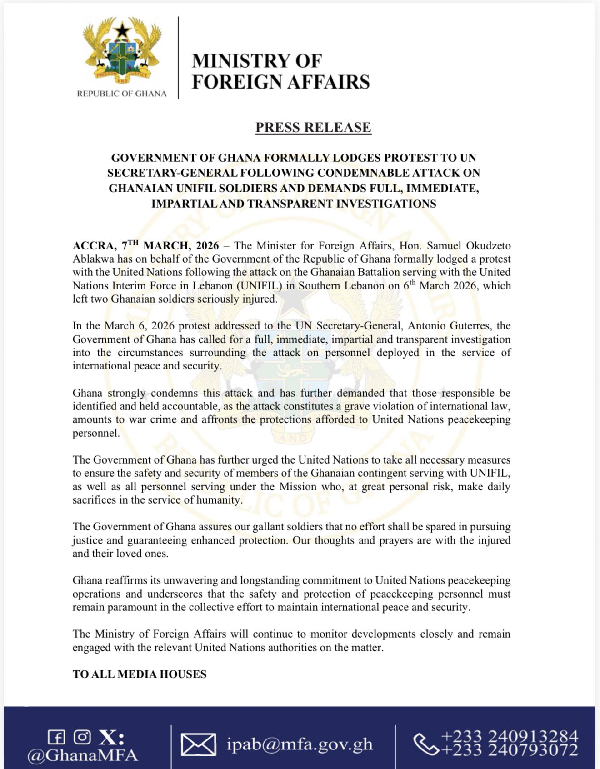
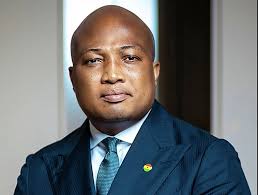
Following the attack, Ghana’s Minister of Foreign Affairs, Samuel Okudzeto Ablakwa, announced that the government had lodged a formal complaint with the United Nations, demanding an immediate investigation.
In a statement released on March 7, 2026, the government condemned the strike and called for international accountability.
“Samuel Okudzeto Ablakwa, on behalf of the Government of the Republic of Ghana, has formally lodged a protest with the United Nations following the attack on the Ghanaian Battalion serving with UNIFIL in Southern Lebanon on March 6, 2026, which left two Ghanaian soldiers seriously injured.”
The protest was formally addressed to António Guterres, Secretary-General of the United Nations.
“In the protest addressed to UN Secretary-General Antonio Guterres, the Government of Ghana called for a full, immediate, impartial, and transparent investigation into the circumstances surrounding the attack on personnel deployed in the service of international peace and security.”
The government described the attack in unusually strong terms, signaling its seriousness at the diplomatic level.
“Ghana strongly condemns this attack and has further demanded that those responsible be identified and held accountable, as the attack constitutes a grave violation of international law, amounts to a war crime, and affronts the protections afforded to United Nations peacekeeping personnel.”
A Conflict Zone Where Peacekeepers Are Increasingly at Risk
The missile strike occurred amid escalating hostilities between the Israel Defense Forces and the Lebanese militant group Hezbollah, whose cross-border exchanges of fire have intensified in recent months.
Southern Lebanon, particularly along the volatile “Blue Line” separating Lebanon and Israel, has become one of the most dangerous operational environments for international peacekeepers.
Military analysts say the situation illustrates the growing risks faced by peacekeeping missions deployed in active conflict zones where modern precision weapons, drones, and artillery fire increasingly blur the distinction between military targets and international observers.
UNIFIL troops—drawn from dozens of countries including Ghana, Ireland, France, and Malaysia—have operated in southern Lebanon since 1978, tasked with monitoring hostilities, supporting the Lebanese armed forces, and maintaining stability in the region.
However, experts say the mission has been operating in a deteriorating security environment.
“The presence of UN peacekeepers is meant to stabilize the region,” said a Middle East security analyst familiar with UN operations. “But when active combat erupts between heavily armed actors, peacekeeping forces inevitably become vulnerable.”
UN Condemns Attack, Launches Investigation
The UN peacekeeping mission has also condemned the incident and launched its own investigation.
UNIFIL said targeting peacekeepers is unacceptable under international humanitarian law.
“It is unacceptable that peacekeepers performing Security Council-mandated tasks are targeted,” the mission said in a statement.
“Any attack on UNIFIL peacekeepers constitutes a grave violation of international humanitarian law and Security Council Resolution 1701 and may amount to a war crime.”
The mission added that it is investigating the circumstances surrounding the attack and has not yet officially determined the source of the missile fire.
The strike occurred amid heightened regional instability, raising fears that escalating military operations could further destabilize the already fragile Middle East security landscape.
International Reaction and Solidarity
The attack has also prompted international condemnation.
Ireland’s Prime Minister Micheál Martin condemned what he described as a reckless strike on a UN base and expressed solidarity with the Ghanaian contingent serving in Lebanon.
“I strongly condemn the reckless strike on a UNIFIL base in southern Lebanon that has left Ghanaian peacekeepers seriously injured,” Martin said, adding that the role of peacekeepers must be respected by all parties in the conflict.
Irish troops stationed nearby reportedly rushed to assist the injured Ghanaian soldiers following the strike.
International diplomats say such attacks, whether intentional or accidental, threaten to undermine the credibility and operational effectiveness of UN peacekeeping missions worldwide.
—
Ghana’s Longstanding Role in UN Peacekeeping
Ghana has been one of the most consistent contributors to United Nations peacekeeping missions since the early 1960s, deploying thousands of soldiers to conflict zones across Africa, the Middle East, and the Balkans.
The country’s participation in UN peacekeeping began shortly after independence under the leadership of Kwame Nkrumah, when Ghanaian troops were deployed to the Congo in 1960.
Since then, Ghanaian soldiers have served in missions in Liberia, Sierra Leone, Sudan, South Sudan, Mali, and Lebanon.
According to UN data, Ghana remains among the top troop-contributing countries to peacekeeping operations globally.
Military historians say the Lebanon deployment reflects Ghana’s long-standing commitment to international peace and security.
But the latest attack has renewed domestic debate over the risks faced by Ghanaian troops deployed abroad.
—
Government Reassures Ghanaian Peacekeepers
Despite the incident, the Government of Ghana has reaffirmed its commitment to international peacekeeping operations while assuring deployed troops that their safety remains a national priority.
“The Government of Ghana assures our gallant soldiers that no effort shall be spared in pursuing justice and guaranteeing enhanced protection.”
“Our thoughts and prayers are with the injured and their loved ones.”
“Ghana reaffirms its unwavering and longstanding commitment to United Nations peacekeeping operations and underscores that the safety and protection of peacekeeping personnel must remain paramount in the collective effort to maintain international peace and security.”
—
A Test for International Accountability
As investigators from the United Nations begin examining the incident, the attack on the Ghanaian peacekeepers is expected to intensify debate about the protection of international forces operating in active conflict zones.
Diplomats say the outcome of the investigation could carry significant implications—not only for Ghana and its troops but also for the broader credibility of international peacekeeping missions.
For now, the injured soldiers remain under medical care, while Ghana awaits answers from the international community.
And for the families of the wounded troops, the question remains painfully simple: how could soldiers sent to keep the peace become casualties of war?
Read the full statement below: