

By Alex Ababio
At the ornate halls of the Accra International Conference Centre, Ghana signaled what officials describe as a historic break from its colonial-era commodity export model: a determined pivot from shipping raw produce to exporting finished, value-added products.
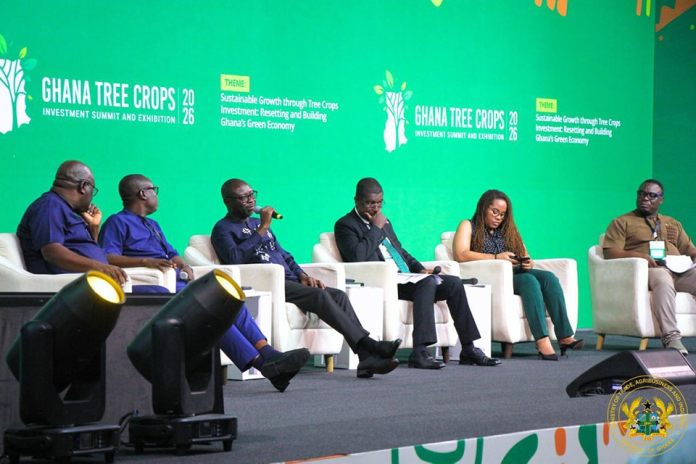
Opening the maiden Ghana Tree Crops Investment Summit and Exhibition (GTCIS 2026), President John Dramani Mahama laid out an ambitious target—US$12 billion in annual earnings from six priority tree crops by 2030—and announced an outright ban on the export of unprocessed cashew, shea nuts and rubber. The four-day summit, which runs through February 28, was framed not as a ceremonial gathering but as a decisive inflection point in Ghana’s economic history.
“Let the Ghana Tree Crop Summit 2026 mark a turning point at which Ghana decisively shifts from raw crop exports to industrial processing, from vulnerability to resilience and from promise to performance,” President Mahama declared to investors, policymakers, chiefs and agribusiness executives.
A Blueprint for Six Crops
At the heart of the strategy is a comprehensive growth blueprint presented by the Tree Crops Development Authority (TCDA). The authority identified six priority commodities—cashew, oil palm, shea, coconut, rubber and mango—projecting that with adequate investment in processing capacity and supply chains, each crop could generate an average of US$2 billion annually by 2030.
If achieved, the combined US$12 billion target would more than double the current export value of non-traditional agricultural exports and significantly diversify Ghana’s foreign exchange base beyond cocoa and gold.
The summit itself is projected to generate up to US$500 million in investment interest across Ghana’s tree crops economy—capital deemed critical for expanding local processing capacity, strengthening farmer livelihoods and reducing the country’s long-standing dependence on exporting raw commodities.
According to TCDA officials, Ghana currently processes less than 20–30 percent of its cashew output locally, with the bulk exported raw to Asia for value addition. Shea nuts follow a similar pattern, with European and Asian processors capturing higher margins from shea butter and cosmetics derivatives. Rubber and coconut sectors face comparable constraints, including aging plantations, limited mechanization and inadequate processing infrastructure.
Industry analysts note that while Ghana ranks among Africa’s leading producers of cashew and shea, it captures only a fraction of the global value chain. “The economics are clear,” said an Accra-based agribusiness consultant interviewed on the sidelines. “A tonne of raw cashew nuts earns far less than processed kernels. The same applies to shea derivatives and refined palm oil products. The margin difference is transformative.”
Government’s Investment Pitch
Deputy Minister for Trade, Agribusiness and Industry Sampson Ahi told investors that “the window is open and the government is ready to hold their hand through it.” The Ministry’s agribusiness unit has committed to fast-tracking permits, supporting land acquisition, linking investors with farmer cooperatives and helping move projects from agreement to groundbreaking within six months.
Ahi underscored Ghana’s strategic advantage as host of the African Continental Free Trade Area Secretariat (AfCFTA), which offers investors gateway access to a market of 1.3 billion people across Africa. Under AfCFTA’s tariff-reduction framework, processed agricultural goods produced in Ghana could potentially access regional markets with reduced trade barriers—an incentive officials say strengthens the case for local value addition.
President Mahama announced a target of achieving a 50 to 60 percent local processing rate annually across the six crops. This, he said, will be supported by expansion of agro-industrial parks, fiscal incentives for private sector processors and stronger regulatory oversight through the TCDA.
Under the National Policy on Integrated Oil Palm Development, the government has committed a US$500 million facility to develop 100,000 hectares of oil palm and create 250,000 jobs. The oil palm sector, long seen as underperforming compared to peers such as Indonesia and Malaysia, is expected to play a central role in reducing edible oil imports and supplying raw materials for domestic refining and manufacturing.
Breaking the Raw Export Cycle
The ban on exporting unprocessed cashew, shea nuts and rubber marks one of the boldest components of the policy shift. Ghana’s economy has historically relied on exporting raw cocoa, gold and timber—an economic structure inherited from colonial trade systems that positioned the country primarily as a supplier of raw materials.
Economists caution that such bans can be double-edged. While they can stimulate domestic processing, they may also disrupt farmer incomes if processing capacity is not scaled up rapidly enough to absorb output. “The sequencing is critical,” said a University of Ghana agricultural economist. “If factories are not ready, farmers could face delayed purchases or depressed prices.”
Government officials insist safeguards are in place, including phased implementation and targeted incentives to expand factory capacity before enforcement tightens.
Cocoa: A Candid Reckoning
On cocoa—Ghana’s most iconic crop—the President was blunt. “In the 21st century, being the leading exporter of raw cocoa beans is not an accolade we should take pride in,” he said. “We should take pride in being the leading exporter of manufactured cocoa products.”
Ghana is the world’s second-largest cocoa producer, but historically exports the majority of its beans raw. While the Ghana Cocoa Board has in recent years expanded domestic grinding capacity, global industry reports show that much of the higher-value chocolate manufacturing still occurs in Europe and North America.
President Mahama said cocoa financing reforms would include raising funds locally, paying farmers more promptly and allocating a defined share of beans directly to domestic processors. These reforms come amid ongoing debates about cocoa pricing, living incomes for farmers and sustainability compliance in European markets.
Climate and Environmental Pressures
The Asantehene, Otumfuo Osei Tutu II, in a message read on his behalf, warned that cocoa alone can no longer carry Ghana’s economic ambitions. He cited galamsey-induced water pollution, shifting rainfall patterns and declining yields across major growing areas as compounding threats to the crop’s long-term viability.
Illegal small-scale mining—known locally as galamsey—has severely polluted major river systems in cocoa-growing regions, affecting irrigation and soil quality. Environmental reports from civil society organizations indicate rising mercury contamination and deforestation in forest belts historically associated with cocoa cultivation.
Climate variability further complicates production forecasts. Irregular rainfall patterns and higher temperatures have been linked to disease outbreaks such as black pod and swollen shoot virus, reducing yields in some districts.
These pressures strengthen the case, policymakers argue, for diversifying Ghana’s agricultural base beyond cocoa and investing in climate-resilient tree crops.
Jobs, Industrial Parks and Rural Transformation
The government’s industrialisation drive hinges on agro-industrial parks designed to cluster processing plants near production zones. Officials say this will reduce post-harvest losses, lower transport costs and stimulate rural employment.
The projected 250,000 jobs under the oil palm expansion plan are part of a broader employment narrative aimed at addressing youth unemployment. Rural youth, often drawn into informal mining due to limited opportunities, could find alternative livelihoods in structured agribusiness value chains if the plan materializes.
Farmer cooperatives, too, stand to benefit. By linking organized farmer groups directly with processors, authorities hope to improve traceability, bargaining power and compliance with international quality standards.
Risks and Realities
Despite the optimism, analysts caution that Ghana’s history of ambitious industrial policies offers mixed lessons. Previous attempts at agro-processing expansion have faltered due to energy costs, inconsistent raw material supply and limited access to affordable credit.
Energy reliability remains a key factor. Processing plants require stable electricity to maintain quality standards, especially for export markets with stringent sanitary and phytosanitary regulations.
Access to long-term financing is another hurdle. While the summit projects US$500 million in investment interest, converting pledges into operational factories will require sustained policy consistency and macroeconomic stability.
“There is strong investor appetite,” noted a West African private equity executive attending the summit. “But investors need clarity on export regulations, tax incentives and the timeline for enforcing the raw export ban.”
A Turning Point?
The symbolism of launching the initiative at the Accra International Conference Centre was not lost on observers. The venue has hosted countless policy announcements, but few have aimed to restructure Ghana’s agricultural economy so comprehensively.
President Mahama’s framing of the summit as a “turning point” reflects both urgency and aspiration. For decades, Ghana’s export structure has left it vulnerable to global price shocks. By moving up the value chain, policymakers hope to stabilize foreign exchange earnings, increase tax revenues and build domestic manufacturing capacity.
Whether the US$12 billion target by 2030 is attainable will depend on implementation speed, investor confidence, farmer buy-in and environmental sustainability.
For now, the message from Accra is clear: Ghana intends to end the era of exporting raw cashew, shea nuts and rubber, and to redefine its place in global agricultural trade—not merely as a supplier of raw materials, but as a processor and manufacturer capturing greater value at home.
As the summit continues through February 28, stakeholders across the agricultural value chain will be watching closely. The ambition is bold. The stakes—for farmers, investors and the broader economy—are even higher.